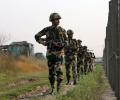
Army troops could not open fire on the terrorists due to the presence of Pakistani posts nearby, they said. Drone footage of the area showed a blood trail, indicating that the terrorists had suffered injuries due to the fall.

A total of 24 teams will vie for the top honours in the 134th edition of the Durand Cup, Asia's oldest football tournament, to be played across five states from July 23 till August 23.

The visiting personnel will also ascertain difficulties, if any, being faced by the "families of our war heroes", he said.
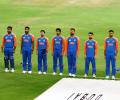
Asian Cricket Council chairman Mohsin Naqvi, who is also the PCB chief, walked away with the Asia Cup trophy after India refused to take the silverware from his hands.
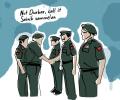
>The Indian Army still uses old British-era names and recruits soldiers based on caste or region, which hurts national unity, argues Colonel K Thammayya Udupa (retd).
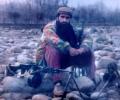
'A man with a gun commanded respect. I thought if I also got a gun, I could save my family. With this thought, I went to Pakistan and got training there'

Defence Minister Rajnath Singh says India achieved all objectives of Operation Sindoor, emphasizing that escalating the situation to war with Pakistan was not the aim. He highlighted India's fight against cross-border terrorism and the successful exposure of Pakistan's air defense system.

'You are Leader of Opposition. Say things in Parliament, why do you have say it on social media?'
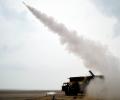
The Indian Army in the intervening night of May 8 and May 9 successfully repelled and responded to multiple drone attacks by Pakistan along the western border and the Line of Control (LoC) in Jammu and Kashmir.
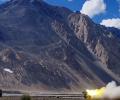
The successful validation will speed up induction and significantly bolster India's air defence posture in sensitive frontier zones.
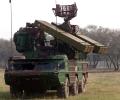
The Indian Army is conducting field trials of several cutting-edge defence systems under 'near-combat conditions', integrating electronic warfare simulations, to assess their performance rigorously, officials said on Saturday.
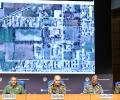
'We completely destroyed at least three posts, an ammunition depot, fuel storage facility, and gunnery, among other targets. Our retaliation was so devastating that it will take Pakistan at least 8-12 months to rebuild, possibly longer'
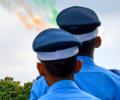
An Indian Air Force paramedic, who lost his hand in an operation, is regaining independence with the help of a cosmetic hand and support from the Artificial Limb Centre in Pune. The centre is also helping other armed forces personnel recover from severe injuries.
Family members of a Kargil war veteran in Pune allege harassment and demands for citizenship proof by a Hindutva group, accusing them of being Bangladeshis. Police deny a large group barged into the house, but confirm document verification.
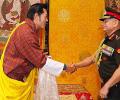
Chief of Army Staff General Upendra Dwivedi called on Bhutan's King Jigme Khesar Namgyel Wangchuck in Thimphu on Tuesday, July 1, 2025.

Customs officials in Kerala conducted raids across the state, seizing luxury vehicles illegally imported from Bhutan with forged documents. The operation, dubbed 'Operation Numkhor,' targeted multiple locations and uncovered a network involved in smuggling cars, gold, and drugs.
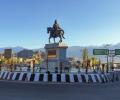
Terming the charge that Wangchuk incited the violence in Leh as 'misplaced', she claimed that he has been protesting in the "most Gandhian way possible" and the "situation escalated" on September 24 due to the actions of the CRPF.

Top commanders of the Indian Army deliberated on the Russia-Ukraine war and Israel-Hamas conflict at a five-day conclave to draw relevant lessons besides focusing on ways to make the force 'future ready' in line with with emerging contours of threats and challenges.
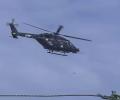
Three security force personnel were injured in a fresh firefight as the anti-terror operation in Jammu and Kashmir's Kulgam district entered its seventh day. The Army's Northern Commander reviewed the security situation in South Kashmir.

The encounter broke out when a joint search party of the army and police launched a search operation, based on a specific intelligence, in remote Bihali area of Basantgarh in the district this morning. Reinforcements have been rushed in and a massive search operation is going on despite bad weather.
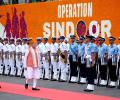
The bilingual -- Hindi and English -- invitation cards for I-Day anniversary celebrations carry this image on the top right corner of the invite, while the silhouetted image of the Chenab bridge, the world's tallest railway arch bridge, sits at the lower side of the cards, which have largely being issued online via 'Aamantran' website of the Ministry of Defence.
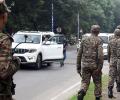
Kolkata Police intercepted a military truck for alleged reckless driving, a day after the army dismantled a TMC protest stage. The incident occurred near the Writers' Buildings, with police citing dangerous driving and traffic violations. Army officials deny any wrongdoing.
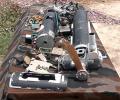
The Indian Army used Medium Machine Guns (MMGs) to target Pakistani Army forward posts along the Line of Control (LoC), inflicting heavy casualties during a ceasefire violation on the intervening night of May 7-8.
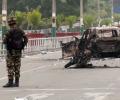
Having control over both digital media and NGOs, it was easy for the US to topple the government and destabilise Nepal -- to undercut Chinese influence and pressure India, argues Lieutenant General Prakash Katoch (retd).

Two suspected Lashkar-e-Taiba terrorists were killed when army troops scuttled an infiltration attempt along the Line of Control in Poonch district of Jammu and Kashmir, officials said on Wednesday.

A comprehensive risk assessment warns that Kishtwar district in Jammu and Kashmir faces a serious threat from glacial lake outburst floods (GLOFs), endangering lives, infrastructure, and the ecosystem. The report calls for immediate mitigation measures and long-term strategies to build resilience.

It is considered one of the most crucial appointments within the Indian Army, according to an official statement from the Ministry of Defence.
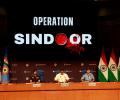
The logo for India's Operation Sindoor, which has captured the imagination of millions, was designed by two Armymen. The operation, a decisive military action against terror camps in Pakistan and Pakistan-Occupied-Kashmir, was launched in response to the Pahalgam massacre. The logo, featuring a bowl of vermilion, has become a powerful symbol of India's resolve against terrorism.

'Saudi-Pak defence pact is to anchor the defence and security of Saudi Arabia and not Pakistan, per se, with Islamabad being the junior partner.'
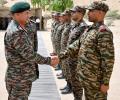
The army chief reviewed the joint operations carried out by the Indian Army, Indian Air Force and Border Security Force in response to Pakistani drone and military attacks that followed India's retaliatory strike on May 7 for the horrific Pahalgam terror attack.

The step has been taken to promote and strengthen common identity and approach in service matters amongst senior leadership beyond the boundaries of regiments, officials said.

The multi-agency search operation to trace 33 missing persons in cloudburst-hit Kishtwar district in Jammu and Kashmir has entered its eighth day. The death toll stands at 65, and rescue efforts are ongoing with the help of multiple agencies and heavy machinery.
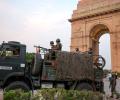
Bollywood celebrities have extended support to the nation and offered prayers for the safety and well-being of the people.

The Indian Army effectively repulsed multiple drone attacks and other munitions launched by Pakistan's armed forces along the western border on the intervening night of May 8-9. Pakistan also violated ceasefire along the Line of Control in Jammu and Kashmir. The Indian Army said it responded with force, asserting that all nefarious designs will be countered.

Heavy rains exacerbate the flood situation in Punjab, leading to 37 deaths and widespread crop damage. Rescue and relief operations are underway as authorities issue alerts and provide assistance to affected populations.
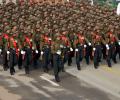
'Gorkhas are terrific soldiers. They are known the world over for their fighting qualities.'
Glimpses from India and around the world that will make you smile and cry.

The Defence Acquisition Council (DAC) has approved military projects worth approximately Rs 67,000 crore, including drones, radars, and missile systems, aimed at enhancing India's military capabilities.

Field Marshal Sam Manekshaw Field Marshal K M Cariappa Marshal of the Indian Air Force Arjan Singh The three highest-ranking military heroes of the Indian Armed Forces. They were the rarest of the rare. The bravest of the brave.
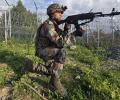
On Saturday, May 24, 2025, Indian Army soldiers carried out a military drill with heavy artillery at an undisclosed location along the Line of Control between India and Pakistan in north Kashmir.
