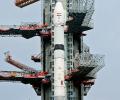
The main focus of the all weather RISAT-1B satellite will be to observe the Indian land with its C-band synthetic aperture radar.

US Vice President JD Vance's three children, dressed in traditional Indian attire, won hearts in India during their visit. The children, who landed in Delhi on Monday, were photographed in their outfits, which quickly went viral on social media. The children's outfits were a hit with photographers covering the visit, and their photos trended on social media throughout the day.

'There's a lot of sense in what Prime Minister Modi did, but the Indian government has to be really prepared for a really sharp escalation spiral.'

US Vice President J D Vance and his wife Usha arrived in Delhi on Monday for a four-day visit. They were welcomed by Union Minister Ashwini Vaishnaw. Vance's visit comes amid ongoing trade talks between India and the US. Prime Minister Narendra Modi will host a dinner for the Vances on Monday evening after holding talks with the US Vice President. Vance and his family will also travel to Jaipur and Agra during their trip.
'Pakistan is no longer a front-burner issue for America.'
'It brings precarious peace because the red lines have shifted. 'The next Pahalgam attack would mean a full scale war.'
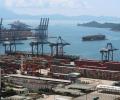
India's major imports from the US include crude oil and petroleum products, gold and jewellery, plastics, aircraft, and electrical machinery and components. The key exports to the US comprise pharmaceuticals and biologicals, telecom equipment, precious and semi-precious stones, petroleum products, gold and precious metal jewellery, and ready-made garments.
'Unfortunately, India and Pakistan could learn a 'lesson' from this conflict that will make them more likely to use these weapons against each other in the future.' 'Rounds of missile and drone attacks could be more routine features of their hostility, just like artillery fire has become a familiar fact of life along the Line of Control.'
'It is typical of China's strategic deception of making virtue out of necessity,' observes Rup Narayan Das.

From the Sensex pack, Zomato jumped nearly 5 per cent, followed by Titan which climbed almost 4 per cent. IndusInd Bank, Maruti, Tech Mahindra, Adani Ports, Bharti Airtel and HDFC Bank were also among the gainers.

'The border deal offers a hedge for India against Trump's unpredictability when it comes to his approach to competition with China.'
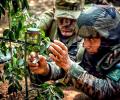
Indian and US armed forces conclude a comprehensive training phase as part of Exercise Tiger Triumph 2025.

'Fears in Washington began to intensify when it was realised that subsequent Pakistani and Indian attacks on major military facilities -- which were significant in terms of geographic scope and intensity -- could rapidly take both sides to where neither actually wanted to go.' 'The US objective was to stop the fighting as soon as possible. Everything else was secondary.'
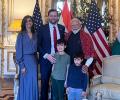
US Vice President JD Vance and his wife Usha, the first Indian-American Second Lady, are set to visit India early next week. Vance will hold talks with Prime Minister Narendra Modi during his visit. The visit comes amid global concerns over President Donald Trump's policy on tariffs. Vance's visit is likely to be more of a private trip though it will have official components.

Executives from India's leading airlines are conducting internal meetings to devise alternative routes for their international flights that currently pass through Pakistani airspace.
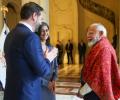
Vance is expected to be accompanied by at least five senior officials, including from the Pentagon and the State Department, the people cited above said.
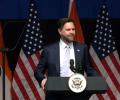
US Vice President JD Vance called on India to drop non-tariff barriers, give greater access to its markets and buy more American energy products and military hardware. Vance, in a speech in Jaipur, highlighted the need for a stronger US-India partnership for a prosperous and peaceful 21st century. He emphasized the importance of working together to address global challenges and praised Prime Minister Narendra Modi, describing him as a "special person." Vance also urged India to provide greater market access to American products and buy more defense platforms and energy from the US. He suggested that India consider dropping some of the non-tariff barriers for American access to the Indian market and highlighted the benefits of closer India-US defense collaboration, advocating for New Delhi to procure more military hardware from the US. He cited the example of American fifth-generation F-35s, arguing they would give the Indian Air Force the ability to defend its airspace and protect its people like never before. Vance also welcomed the Modi government's budget announcement to amend India's civil nuclear liability laws, paving the way for US producers to export small modular reactors and build larger US-designed reactors in India. He emphasized the importance of energy security for India's AI ambitions, stating "there is no AI future without energy security and energy dominance." Vance's visit comes amid growing global concerns over the US's tariff war.
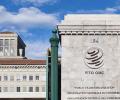
This is the first case involving India and the US at the WTO after both sides decided to withdraw all seven pending cases at the WTO during the Biden administration.

The two countries also signed a 'Memorandum of Agreement regarding the Assignment of Liaison Officers', which will facilitate the posting of one military officer from each country with the military of the other.
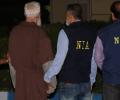
Tahawwur Hussain Rana, a key accused in the 26/11 Mumbai terror attacks, was brought to India on Thursday after being "successfully extradited " from the US, the National Investigation Agency (NIA) said. The 64-year-old Canadian citizen of Pakistani origin landed in Delhi in a special plane on Thursday evening, ending days of speculation of when and how he will be extradited, officials said. The NIA said in a statement that it had secured the successful extradition after years of sustained and concerted efforts to bring to justice the key conspirator behind the 2008 mayhem that claimed 166 lives. Rana is accused of conspiring with David Coleman Headley alias Daood Gilani, and operatives of designated terrorist organisations Lashkar-e-Taiba (LeT) and Harkat-ul-Jihadi Islami (HUJI) along with other Pakistan-based co-conspirators, to carry out the the three-day terror siege of India's financial capital.
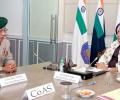
India and the US have agreed to work together to draft a comprehensive framework on defence cooperation, aimed at structuring the bilateral collaboration for the 2025-2035 period. The framework will cover multiple domains in land, air, maritime and space, and will focus on intelligence, logistics, operational and industrial engagement. The agreement comes ahead of Prime Minister Narendra Modi's planned trip to Washington, where he is expected to meet with US President Donald Trump to discuss boosting India-US cooperation in the areas of trade, energy and defence.

The scaling up of the India-US strategic partnership to the level of non-NATO ally with defence deals, sharing and transfer of defence technology, interoperability, joint collaboration and joint production of defence equipment has exacerbated Moscow's anxiety, notes Rup Narayan Das.
'But I don't think the government is in a great hurry to sign the BTA.'
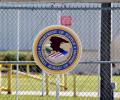
Tahawwur Rana, accused in the 2008 Mumbai terror attacks, has been extradited to India after the US Supreme Court denied his last-ditch effort to avoid being sent back. Rana, a close associate of David Coleman Headley, another key conspirator in the attacks, was expected to be extradited "shortly" after his legal appeals failed. This decision comes after a multi-agency team from India traveled to the US to complete all necessary paperwork and legalities with the US authorities. Rana's extradition marks a significant development in the pursuit of justice for the victims of the Mumbai attacks.
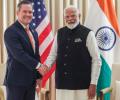
Prime Minister Narendra Modi said he had a 'fruitful meeting' with United States National Security Advisor Michael Waltz and they discussed defence, technology and security areas, which are important aspects of the India-US ties.
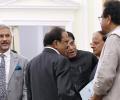
India's National Security Advisor Ajit Doval held bilateral talks with US Director of National Intelligence Tulsi Gabbard, and chaired a conclave of top global intelligence chiefs focusing on strengthening cooperation in confronting various security challenges including terrorism and threats posed by emerging technologies. The meeting also focused on security in the Indo-Pacific region, cooperation to counter terror funding and money laundering, and issues relating to extradition and immigration.
'As negotiations continue, the path forward demands not only diplomatic skill, but also vigilance against legal asymmetries embedded in America's trade playbook.'
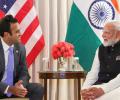
Prime Minister Narendra Modi met with Indian-American billionaire entrepreneur Vivek Ramaswamy and SpaceX CEO Elon Musk in Washington, D.C., discussing India-US relations, innovation, biotechnology, and the role of entrepreneurship. Modi also met with US National Security Advisor Michael Waltz and Director of National Intelligence Tulsi Gabbard during his visit.
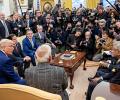
During the talks, India and the US decided to take a big leap in broad-basing their strategic ties in several critical areas.
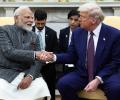
'The cooperation in technology is one of the most important aspects of the visit.' 'It will have a long-lasting impact because it will shift the entire paradigm in the context of artificial intelligence and emerging technologies.'
Government representatives told a parliamentary panel that the US has not officially conveyed to India that it should cut tariffs by April 2.
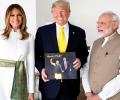
India is working with the US on an "early" visit to Washington by Prime Minister Narendra Modi to further deepen the comprehensive global strategic partnership between the two countries, the External Affairs Ministry said on Friday. Following a phone conversation with Modi this week, US President Donald Trump said the Indian prime minister "is going to be coming to the White House, over next month, probably February". It would be Modi's first bilateral visit to Washington after Trump became US president for a second term. While confirming discussions between India and the US on the proposed visit, External Affairs Ministry spokesperson Randhir Jaiswal did not mention any possible time-line for the trip. In their phone conversation on January 27, Modi and Trump vowed to work towards a "trusted" partnership with a focus on boosting India-US cooperation in areas of trade, energy and defence. "PM Modi and President Trump had a telephone conversation recently. The two sides are working on an early visit of the PM to the US to further deepen India-US Comprehensive Global Strategic Partnership," Jaiswal said at his weekly media briefing while replying to a question. "Specific dates for the visit would be announced at the appropriate time," he said. It is learnt that both sides were initially looking at the window between February 12-14 for Modi's visit but there has been no finality on it yet. The prime minister is set to travel to Paris to attend the Artificial Intelligence Action summit on February 10 and 11. Though the US president has also been invited to the summit, his participation is not yet confirmed.
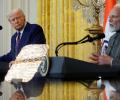
Prime Minister Narendra Modi met United States President Donald Trump at the White House in Washington, DC on Thursday.

India and the United States have announced a groundbreaking 10-year defence partnership, paving the way for increased military cooperation and potential sales of F-35 stealth fighter jets. The agreement aims to bolster both countries' defence capabilities in the Indo-Pacific region, with plans for joint production of weapons and platforms. The move comes amid China's growing military presence in the region.
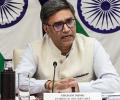
The United States has approved the extradition of Tahawwur Rana, accused of involvement in the 2008 Mumbai terror attacks, to India. The decision was announced by President Donald Trump during a joint press conference with Prime Minister Narendra Modi in the White House. India is currently working on the logistics of Rana's surrender and extradition, with several final steps to be completed before he is sent back to India. The joint statement issued by India and the US during Prime Minister Modi's visit reaffirmed their commitment to fighting terrorism and eliminating terrorist safe havens. The leaders also called on Pakistan to bring to justice the perpetrators of the 26/11 Mumbai and Pathankot attacks. Rana, a Canadian national of Pakistani origin, is currently lodged at a metropolitan detention center in Los Angeles. He is associated with Pakistani-American terrorist David Coleman Headley, one of the main conspirators of the 26/11 attacks.
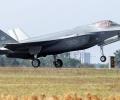
We need to equip the Indian Armed Forces, not 'commercial' as Trump wants, but 'operationally' looking at growing Chinese military capabilities, asserts Lieutenant General Prakash Katoch (retd).
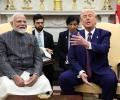
US President Donald Trump and Indian Prime Minister Narendra Modi met in Washington D.C. to discuss a range of issues including trade, defense, and energy. The two leaders announced plans to finalize "wonderful trade deals" for both countries, and Trump emphasized the need for India to purchase US oil and gas. Modi congratulated Trump on his second term and highlighted the importance of working together to further strengthen the India-US relationship. The meeting also addressed the ongoing conflict in Ukraine, with Modi reiterating India's commitment to peace.
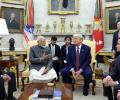
India and the United States have agreed to deepen their strategic partnership in several key areas, with President Donald Trump announcing plans to provide India with F-35 fighter jets and billions of dollars in military supplies. The two leaders also discussed energy cooperation, critical technologies, connectivity, and countering terrorism. They agreed to work together on the India-Middle East-Europe Economic Corridor, and Trump noted India's reforms to welcome US nuclear technologies. Prime Minister Modi said the two countries can shape a better world through their cooperation. Both leaders also addressed the Russia-Ukraine conflict, with Modi stressing India's commitment to peace.
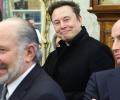
The United States Department of Government Efficiency (DOGE), led by Elon Musk has announced cancelling a $22 million funding intended for 'voter turnout in India' on Saturday (Local Time).
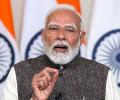
India on Saturday announced plans to amend its nuclear liability law and set up a nuclear energy mission, a move that came ahead of Prime Minister Narendra Modi's likely visit to the United States.
 © 2026 Rediff.com - Investor Information - Advertise with us - Disclaimer - Privacy Policy - Sitemap - Feedback - About us - Terms of use - Grievances