
The southwest monsoon arrived in Maharashtra on Sunday, making it the earliest onset of the annual rainfall season over the state in 35 years, according to the India Meteorological Department. The monsoon is expected to advance to Mumbai and some other parts over the next three days. The monsoon advanced into some more parts of the Arabian Sea, Karnataka, entire Goa, parts of Maharashtra, north Bay of Bengal, and parts of Mizoram, parts of Manipur and Nagaland on Sunday. The northern limit of monsoon passes through Devgad, Belagavi, Haveri, Mandya, Dharmapuri, Chennai, Aizawl and Kohima. Conditions are favorable for further advance into some more parts of central Arabian Sea, more parts of Maharashtra including Mumbai, Karnataka including Bengaluru, some parts of Andhra Pradesh, remaining parts of Tamil Nadu, more parts of west-central and North Bay of Bengal and some more parts of North Eastern states during next three days. The southwest monsoon hit Kerala on Saturday, marking its earliest arrival over the Indian mainland since 2009.

A school bus carrying six children and two staffers got stuck on a waterlogged road in Mumbai after heavy rains. Police rescued them. Schools declared a half-day due to the rains.

Heavy rains in Nanded, Maharashtra, have caused severe flooding, leading to the evacuation of hundreds of residents as the Godavari and Asna rivers overflow. The Vishnupuri dam released a large amount of water, exacerbating the situation.

India is set to experience extreme heat during the April to June period, with the central and western peninsular parts expected to face the worst impact, the IMD said on Monday as the country prepares for seven-phase general elections from April 19.
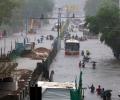
The India Meteorological Department issued an orange alert of heavy rains for Mumbai for Wednesday, and predicted the intensity of rainfall in the metropolis will go down from Thursday.
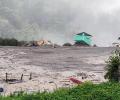
A new study identifies flash flood hotspots in India, highlighting the influence of land features, rainfall, and the growing impact of climate change.
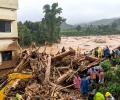
A red alert indicates heavy to extremely heavy rain of over 20 cm in 24 hours. An orange alert means very heavy rain of 11 cm to 20 cm, and a yellow alert means heavy rainfall between 6 cm and 11 cm.

Incessant rains with intermittent spells of moderate to heavy showers since Friday morning have slowed down public transport services and traffic in Mumbai.

The labourers, who are said to be of Nepali origin, were engaged in the construction of a hotel.

The aircraft, later, flew to Guwahati after an improvement in the weather conditions in Guwahati, said KC Meena, the director of the Maharaja Bir Bikram (MBB) Airport at Agartala.

Historically, October has seen some of the worst landslide events in Darjeeling and Sikkim Himalayas.

Heavy rains lashed Delhi, leading to a red alert, traffic snarls, and waterlogging. The IMD predicts continued rainfall.

The early onset of the southwest monsoon brought continuous rainfall across southern and eastern India, contributing to this record.

At least 23 people, including children, were killed as relentless rain triggered one of the worst landslides in a decade in Darjeeling hills and adjoining areas on Sunday, sweeping away homes, cutting off roads, isolating villages, and leaving hundreds of stranded tourists amid widespread devastation, officials said.

Several areas of Tamil Nadu remain inundated after hours of heavy to moderate rainfall in the region. Water entered houses and markets in the low-lying residential areas of Erode district due to heavy rainfall throughout the night.

Temperatures are likely to remain in a similar range until Thursday, with a gradual fall expected from June 13.
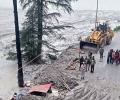
Experts question whether a cloudburst caused the recent flash flood in Uttarkashi, India, citing insufficient rainfall and other potential factors like ice chunks, rockfalls, or landslides.
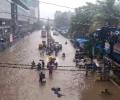
Heavy rains in Maharashtra have caused floods, road blockages, and widespread damage, resulting in casualties and displacement. The state government is monitoring the situation and coordinating rescue efforts.

Bhavnagar was also one of the worst affected districts, they said, adding that more downpour is likely over the next four day in parts of the state.

At least 14 people have died in rain-related incidents as thunderstorms, strong winds and dust storms battered several parts of Gujarat, India. The India Meteorological Department (IMD) has forecast thunderstorms with lightning and strong winds of up to 50-60 kmph across the state for the next few days. Strong winds uprooted trees, hoardings, and pillars, and parts of houses collapsed in several districts, leaving many injured. The deaths were reported in Ahmedabad, Anand, Kheda, Dahod, Aravalli and Vadodara districts of Gujarat on Monday and Sunday. The IMD has also forecast heavy rainfall in isolated parts of Banaskantha, Kutch, Sabarkantha, Aravalli and Anand districts in the next three days.

Heavy overnight rainfall caused widespread flooding in Kolkata, disrupting traffic, public transport, and daily life. Train and Metro services were suspended, and many areas experienced significant waterlogging.

A landslide on the Kedarnath route in Uttarakhand killed two pilgrims and injured six, while heavy rain led to the temporary suspension of the Char Dham and Hemkund Sahib pilgrimages.

Heavy overnight rains severely affected parts of the city on Monday, leading to water-logged roads, inundated residential areas and traffic pile-up, as the city braces for more spells in the coming days.

Normally, the southwest monsoon makes its onset over Kerala by June 1 and covers the entire country by July 8. It starts retreating from northwest India around September 17 and withdraws completely by October 15.

Intense rains lashed Kerala on Sunday, uprooting trees across the state, including one that fell on a moving train in Thrissur and another that caused a fatality in Kozhikode. Houses were damaged, rivers were in spate, and shutters of some dams were raised as the southwest monsoon gained strength. The Indian Meteorological Department (IMD) placed five northern districts - Malappuram, Kozhikode, Wayanad, Kannur, and Kasaragod - under a 'red alert' for the day, predicting extremely heavy rainfall there.

The BCCI press conference scheduled at 1.30pm in Mumbai is 'expected to be delayed owing to weather disruptions'.

The very severe cyclonic storm was located over the east-central Arabian Sea located 840-kilometer west-southwest of Goa and 870 km west-southwest of Mumbai at 11.30 pm on June 8, the IMD said.
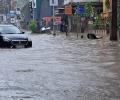
The IMD issued a "Nowcast" warning, forecasting thunderstorms accompanied by lightning and intense spells of rain with gusty winds reaching 50-60 kmph at isolated places in Mumbai in the next three to four hours.

The heatwave alert has been issued for Mumbai, Thane, Raigad and Ratnagiri on February 25 and 26, the IMD said.

Houses in low lying areas of Kerala were flooded in the heavy rains, while the accompanying strong winds uprooted trees, damaged homes and caused power disruptions, throwing normal way of life into disarray across the state.

Cyclone 'Biparjoy' has an extensive damaging potential and it is likely to impact Kutch, Devbhoomi Dwarka and Jamnagar districts of Gujarat the most, the India meteorological department said on Tuesday.

India is likely to see above-normal maximum and minimum temperatures in most parts of the country in the March to May period, IMD director general Mrutyunjay Mohapatra said at a press conference.

The BMC declared a holiday for all government and private schools and colleges in Mumbai on Thursday after the IMD issued a 'red' alert for the metropolis.

The India Meteorological Department (IMD) has forecast cloudy skies with the possibility of heavy rainfall at a few places in the city and suburbs in the next 24 hours.

India is likely to see above-normal rainfall in the four-month monsoon season (June to September) with cumulative rainfall rainfall estimated at 106 percent of the long-period average (87 cm), he said.
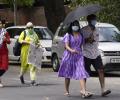
The India meteorological department said heatwave conditions will persist for at least two more days.

'Marathwada is the suicide capital of Maharashtra.' 'To stop such man-made disasters, the government should immediately come up with a rightful package, not this charitable approach to compensation.'

Rainfall in August is predicted to be below normal (less than 94 per cent of LPA), but the situation is expected to improve comparatively in September, the IMD said.

A strong dust storm and gusty winds followed by rain hit Delhi-NCR on Friday evening, causing trees to be uprooted in several parts and leading to traffic congestion. Thunderstorms caused power disruptions in several parts of the city, primarily due to trees and branches falling on electricity cables. The India Meteorological Department (IMD) has issued an orange alert, recommending people stay indoors and avoid unnecessary travel.
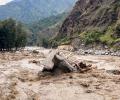
While two bodies were recovered on Wednesday, the death toll climbed to four on Thursday after the recovery of two more bodies from the Indira Priyadarshini Hydroelectric project site in Kangra district.
