
Four astronauts from NASA's Artemis II mission have safely returned to Earth after completing a historic flyby of the moon, marking the first human journey to the moon in over 50 years.

Astronaut Shubhanshu Shukla discusses the Gaganyaan mission and its potential to inspire other nations in space exploration, drawing on his experiences as an IAF test pilot and his time on the International Space Station.

NASA has announced three missions to the moon as part of efforts to establish a permanent base on the earth's natural satellite. The USD 20 billion plan includes lunar rovers and drones for experiments to help master skills to live and operate in the dangerous environment.

The Artemis II mission has made history as its astronauts journeyed farther from Earth than any humans before, conducting a lunar flyby and observing the moon's far side in unprecedented detail.

Glimpses from Artemis II's dramatic return to Earth

Spiders, spies and sleuths on OTT this week, Sukanya Verma lists your top picks.
The National Aeronautics and Space Administration (NASA) on Monday said the crew of Artemis II is preparing for a historic lunar flyby that will take humans farther from Earth than ever before.

From selfies to science, astronauts aboard Orion document life, work and discovery during their historic Moon flyby.

The glimpses from NASA's Artemis II mission capture a historic moment -- preparations for humanity's return to the Moon for the first time since the Apollo 17 Moon landing in 1972.

A crew of four astronauts boarded their spacecraft for the landmark flight, which represents a major milestone in lunar exploration.

After days of intense activity, this phase is about staying sharp and ready for the last critical steps.

The mission ferries four astronauts -- NASA's Reid Wiseman, Christina Koch and Victor Glover and Canada's Jeremy Hansen -- onboard the Orion spacecraft for a 10 day lunar flyby. Unlike the Apollo missions that aimed for landing, Artemis II is focused on testing. The crew will evaluate critical systems such as life support, navigation, and communication in deep space -- essential steps before humans can return to the lunar surface.

NASA's Artemis II mission, launched on April 1, 2026, marks humanity's return journey to the Moon with four astronauts aboard the Orion spacecraft. Commander Reid Wiseman, Pilot Victor Glover, Mission Specialist Christina Koch, and Canadian astronaut Jeremy Hansen are on an approximately 10-day mission around the Moon. Stunning images from Orion's windows capture breathtaking views of Earth after the historic translunar injection burn.
The successful Artemis II mission has boosted confidence in India's upcoming Gaganyaan mission, as both aim to demonstrate similar spaceflight capabilities. Experts highlight the collaboration between ISRO and NASA and the shared training programmes for astronauts.

NASA's Artemis II crew offers a rare look at Earth shrinking into space and the Moon coming into view during humanity's return to deep space.

Indian-American scientist Amit Kshatriya's journey from watching rocket launches in Houston to becoming NASA's Associate Administrator is a testament to his dedication and expertise in space exploration.

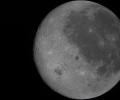
One of the most striking features in this view is the Orientale Basin, a massive impact crater about 600 miles (965 km) wide.

While India's interplanetary ambitions remain significant, the current pace of financial and technical progress raises questions about whether the 2027-2028 timelines can be met.

After 54 years, the human race will set out for an encounter with planet earth's closest neighbour, the Moon. The Artemis II Moon mission was initially scheduled to launch in February as a 10-day lunar flight, carrying four astronauts -- NASA's Reid Wiseman, Christina Koch and Victor Glover, along with Canadian astronaut Jeremy Hansen.
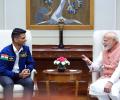
Shukla said the two missions presented a major opportunity for the country and the sustained commitment of the government to the space sector, despite setbacks such as the Chandrayaan-II mission was laudable.

Indian astronaut Shubhanshu Shukla will enjoy a range of Indian dishes, including rice varieties, moong dal halwa, and mango nectar, during his 14-day mission aboard the International Space Station (ISS). He will also have the option to choose from international cuisine, as approved by NASA. ISRO and DRDO have developed the Indian food options for astronauts of the Gaganyaan mission and Shukla will be able to savor them with NASA's approval.

For the first time, there will be an Indian connection to a crewed Moon mission.

NASA astronaut Sunita Williams retires after 27 years, completing three missions aboard the International Space Station and setting numerous spaceflight records. She is currently visiting India.

Astronaut Sunita Williams discusses how space travel changed her perspective on life, emphasizing the unity of Earth and the silliness of human conflicts when viewed from space.
Shukla, who goes by the nickname "Shux", will be the second Indian to travel to space, 41 years after his idol Rakesh Sharma undertook a spaceflight in 1984 onboard erstwhile Soviet Union's Soyuz spacecraft for an eight-day stay in orbit.

Kamna Shukla, wife of astronaut Shubhanshu Shukla, shares plans for his homecoming after his 18-day mission on the International Space Station, emphasizing family time and simple pleasures.
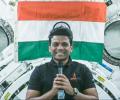
Group Captain Shubhanshu Shukla, the second Indian to travel to space, is expected to arrive in India this weekend after completing his mission to the International Space Station (ISS). He will meet with Prime Minister Narendra Modi and participate in National Space Day celebrations.

'I carry the hopes and dreams of over a billion hearts.'

'He's gonna inspire billions of girls and boys.'
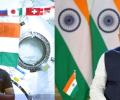
The interaction is planned via a telebridge set up at the U R Rao Satellite Centre in Bengaluru, said the Amateur Radio on International Space Station (ARISS), which facilitates interaction of school students with astronauts on the orbital laboratory.

Indian astronaut Shubhanshu Shukla stands on the cusp of history as he prepares to set off on a space odyssey, marking India's return to space flight 41 years after his idol Rakesh Sharma orbited the earth for eight days as part of Soviet Union's Interkosmos programme.

Residents of NASA astronaut Sunita Williams' ancestral village in Gujarat are celebrating her safe return to Earth with Diwali-like festivities. The village, Jhulasan, is alive with excitement and prayers for Williams' safe return after a nine-month stay at the International Space Station. A grand procession will be held in her honour, accompanied by prayer chanting and fireworks.
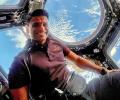
Astronaut Shubhanshu Shukla and the Axiom-4 mission crew are scheduled to return to Earth from the International Space Station on July 14, according to NASA.
On Friday, SpaceX and NASA launched a mission to bring back US astronauts Sunita Williams and Butch Wilmore from the ISS, where they have been stranded for nine months.

President Droupadi Murmu addressed Parliament, urging unity on national issues like 'Viksit Bharat', swadeshi, and national security. She highlighted government initiatives and the nation's progress.
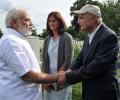
Prime Minister Narendra Modi has written to NASA astronaut Sunita Williams, inviting her to visit India after her return from a nine-month stay at the International Space Station. In his letter, Modi expressed pride in Williams' achievements and said that India is looking forward to hosting "one of its most illustrious daughters." The letter was shared on X by Union Science and Technology Minister Jitendra Singh.

2026 looks promising for cinema lovers, with many highly anticipated, big-budget Hollywood films set to hit theatres this year.
Indian astronaut Shubhanshu Shukla will be the first Indian to travel to the International Space Station (ISS), flying aboard a SpaceX Dragon spacecraft as part of a joint effort between NASA and ISRO. Shukla, a group captain in the Indian Air Force, will serve as the pilot for the Axiom Mission 4, scheduled for launch no earlier than spring 2025. The mission will also carry the first astronauts from Poland and Hungary to stay aboard the ISS.
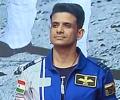
Shukla will be the second Indian to travel to space four decades after Rakesh Sharma's iconic spaceflight onboard Russia's Soyuz spacecraft in 1984.
Group Captain Shubhanshu Shukla, the first Indian to visit the International Space Station, has been awarded the Ashoka Chakra, India's highest peacetime gallantry award. The award recognizes his contributions to the Axiom-4 mission and India's advancements in human space exploration.
