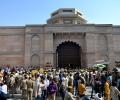
The ASI had on Wednesday urged the court not to make its Gyanvapi complex survey report public for at least four more weeks, citing the December 19 judgment of the Allahabad high court.
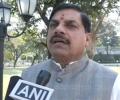
Madhya Pradesh Chief Minister Mohan Yadav has ordered strict action against those responsible for the death of an ASI who was killed while trying to rescue a man from an attack by a group of tribals in Mauganj district. The incident has sparked outrage and raised concerns about the law and order situation in the state. The opposition Congress has criticized the government, alleging that law and order has collapsed in Madhya Pradesh.
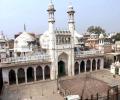
The ASI on Wednesday urged the court not to make its report public for at least four more weeks.
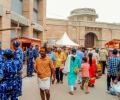
The Archaeological Survey of India (ASI) team surveyed the northern wall, the dome and basements of the Gyanvapi complex here on Tuesday, the fourth day of the court-mandated exercise to determine if the mosque was built over a temple.
The Shiv Sena, a ruling party in Maharashtra, has demanded the removal of the protected monument status from Aurangzeb's tomb in Khultabad. This demand comes after protests and calls for the tomb's demolition from organizations like the Bajrang Dal and Vishwa Hindu Parishad. The Archaeological Survey of India (ASI) protects the tomb as a monument of national importance. Maharashtra Chief Minister Devendra Fadnavis has stated that the state government will protect the tomb but will not allow the glorification of Aurangzeb.

The ASI is carrying out a scientific survey of the Gyanvapi mosque premises, next to Kashi Vishwanath temple here, to determine whether the 17th-century mosque was constructed over a pre-existing structure of a Hindu temple.

The Allahabad high court on Thursday allowed the Archaeological Survey of India (ASI) to conduct a scientific survey at the Gyanvapi premises in Varanasi to determine whether the 17th-century mosque has been constructed over a pre-existing structure of a Hindu temple.

A Varanasi court on Tuesday fixed February 15 for the hearing of a petition seeking a survey of all closed basements in the Gyanvapi mosque complex by the Archaeological Survey of India (ASI).
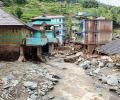
Monsoon hit the state on June 20 and has since then cost it Rs 5,000 crore in damages.

The ASI told the court on November 2 that it might take some more time to compile the report, along with the details of the equipment used in the survey work, following which additional time till November 17 was granted for the submission of the document.
The Gyanvapi mosque management committee has objected to the Archeological Survey of India (ASI) seeking eight more weeks to complete the survey of the complex.

A 30-member Archaeological Survey of India team halted a survey here of the Gyanvapi mosque -- just hours after beginning the exercise Monday morning -- following a Supreme Court order.
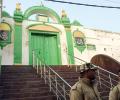
The Committee of Management, Shahi Jama Masjid, moved the high court challenging the suit and the Sambhal court order which directed the survey through an advocate commissioner.
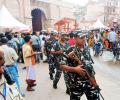
The Archaeological Survey of India (ASI) began working on a scientific survey of the Gyanvapi premises in Varanasi on Friday to determine whether the 17th-century mosque was constructed over a pre-existing structure of a Hindu temple.
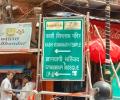
In a relief to the Hindu side, the Supreme Court on Friday refused to stay the Allahabad high court order allowing the Archaeological Survey of India (ASI) to conduct a scientific survey at the Gyanvapi mosque complex to determine if the 17th-century structure was built upon a pre-existing temple.

The Allahabad high court on Thursday reserved till August 3 its order on a plea against the survey of Gyanvapi mosque premises by the Archeological Survey of India.
The Allahabad high court on Wednesday extended the stay on a survey of the Gyanvapi mosque premises by the Archaeological Survey of India till Thursday.

The Archaeological Survey of India on Sunday conducted scientific tests of the area under the three domes of Gyanvapi mosque in Varanasi on the third day of the scientific survey to determine if the mosque was built over a temple.

The demand comes nearly a month after violence erupted in Nagpur during a rally which demanded the removal of Aurangzeb's tomb.

The court was hearing a petition against the stopping of prayers by devotees inside the Mughal Mosque which, according to ASI, falls within the category of protected monuments on account of being part of the Qutub complex.

Muslim body Anjuman Intezamia Masjid committee on Thursday moved the Supreme Court against the Allahabad high court order permitting an Archaeological Survey of India (ASI) survey at the Gyanvapi mosque.
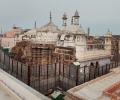
Jain told reporters that copies of the survey report consisting of 839 pages were made available to the parties concerned by the court late Thursday evening.

Shiromani Akali Dal leader Sukhbir Singh Badal expressed gratitude to two police officers who saved his life when a former terrorist opened fire at him in Amritsar. Badal hugged the officers and praised their courage and loyalty, saying his family could never repay their bravery. The attack occurred at the Golden Temple, where Badal was performing religious penance. The former Khalistani terrorist Narain Singh Chaura fired from a close range but missed his target. The police overpowered the attacker before he could cause any harm.
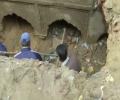
A stepwell, approximately 125 to 150 years old and covering an area of 400 square metres, was unearthed during excavation in the Laxman Ganj area of Chandausi in Sambhal, an official said.
A court in Varanasi on Friday directed the Archaeological Survey of India to conduct a "detailed scientific survey" -- including excavations, wherever necessary -- to determine if the Gyanvapi mosque located next to the Kashi Vishwanath temple is built upon a temple.

An assistant sub inspector of traffic police died and six others were injured when two vehicles of Chief Minister Bhajanlal Sharma's carcade met with an accident in Jagatpura area of Jaipur on Wednesday.
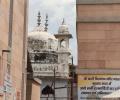
The Supreme Court's 2023 order refusing to stay a scientific survey at the Gyanvapi Mosque complex has sparked claims over several other disputed places of worship across India. This has led to several court cases, including one in Mathura where a survey of the Shahi Idgah Mosque complex was ordered, and another in Ajmer where a claim was made that a Shiva temple existed within the dargah of Sufi saint Moinuddin Chishti. The article also highlights a dispute over the Bhojshala in Madhya Pradesh, which Hindus consider a temple and Muslims consider a mosque. The Supreme Court's order has reignited debates about the Places of Worship (Special Provisions) Act, 1991, which prohibits the change of character of religious places as they existed on August 15, 1947.
The Supreme Court ordered on Monday that no invasive work would be undertaken by the Archaeological Survey of India (ASI) to determine if the Gyanvapi mosque located next to the Kashi Vishwanath temple in Varanasi was built upon a temple and agreed to hear a plea moved by the mosque committee during the day.
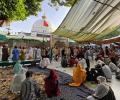
A local court in Ajmer has ordered notices to be issued to three parties in a civil suit claiming the existence of a Shiva temple within the dargah of Sufi saint Moinuddin Chishti. The suit, filed in September, seeks directions to resume worship at the alleged temple. The court has issued notices to the Ajmer Dargah Committee, Ministry of Minority Affairs, and the Archaeological Survey of India. The next hearing is scheduled for December 20.
Mishra said that the court has fixed July 7 for the next hearing.
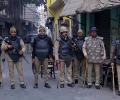
A lawyer representing the Hindu side in the ongoing dispute over the Sambhal Jama Masjid has defended the second survey of the mosque, claiming it was conducted on the orders of the advocate commissioner. He also dismissed claims that the survey was conducted in haste or without court orders.

Owaisi criticized the court-ordered survey of a Mughal-era mosque in Sambhal, Uttar Pradesh, saying it weakens India and distracts from real issues like inflation and unemployment.
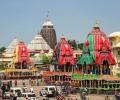
The ongoing Puri heritage corridor construction work might have caused damage to the 800-year-old Jagannath temple there and the state government project was being carried out without valid permission from the competent authorities, the Archaeological Survey of India on Monday informed the Orissa high court.

A body representing the 'Khadims' of the Ajmer dargah has condemned a plea in a local court that seeks to declare the shrine of Khawaja Gharib Nawaz as a temple, saying right-wing forces were trying to "isolate" Muslims and "disrupt" communal harmony in the country.

'The irony of this country is that the party in Opposition and the party in power both depend on Muslims.'
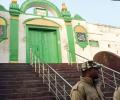
The Uttar Pradesh government has informed the Supreme Court that the disputed "private well" near the Mughal-era Jama Masjid mosque in Sambhal was situated on public land. The state government said the petitioner failed to disclose there was a well within the boundary walls of the mosque known locally as "yagna koop". The committee, in a spot inspection, found that the well was situated outside the mosque boundary wall, the report said. The report said the state was committed to ensuring peace and harmony in the region and any restraint on the use of such public wells by the community at large may not help in achieving that goal.

A local court in Ajmer has issued notices to the dargah committee, the Ministry of Minority Affairs, and the Archaeological Survey of India on a plea seeking to declare the shrine of Sufi saint Khwaja Moinuddin Chishti a temple. The petition, filed in September, has sparked a heated debate, with politicians and community leaders weighing in on the potentially volatile issue. The dargah committee has declined to comment, but the Anjuman Syed Zadgan, a body representing the caretakers of the dargah, described the petition as a deliberate attempt to fracture society along communal lines. The petition comes just days after four people were killed in Sambhal, Uttar Pradesh, following a local court ordering survey of a Mughal-era shrine. The Places of Worship (Special Provisions) Act, 1991, which fixed August 15, 1947, as the cut-off date for status quo on the character of religious places, is at the centre of much of the debate. Several politicians, including Union minister Giriraj Singh and PDP chief Mehbooba Mufti, have weighed in on the issue. The Communist Party of India (Marxist) has called the civil court's decision to entertain the petition unwarranted and has asked the Supreme Court to immediately intervene.

Of the total 29 major industry groups covered in the Annual Survey of Industries (ASI), 'manufacture of computer, electronic and optical products' has seen the highest growth in the number of people engaged between the pre-pandemic period (2019-20) and 2022-23. A Business Standard analysis of the latest ASI results has taken into consideration only industry groups having more than 1,000 operating factories. This industry group, which includes manufacture of electronic components, computer equipment, consumer electronics and optical instruments, among others, saw the total number of people engaged rise nearly 50 per cent to 425,000 from 283,000.

The Archeological Survey of India (ASI) has asked the Bihar government to quickly submit its plan to conserve Nalanda Mahavihara in order to keep the World Heritage site status for the remains of the ancient centre of learning.
 © 2026 Rediff.com - Investor Information - Advertise with us - Disclaimer - Privacy Policy - Sitemap - Feedback - About us - Terms of use - Grievances