
Pakistan's army chief held a series of engagements with Iranian leaders in Tehran as regional diplomacy remained in focus.

US President Donald Trump has declared an 'economic D-Day' against Iran, unveiling what he terms the 'most crushing economic operation ever taken' and warning global entities against providing any support to Tehran.

Donald Trump stated that Iran has been given a "last chance" to reach an agreement, revealing that the US paused a planned military strike after receiving requests from Saudi Arabia, the UAE, Qatar, and Iran to pursue diplomacy instead.

Millions of people, including international representatives, are expected to attend the funeral of Iran's Supreme Leader Ayatollah Ali Khamenei in Tehran. His death occurred at the start of the US-Israel war on Iran. US President Donald Trump announced a week-long pause in bombing for the funeral, while India was represented by Governor Syed Ata Hasnain and MoS External Affairs Pabitra Margherita. The event is anticipated to be one of the largest gatherings in Iran's history, with ceremonies delayed due to security concerns.

UK Prime Minister Andy Burnham stated that the UK believes Iran played a part in an incident near an RAF base in south-west England, currently under counter-terrorism investigation. Five British nationals were arrested and bailed. The incident occurred near RAF Fairford, which hosts US Air Force operations and has been used for airstrikes against Iran. Iran has denied involvement, calling it "Iranophobia."

Former US President Donald Trump has issued a stern warning to Iran, stating that "nothing will get through" unless a deal or "total surrender" is achieved, amid escalating tensions and conflicting reports on direct negotiations.

Iranian woman volunteers receive military training at a military training center for ordinary citizens at the Imam Hussein Square in central Tehran.

Iran has conveyed seven conditions to the United States through Qatari mediators for starting negotiations to end the ongoing war, while warning that Tehran is prepared for a "decisive war" if Washington rejects its demands.

On September 18, 2026, Tehran witnessed a large military march featuring the feared-by-Iranian civilians Basij militia. Female members carried missile mockups and banners while coffins with images of US President Donald John Trump and Israeli Prime Minister Benjamin Netanyahu were displayed.

US President Donald Trump has expressed interest to his advisers in setting up a meeting with Iranian officials present in New York for the UN General Assembly's 81st session, "if the conditions are right."

Two members of Iran's delegation to the United Nations General Assembly in New York were "kicked out" of the United States on Saturday after allegedly failing to comply with a US State Department order to leave the country, Axios reported, citing a US official, as tensions between Washington and Tehran continue to rise amid the West Asia crisis, particularly the Strait of Hormuz.

Iran's Khatam al-Anbiya Central Headquarters has threatened "continuous, effective and painful" attacks on US bases and interests across the region if Washington resumes military action against Tehran, amid escalating tensions and a US naval blockade on Iranian ports.

The US rejected Iran's proposal to reopen the Strait of Hormuz, citing Tehran's demands for sanctions relief and access to frozen assets before nuclear program negotiations. US Ambassador Mike Waltz called the offer a "cynical attempt," while Iranian Foreign Minister Seyyed Abbas Araghchi disputed Waltz's account and reiterated Iran's readiness for both diplomacy and renewed hostilities. President Trump expressed confidence in winning the conflict soon and keeping all options, including military strikes, on the table, with denying Iran a nuclear weapon as the primary objective.

Reports from the New York Post, citing Mohsen Heydari, reveal that Mojtaba Khamenei was "pulled from the rubble" of a Tehran hospital after alleged US and Israeli strikes. This occurred before his secret selection as Iran's new Supreme Leader by the Assembly of Experts, which was also reportedly targeted. Conflicting accounts from Donald Trump and Iranian President Masoud Pezeshkian have further shrouded Khamenei's health in mystery, with some suggesting severe injuries while others claim he is "completely" healthy.

US President Donald Trump has shared a map on Truth Social showing the Strait of Hormuz labelled as "Trump Strait".

United States Treasury Secretary Scott Bessent has warned that Iranian airlines could be effectively shut out of international travel from Wednesday, September 23, as Washington threatens secondary sanctions against foreign companies that continue providing services to Iran's carriers.

Iran's Islamic Revolutionary Guard Corps (IRGC) on Thursday claimed it had struck the US Al-Azraq air base in northern Jordan with 10 ballistic missiles on what it described as an "enemy command and control centre in West Asia" in retaliatory strikes in response to a recent attack on Tehran by Washington.
Donald Trump expressed confidence in a swift victory over Iran, suggesting military strikes before midterm elections are possible, with the primary goal of denying Tehran nuclear weapons. Meanwhile, Iranian Foreign Minister Seyyed Abbas Araghchi declared readiness for a "doomsday war" if hostilities resume, while also expressing openness to diplomacy if assets are unfrozen and oil sales allowed.

Pakistan's Interior Minister Mohsin Naqvi visited Tehran for the third time recently to mediate peace amidst rising tensions between the US and Iran. Pakistan is actively leading diplomatic efforts to de-escalate the conflict in West Asia, which has impacted global energy markets and trade.

Explore the resilient daily life in Tehran, where residents navigate geopolitical tensions and economic challenges with routine activities, showcasing a striking contrast between normalcy and underlying uncertainty.

The US has informed allies it will avoid new military strikes on Iran, instead focusing on economic sanctions and maritime enforcement, particularly in the Strait of Hormuz. This strategic shift aims to intensify pressure on Tehran's economy and oil exports while keeping the military option open if Iran initiates aggression. Diplomatic efforts continue amidst persistent regional tensions and maritime incidents.

Iranian President Masoud Pezeshkian delivered a strong address at the UN General Assembly, rejecting US allegations against Iran and accusing Washington and Israel of aggression and terrorism. He criticised US sanctions, defended Iran's peaceful nuclear programme, and highlighted the Palestinian issue.

US President Donald Trump indicated that American military operations targeting Iran might not have concluded, while firmly rejecting immediate talks with Tehran. He asserted that Iran is facing severe military and economic difficulties and possesses limited capabilities, despite the reopening of the Strait of Hormuz.

New photographic evidence and a Pentagon inspector general's report confirm extensive damage to US military installations across the Middle East due to Iranian missile and drone strikes. The report details billions in financial costs, structural losses to hundreds of buildings, and damage to dozens of aircraft, contradicting previous assertions about US military readiness and ordnance stockpiles. The conflict also led to disruptions in the Strait of Hormuz, impacting global oil prices.

A Pakistani delegation, led by Army Chief Field Marshal Asim Munir, has arrived in Tehran to mediate the ongoing conflict between the US and Iran, following initial talks in Islamabad.

The United States military and Kuwaiti air defence forces successfully intercepted multiple Iranian ballistic missile and drone attacks targeting Kuwait and Bahrain, with Iran's state broadcaster claiming American military installations in Kuwait were deliberately targeted.

Pakistan's Prime Minister Shehbaz Sharif used his UN General Assembly address to thank former US President Donald Trump for his "timely intervention" in the 2025 conflict with India, a claim India consistently denies. Sharif also raised the Kashmir issue and discussed the Indus Waters Treaty, while touting Pakistan's role in mediating US-Iran peace.

Former US National Security Adviser John Bolton has stated that China is not prepared to back India's bid for a permanent seat on the UN Security Council. He highlighted that any expansion of permanent membership would require a UN Charter amendment, which China could veto. Bolton also discussed the broader institutional challenges facing the UN and suggested that regime change in Iran is crucial for long-term stability in West Asia, linking Houthi attacks to Iran's "ring of fire" strategy.

An Indian captain on a Flydubai flight heroically prevented a co-pilot from crashing the plane en route to Tel Aviv. The co-pilot, allegedly radicalized, attacked Captain Smit Machchhar, who managed to open the cockpit door, allowing passengers and off-duty aviators to subdue the assailant and make an emergency landing in Saudi Arabia. Investigations are ongoing, with Israeli and UAE authorities involved.

US President Donald Trump asserted that Iran is attempting to remove him from office, believing a Democratic administration would permit them to develop nuclear weapons. Trump vowed to prevent Iran from acquiring nuclear capabilities and stated he has no regrets about his confrontational approach, claiming he would act the same way again. He also linked the ongoing conflict to rising stock markets and oil prices, and controversially suggested renaming the Strait of Hormuz.

US Central Command (CENTCOM) forces conducted additional strikes against multiple targets in Iran, on Saturday (local time), at the commander in chief, US President Donald Trump's direction.

Lieutenant General Apti Alaudinov, deputy chief of the Russian Armed Forces' Main Military-Political Department, has warned that the escalating conflict in West Asia could lead to Israel ceasing to exist as a state, accusing Israel of seeking to widen the confrontation to involve the US and NATO.
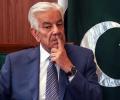
Pakistan's Defence Minister Khawaja Asif has reiterated the nation's unwavering commitment to the Makkah Joint Defence Agreement, underscoring its role in regional security following an attempted drone attack near the holy city of Mecca. The pact, signed by Pakistan, Turkiye, and Saudi Arabia, establishes a framework for collective deterrence against armed attacks.

As international investigations intensify into the mid-air security scare aboard the Flydubai flight, Israel's i24 News reported that an Emirati source has revealed that among the belongings of the Omani co-pilot were leaflets and publications from "Free Palestine" groups, alongside pro-Palestinian material.

A FlyDubai flight captain was stabbed by his co-pilot in a suspected terror attack, leading to a desperate fight for survival that was heroically thwarted by an Israeli dentist and other passengers, averting a major mid-air disaster.

Iranian President Masoud Pezeshkian declared that Iran will not succumb to "bullying" from the US and Israel, vowing to protect national interests amidst escalating West Asian hostilities. During his visit to New Delhi for the BRICS summit, Pezeshkian also discussed strengthening bilateral ties with Prime Minister Narendra Modi and advocated for local currencies in BRICS trade, positioning Iran as a strategic energy and transport partner.

US President Donald Trump announced that a peace deal with Iran, which includes a commitment from Iran to abandon nuclear weapons, is nearly complete and expected to be signed in Europe this weekend. This development follows Trump's decision to call off military strikes against Iran hours after threatening to take control of its oil industry.

The United States has sanctioned four India-based companies, including a customs broker and three other firms, for their involvement in importing petroleum and petrochemical products from Iran. This action is part of "Operation Economic Outcast," a broader US campaign to sever Iran's financial lifelines and prevent funding for its destabilising activities.

The US military has refuted Iran's Revolutionary Guards' assertion that an oil tanker struck a naval mine in the Strait of Hormuz. US Central Command stated the Panama-registered vessel, El Gaia, was previously hit by an Iranian missile and then a drone, highlighting ongoing Iranian attempts to impede commercial vessels in the crucial maritime trade route.
The US military is considering a new wave of military operations in Iran, including potential strikes on infrastructure and securing Iran's stockpile of enriched uranium, amid a fragile ceasefire and stalled nuclear talks.
