
The speed of implementation of the 2,400-kilometre long strategic Trans-Arunachal Highway project in the Frontier State of Arunachal Pradesh in northeast India has been on the slower side because of various factors including adverse weather conditions and law and order problem in certain areas in the Frontier State.

The project is aimed at enabling faster movement of security forces and military equipment during exigencies, while also improving connectivity to Arunachal Pradesh, Manipur and other north eastern states.

For decades, the Siliguri Corridor was treated as a geographical vulnerability to be quietly managed. Today, it has emerged as a focal point of eastern geopolitics.

China is set to build a rail link connecting Xinjiang province with Tibet, part of which will run near the Line of Actual Control (LAC) with India.

China plans to build a new highway along the Line of Actual Control (LAC) with India as part of Beijing's efforts to strengthen its strategic position and project its power, a media report said on Wednesday.

"Based on this consensus, the process of disengagement is almost complete. Our efforts will be to take the matter beyond disengagement; but for that, we will have to wait a little longer," he added.

The notification issued by the Union Environment Ministry also exempts projects pertaining to the expansion of terminal buildings at airports (without an increase in the existing area of the airport) from seeking green nod.

'The greatness of India can be experienced by meeting Indians on the frontiers of India.' 'Every citizen on the border is a soldier'

The ministry of home affairs has identified around 1,700 km of fencing that needs to be done, BRO's additional director general (East) PKH Singh said.

The Bogibeel Bridge, which was a part of the Assam Accord and sanctioned in 1997-98, is likely to play a crucial role in defence movement along the India-China border in Arunachal Pradesh.
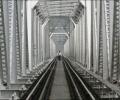
India has planned 14 strategic railway lines in areas bordering China, Pakistan and Nepal, but most of these projects are stuck for want of funds. Anusha Soni reports

Prime Minister Narendra Modi's visit to Arunachal Pradesh on Friday, February 20, irritated the Chinese government so much that it summoned the Indian ambassador to register its protest against Modi visiting a territory China claims as Southern Tibet.

In the two years since the PLA's intrusions into Eastern Ladakh, the Border Roads Organisation is sparing no effort to build and upgrade road highways from Tezpur to the McMahon Line.

Defence minister Rajnath Singh virtually conducted the final breakthrough blast of the Sela tunnel in Arunachal Pradesh and flagged of a 20,000-km-long motorcycle expedition of the BRO on Thursday.
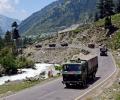
Work is also progressing on 17 strategic highway-cum-airstrips, three of which have been completed, he said. Besides, work is on in full swing on the Rs 12,000 crore ambitious Chardham project for providing all-weather connectivity to Gangotri, Kedarnath, Yamunotri and Badrinath.

Though Beijing asserts the Dalai Lama's successor needs its approval, observers say it remains concerned as the present Panchen Lama, the number two spiritual leader who was appointed by it after unseating the boy nominated by the Dalai Lama, has not gained much traction in Tibet.

A lesson we have not learnt from China is the urgent need to knit the vast country together to keep it from falling apart at the seams. While there is considerable dent in poverty, sadly, the North East remains as distant today as it always was, points out Shreekant Sambrani.

'Unless India ups the ante, Beijing will continue to believe its transgressions are cost free and will feel encouraged to do more of the same.'

The construction of the bridge began in 2011 at a project cost of Rs 950 crore. Its has been designed to withstand the movement of military tanks.

'Given the way in which the PLA operates today, I don't believe local commanders were necessarily acting without approval of higher levels.' 'They were acting in a way which they believed they were carrying out the intent of the higher levels.'
In all likelihood, the next conventional Chinese attack on India would be preceded by a massive cyber attack designed to cripple Indian networks and interfere with our disaster-relief programmes.
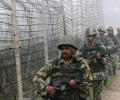
Most of India's reserves for war in the mountains have been sucked in by the standoff with China. A large part of India's airpower has also similarly been committed on the eastern border. By moving these reserves to the China border, India has been weakened vis-a-vis Pakistan. All in all, the nightmare scenario for India of a two-front war may well come true, warns Colonel Anil A Athale (retd).

China on Friday inaugurated its second railway line in Tibet, built at a cost of $2.16 billion, close to Indian border in Sikkim, enhancing mobility of its military in the remote and strategic Himalayan region.

The "caution level" among the troops has also been raised.

The Indian Army has shown it can face down the PLA, but is too often held back by a political leadership that lacks boldness, asserts Ajai Shukla.
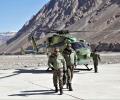
'This reluctance to respond forcefully to Chinese PLA provocations and outright aggression has as much to do with Prime Minister Modi personally, as with the institutional mindset of the MEA or even the Indian Army.' 'They are scarred by the 1962 War and are still cowed by China.'

Dai Bingguo, who served as the China's boundary negotiator with India from 2003 to 2013, told Chinese media, "If the Indian side takes care of China's concerns in the eastern sector of their border, the Chinese side will respond accordingly and address India's concerns elsewhere."

China has chosen to keep New Delhi guessing, while retaining for itself the option of constantly changing facts on the ground and shifting the LAC westwards -- the strategy called 'salami slicing', notes Ajai Shukla.

The sources also said another round of military talks between the two sides on Wednesday to defuse tensions in the area remained inconclusive. The talks lasted nearly seven hours.

After the Ladakh fiasco where Xi Jinping did not expect the Indian Army to resist his land-grabbing tactics, he has to save face before his colleagues in the Communist party.' To bring the threat of a mega-dam to the northern Indian border is a clever move, observes Claude Arpi.
Tawang wears its history -- and also its present -- with ease. The flourishing town, with restaurants selling everything from noodles to dosas and locals returning home to new business prospects, shows little sign of the tension building up at the border about 40 km away to the north.

'A breakthrough in eastern Ladakh leading to disengagement and creation of a buffer zone will obviate the need of military deployment through the winter months ahead,' notes Ambassador M K Bhadrakumar.
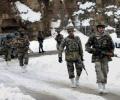
'The Chinese have been moving in step by step; inch by inch for the last 40 years.'
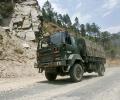
In 2005, the Border Road Organisation was asked to construct 73 roads in the strategically important regions along the Sino-India border but there has been huge delay in implementation of the project which has apparently left the army unhappy.

'The military aim in a future conflict, if it can't be avoided, should be to cause maximum damage to the adversary's war waging capability and capture limited amount of territory as a bargaining counter,' says Brigadier Gurmeet Kanwal (retd).

Until last month more than two-thirds of the Indian Army was deployed against Pakistan. Of 14 army corps, just four-and-a-half faced China, while more than twice that number was ranged against Pakistan.

So far, the Central Sector has never seen active hostilities, remaining peaceful even through the 1962 war. A reason for the Central Sector having remained peaceful is the towering Himalayan watershed that defines the border.

The Tibetan nation still lives under the yoke of the Chinese Communist Party, and Beijing today has a guilty conscience; this creates a great uneasiness for Xi Jinping and his colleagues observes Claude Arpi.
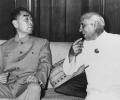
'Unquestionably, the spirit behind the Panchsheel agreement and the 'Hindi Chini bhai bhai' slogan were thrown overboard by the Chinese, and a trust deficit was injected between the two nations.' A revealing excerpt from General J J Singh's The McMahon Line: A Century Of Discord.

Just like China wants Trump to lose the US presidential poll, it may want Modi to lose the Lok Sabha polls. So months before the 2024 elections, China may take possession of an important area, say one of the Char Dhams, warns Sanjeev Nayyar.
 © 2026 Rediff.com - Advertise with us - Disclaimer - Privacy Policy - Sitemap - Feedback - About us - Terms of use - Grievances