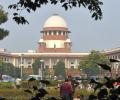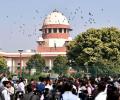
The Allahabad High Court Bar Association has begun an indefinite strike to protest the proposed transfer of Delhi HC judge Yashwant Varma, who is under investigation after a large amount of cash was found at his residence. The Oudh Bar Association (OBA) of the Lucknow bench of the High Court has also condemned the transfer, calling for impeachment proceedings against Justice Varma. Both bar associations are concerned about the impact on public faith in the judiciary and have called for a reconsideration of the transfer decision.
Moderate turnout was recorded in the first four hours of polling across five assembly constituencies across Punjab, West Bengal, Gujarat and Kerala where bypolls are underway on Thursday.
Justice Gavai's comment came while the apex court bench, also comprising Justice Augustine George Masih, was considering a fresh plea seeking an inquiry into the recent violence in West Bengal during anti-Waqf law protests.
The Supreme Court of India has formed a National Task Force (NTF) to address the growing concern of student suicides in higher educational institutions. The court took note of the recurring cases and directed Delhi Police to register FIRs on the complaints of families of two students who died by suicide at IIT Delhi in 2023. The NTF, chaired by former apex court judge Justice S Ravindra Bhat, will prepare a comprehensive report, including the identification of causes leading to suicides, analysis of existing regulations, and recommendations for strengthening protections. The NTF will also have the authority to conduct surprise inspections of higher educational institutions and make further recommendations to ensure a holistic approach to addressing mental health concerns and eliminating suicides.
Dubey launched a broadside against the Supreme Court on Saturday, saying Parliament and state assemblies should be shut if the apex court has to make laws.
The Supreme Court of India has criticized the Enforcement Directorate (ED) for focusing solely on its own fundamental rights while pursuing a money laundering case related to the Nagrik Apurti Nigam (NAN) scam in Chhattisgarh. The court questioned the agency's attempt to transfer the case to New Delhi, noting that the agency's petition under Article 32 of the Constitution is typically reserved for individuals seeking redressal for fundamental rights violations.
Tamil Nadu Chief Minister M K Stalin has announced the formation of a panel headed by a retired Supreme Court judge to study the relationship between the Union and state governments and ensure state autonomy. The panel, which will submit its interim report in January 2026 and its final report in two years, will examine the transfer of subjects from the State List to the Concurrent List, citing the National Eligibility-cum-Entrance Test (NEET) as an example of a subject outside state purview.
The Supreme Court of India has taken a strong stance against child trafficking rackets, canceling the bail granted to 13 accused and criticizing the Uttar Pradesh government for its inaction. The court expressed concern over the rising number of trafficking cases and the changing patterns of the crime. It also directed the state to ensure trafficked children are admitted to schools and receive support for their education.
The Supreme Court of India has refused to relax the ban on firecrackers in the Delhi-NCR region, citing continued alarming levels of air pollution. The court emphasized the right to a pollution-free atmosphere as a fundamental right, stating that the ban is necessary to protect public health. The court also highlighted the issue of noise pollution caused by firecrackers. The decision comes after a batch of petitions were filed by firecracker manufacturers seeking relaxation of the ban.
Farmer leader Jagjit Singh Dallewal, who was on an indefinite hunger strike in support of various demands, has broken his fast after the Punjab government intervened and dispersed protesting farmers at Khanauri and Shambhu borders. The Supreme Court lauded Dallewal's efforts and acknowledged the government's action, while also asking for a status report on the situation. Contempt proceedings against the Punjab chief secretary and Director General of Police for not complying with the court's order of providing medical aid to Dallewal were dropped.
Tamil Nadu Chief Minister and DMK president M K Stalin announced that his party will file a case in the Supreme Court against the Waqf Bill passed in the Lok Sabha. The opposition AIADMK expressed solidarity with the DMK's stance, while the BJP members staged a walkout from the Assembly in protest. The CM argued that the amendment was passed at the behest of a few allies despite opposition from majority parties and that it is an attack on the Constitution and religious harmony. The DMK claims the bill threatens the autonomy of the Waqf Board and the Muslim minority population.
The apex court, instead of reserving the judgement, dictates operative parts and says there is an urgent need to provide certainty and finality to the dispute which affects the career of over 2 million students.
The Supreme Court of India will likely hear a batch of petitions challenging the constitutional validity of the Waqf (Amendment) Act, 2025 on April 15. The Act, which came into force on April 8, has been met with widespread criticism from various stakeholders, including politicians, the All India Muslim Personal Law Board (AIMPLB), and Jamiat Ulama-i-Hind. They argue that the law is discriminatory and violates the fundamental rights guaranteed under Articles 25 and 26 of the Constitution. The petitions allege that the amendments give the government more control over the administration of Waqf, effectively sidelining the Muslim minority from managing their own religious endowments.
In a landmark verdict, the Supreme court fixed a timeline for Governor to act on bills passed by the state legislature as it pulled up Tamil Nadu Governor R N Ravi for reserving 10 bills for President's consideration, saying it was against the constitutional provisions.
The Indian government has claimed a significant increase in waqf land following the 2013 amendment to the Waqf Act, asserting that the addition of 20 lakh acres raises concerns about potential "misuse" of the provisions. In an affidavit to the Supreme Court, the Centre highlighted a 116% rise in auqaf area after the amendment and urged the dismissal of petitions challenging the Act's validity.
The Supreme Court of India has transferred a Public Interest Litigation (PIL) concerning the safety and longevity of bridges in Bihar to the Patna High Court. The court expressed concern over the state government's handling of bridge collapses, noting that officials were suspended after incidents but reinstated after the public outcry subsided. The court also criticized the state's voluminous response to the PIL, which lacked explanations for the collapses. The Patna High Court will now monitor the state's efforts to ensure structural and safety audits of bridges in Bihar.
The Karnataka High Court has ordered an investigation into a city civil court judge's conduct after he cited non-existent Supreme Court rulings in a case. The High Court expressed concern over the judge's actions, stating that the matter required further investigation. The case involved a revision petition challenging the civil court's jurisdiction in a commercial dispute. Senior Counsel Prabhuling Navadgi, representing the petitioners, argued that the lower court had rejected their application based on citations of judgments that did not exist. The High Court also allowed the revision petition, finding that the plaintiffs had used a tactic to file the case in a court that lacked jurisdiction.
The Supreme Court of India has sharply criticized the Uttar Pradesh police for filing FIRs in civil cases, stating there is a "complete breakdown of rule of law" in the state. The court expressed its displeasure after discovering FIRs filed by the UP police in civil disputes, questioning the use of criminal law in such matters. The Chief Justice highlighted the absurdity of converting civil disputes into criminal cases, emphasizing that non-payment of money cannot be considered a criminal offense. The bench has summoned the investigating officer to justify the registration of an FIR in a specific case, and has stayed criminal proceedings against the accused while allowing the cheque bounce case to continue.
A bench of Justices B R Gavai and Augustine George Masih observed it was pained to say that some of the observations made in the high court order depicted total insensitiveness and an inhuman approach.
The Supreme Court of India has criticized the Uttar Pradesh government and Prayagraj Development Authority for the demolition of homes in the city, calling the actions "inhuman and illegal." The court ordered the authority to pay Rs 10 lakh compensation each to the homeowners, stating that the demolitions were carried out in a "high-handed" manner without following due legal process. The petitioners, whose homes were demolished, argued that the state government wrongly believed the land belonged to gangster-politician Atiq Ahmed. The Allahabad High Court had previously rejected their plea challenging the demolition.
The Union Cabinet, at a meeting chaired by Prime Minister Narendra Modi, held a detailed discussion on the Supreme Court judgement on the sub-categorisation of reservation for SCs and STs as granted in the Constitution.
The Supreme Court of India will examine the jurisdiction of the Lokpal, India's anti-corruption ombudsman, in entertaining complaints against sitting high court judges. The court is considering a suo motu proceeding initiated over the Lokpal's January 27 order on the issue. The case involves two complaints filed against a sitting additional judge of a high court, alleging that he influenced a judge of the subordinate judiciary and a judge of the same high court set to deal with a suit filed against the complainant by a private company.
The Supreme Court of India has overturned an order by the National Green Tribunal (NGT) that halted construction activities at Auroville in Chennai. The court emphasized the need for a "golden balance" between the right to development and the right to a clean environment, upholding the principle of sustainable development. The decision comes as a victory for the Auroville Foundation, which had challenged the NGT order, and highlights the ongoing debate about balancing environmental concerns with economic growth in India.
"It is a policy matter. You ask Parliament to enact the law," a bench of Justices B R Gavai and Augustine George Masih told the counsel appearing for the petitioner.
West Bengal Chief Minister Mamata Banerjee has defended her support for teachers who were dismissed following a Supreme Court verdict, accusing the BJP and CPI(M) of "hatching a conspiracy" to influence the ruling. She dared the BJP to arrest her for supporting the affected candidates, while asserting that her government will abide by the verdict but explore all legal options. The development has triggered political reactions with the BJP demanding Banerjee's resignation, while the CPI(M) expressed concern over the impact on the education system. Banerjee also criticized the BJP's handling of the Vyapam scam in Madhya Pradesh, drawing parallels to the school jobs scam in West Bengal.
The Supreme Court of India has ruled that governors cannot indefinitely delay giving assent to bills passed by state legislatures, setting a timeline of one to three months for their actions. The court said the governor must act "as soon as possible" and that failure to comply with the timeline will make their inaction subject to judicial review. The ruling comes as several opposition-ruled states have accused governors of delaying assent to bills passed by their assemblies.
The Supreme Court of India has invalidated the appointment of 25,753 teachers and other staff in West Bengal's state-run and state-aided schools, deeming the selection process "vitiated and tainted." The court ordered the state government to conduct a fresh selection process within three months. The decision comes after a Calcutta High Court verdict in April 2024, which also annulled the appointments. The apex court, while upholding the high court's order, made some modifications, including exempting disabled employees from returning their salaries. The case stemmed from alleged irregularities in the 2016 recruitment process by the West Bengal School Service Commission (SSC), involving OMR sheet tampering and rank-jumping. The Supreme Court had previously termed it a "systemic fraud." Former West Bengal education minister Partha Chatterjee and Trinamool Congress MLAs Manik Bhattacharya and Jiban Krishna Saha are among the accused being investigated in the recruitment scam.
Supreme Court judge, Justice B R Gavai, expressed hope that the "current difficult phase" in ethnic strife-torn Manipur will be over soon with the assistance of the executive, legislature and judiciary and the state will prosper like the rest of the country. Justice Gavai, who led a delegation of Supreme Court judges that visited Manipur, called upon the people of the state to work together to restore peace and harmony. He also urged the people of the state to work together to restore peace and normalcy, and lauded the natural beauty he witnessed while travelling from Imphal to Churachandpur. He expressed delight in noting that training programmes were being imparted at the relief camps, and thanked the Chief Justice of Manipur High Court and the district legal services authority for their efforts. Justice Gavai also stressed the need for readmission of students who had to drop out of school due to the conflict and called upon the educational institutions and the public to ensure all students complete their education.
A trainee pilot was killed when a trainer aircraft crashed into a residential area in Gujarat's Amreli district on Tuesday afternoon. The plane, belonging to a private aviation academy, caught fire after crashing into a tree and then an open plot. The pilot was flying solo and the aircraft had taken off from the Amreli airport. The cause of the crash is under investigation.
The Supreme Court of India has declined to interfere with the bail granted to 17 members of the Popular Front of India (PFI) in connection with the 2022 murder of Rashtriya Swayamsevak Sangh (RSS) leader Srinivasan in Kerala. The court noted that the Kerala High Court, which granted bail, has the power to revoke it if the conditions are violated. The NIA had sought cancellation of the bail, alleging the accused had violated bail conditions and contacted witnesses. The accused are also facing trial for allegedly instigating communal violence in Kerala and other parts of the country.
The Supreme Court of India has expressed concern over the erosion of the family institution, stating that people in India, while valuing the concept of 'vasudhaiva kutumbakam' (the world is one family), are failing to maintain unity even within their immediate families. This observation came in a case involving a dispute between a mother and her eldest son over property and family relations.
The Supreme Court of India expressed shock over a viral video showing an eight-year-old girl fleeing her shanty as it was demolished by a bulldozer during an anti-encroachment drive in Uttar Pradesh. The court mentioned the video while hearing a case concerning illegal demolition in Prayagraj. The incident drew criticism from opposition parties, while local authorities defended the demolition, citing court orders and multiple notices issued to the encroacher.
The Bombay high court on Friday constituted a three-judge special bench to hear the pleas challenging the constitutional validity of the law providing Maratha reservation following a Supreme Court directive.
BJP MP Nishikant Dubey has come under fire for his controversial remarks against the Chief Justice of India and now, he has targeted former Chief Election Commissioner S Y Quraishi, calling him a "Muslim commissioner". Dubey's comments come after Quraishi criticized the Waqf (Amendment) Act as a "sinister and evil plan of the government to grab Muslim lands". Dubey's remarks have been met with widespread condemnation, with many calling them inflammatory and divisive.
The high court erred in holding that the law was violative of the principle of secularism, said a bench comprising Chief Justice of India D Y Chandrachud and Justices J B Pardiwala and Manoj Misra.
The law prohibits conversion of any place of worship and provides for the maintenance of the religious character of any place of worship as it existed on August 15, 1947.
The Supreme Court of India has criticized the Uttar Pradesh government for its "high-handed" demolition of homes in Prayagraj, ordering the reconstruction of the demolished structures. The court expressed concern over the manner in which notices were served and the swiftness of the demolition, stating that it "shocks our conscience." The court has allowed the reconstruction of the homes at the petitioners' expense, provided they file appeals and do not claim ownership of the land. The matter has been adjourned to allow the petitioners to file undertakings.
The Supreme Court has directed a Maharashtra authority to respond to a man's plea for initiating contempt action against it after his properties were demolished for allegedly raising anti-India slogans during a cricket match. The petitioner, who hails from Sindhudurg district in the state, claims his house and shop were demolished on February 24 following an FIR against him, his wife, and his 14-year-old son for allegedly raising anti-India slogans during the India-Pakistan Champions Trophy match. The plea argues that the demolition violated the Supreme Court's November 13, 2024 verdict on demolition of properties, which barred demolition without a prior showcause notice and 15 days' time for the aggrieved party to respond. The petitioner seeks directions for initiating contempt proceedings against the chief officer and administrator of the Malvan Municipal Council.
The SBIF Asha Scholarship Programme for Overseas Education 2024-25 aims to provide financial assistance to meritorious students from low-income families across India, ensuring the continuity of their education.
Four days after the top court cleared 10 bills, which were stalled and reserved by Tamil Nadu Governor R N Ravi for the president's consideration, and set a timeline for all governors to act on the bills passed by the state assemblies, the judgement running into 415 pages was uploaded on the apex court's website at 10.54 pm on Friday.