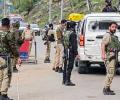
A year after Adil Hussain Shah, a 'ponywallah', died saving tourists during the Pahalgam terror attack, his widow Gulnaz Akhtar remembers his bravery and the hardship she has faced since his death.

'All terrorists are a blot on humanity.' 'No religion in the world teaches you to take the life of an innocent person.' 'Kashmiris have always been known for their hospitality. One moment of darkness cannot erase Kashmiriyat.'
We, Indians, forgot that for Pakistan, Kashmir dispute and blood feud with India is the raison detre for its existence. It is also the excuse with which the Pak army keeps its grip over the state. Peace in Kashmir and between India and Pakistan is against the interests of the Pak army, points out Colonel Anil A Athale (Retd).

India observed the first anniversary of the Pahalgam terror attack, with leaders paying homage to the victims and asserting the country's commitment to fighting terrorism.

Lashkar-e-Taiba (LeT) terrorist Abdullah, alias Abu Hureira, who was tasked with establishing bases outside Jammu and Kashmir, adopted various professions, including share trading, to blend in with the local population. He was recently arrested along with other members of his network.

Jammu and Kashmir Police, in coordination with central intelligence agencies, have detained several people from Haryana and Rajasthan for allegedly facilitating the acquisition of fraudulent identities, including passports, by terrorists linked to Lashkar-e-Taiba (LeT). The investigation uncovered an interstate module providing logistical support to terrorists by creating fake documents.

In a major counter-terror operation spanning three states, the Delhi Police has dismantled a Lashkar-e-Taiba (LeT) module comprising eight operatives, including seven Bangladeshi nationals who had illegally entered India and procured forged identity documents, an official said on Sunday.
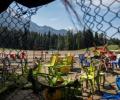
A year after the deadly terror attack in Pahalgam, India remembers the victims and reaffirms its commitment to fighting terrorism. Families of the deceased mourn their loss, while political leaders reiterate the nation's resolve to stand united against terror.

The National Investigation Agency (NIA) will file a charge sheet in the Pahalgam terror attack case, in which 26 people, mostly tourists, were killed by Pakistan-based terrorists.

Sri Lanka's response to the Easter attacks has been slow and politically contested, unlike India's swift institutional reforms after the 2008 Mumbai terror attacks, observes Colonel R Hariharan (retd).
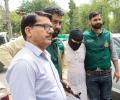
Delhi Police have arrested a suspected Lashkar-e-Taiba (LeT) handler, Shabir Ahmed Lone, in Delhi, uncovering a terror module with links to Pakistan's ISI. Lone is accused of running a network involved in pasting anti-national posters and planning terror activities across India.

Two suspected Lashkar-e-Taiba terrorists were killed when army troops scuttled an infiltration attempt along the Line of Control in Poonch district of Jammu and Kashmir, officials said on Wednesday.

In a key revelation, former Central Intelligence Agency (CIA) officer John Kiriakou has said that Al Qaeda founder Osama bin Laden, who was the most wanted terrorist for the United States after the terrorist attacks of September 11, 2001, had escaped from the Tora Bora hills in Afghanistan in the guise of a woman.
The camera was activated on January 30, 2024 at Dongguan--an industrial metropolis in China, and is among various material objects and electronic devices found and examined by the investigators connected with conspiracy.
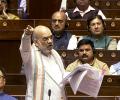
Home Minister Amit Shah stated in the Rajya Sabha that the terrorists responsible for the Pahalgam attack were killed in Operation Mahadev. He also criticized the Congress party's stance on national security.

On Tuesday, August 5, 2025, on the 6th anniversary of the abrogation of Article 370 and Article 35A, Jammu and Kashmir Lieutenant Governor Manoj Sinha along with J&K Police Director General Nalin Prabhat and Chief Secretary Atal Dulloo handed over government job appointment letters to family members of terror victims in Srinagar.
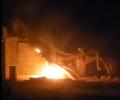
The nine targets struck under 'Operation Sindoor', four in Pakistan and five in Pakistan-occupied-Kashmir, were chosen by the IAF after receiving intelligence inputs about terror camps operating under the guise of health centres to evade detection at these sites, officials said on Wednesday.
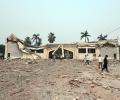
Months after India's precision strikes on nine terror camps across Pakistan and Pakistan-occupied Kashmir (PoK), a viral video of Lashkar-e-Taiba (LeT) commander Qaasim has surfaced.

Indian authorities have requested additional information from the United States based on the interrogation of Tahawwur Rana, an accused in the 2008 Mumbai terror attacks. The request was made through the Mutual Legal Assistance Treaty (MLAT).
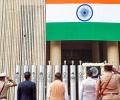
Maharashtra Chief Minister Devendra Fadnavis on Wednesday paid floral tributes at the city police headquarters to those who made the ultimate sacrifice while fighting terrorists during the 2008 Mumbai terror attacks.

The officials found that his browsing history indicated an interest in the deployment of paramilitary forces in the Kashmir valley, prompting them to ascertain the purpose of his visit to the strategically important Zanskar region in Ladakh late last month.
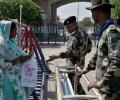
Pakistan Defence Minister Khwaja Asif has admitted the country's history of supporting, training and funding terrorist organisations as 'dirty work' for the West, a mistake for which he said Pakistan had suffered.
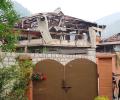
"Similarly, 60 launchpads are working in the other depth areas away from the border," BSF DIG Vikram Kunwar told reporters in Jammu.
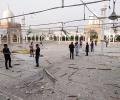
Markaz Taiba of Lashkar-e-Taiba (LeT) in Pakistan's Muridke, one of the nine terror camps struck by the Indian armed forces on Wednesday, is a site where terrorists including Ajmal Kasab involved in the 2008 Mumbai attack were trained, a senior military official said.
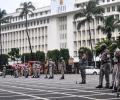
The Maharashtra Police are drafting a drone-use policy to strengthen security and surveillance in key cities, including Mumbai, as part of preparations against unconventional terror threats, a senior official said on Wednesday.

Lashkar-e-Taiba terrorist Razaullah Nizamani Khalid alias Abu Saifullah Khalid, who was the brain behind the 2006 attack on the Rashtriya Swayamsevak Sangh headquarters, was killed by three unidentified gunmen in Sindh province of Pakistan on Sunday, officials in New Delhi said.
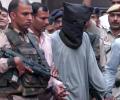
The National Investigation Agency has informed a Delhi court that Mumbai attack accused Tahawwur Rana could spill the beans on the ongoing and future terror plans of outfit Lashkar-e-Taiba and its chief Hafiz Saeed for India.
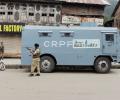
In a major breakthrough, the National Investigation Agency (NIA) has arrested two men for harbouring the terrorists who had carried out the Pahalgam terror attack that left 26 people dead, the agency said on Sunday.

The empty cartridges found at Pahalgam and those after test firing by the recovered guns were matched by the forensic lab, Shah said. The ballistic report is with him, he added.

Attacking the Congress, Union Minister Kiren Rijiju said that India has "paid a heavy price" for the sins committed by the Congress while Union Minister Pralhad Joshi has accused the Oppostion party of "mishandling" the situation after the 2011 terror attacks in Mumbai in under foreign pressure.

The houses of two Lashkar-e-Taiba (LeT) terrorists allegedly involved in the Pahalgam attack were destroyed in Jammu and Kashmir in a blast on Thursday night. Security forces were conducting searches inside the houses of Adil Hussain Thokar and Asif Sheikh when the explosives already kept inside the houses went off.
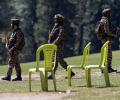
The terrorists chose Baisaran as the target due to its "high tourist presence", "relative isolation" and after considering that the "response (from the security agencies) would take time".

Congress leader P Chidambaram's remarks questioning the origin of the terrorists behind the Pahalgam attack sparked a fierce political row ahead of the debate in Parliament on Operation Sindoor.
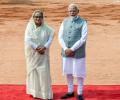
'If she hadn't left Bangladesh, the militants had planned on killing her'
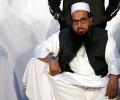
'The fight against terrorism will continue. We have set a new normal and the new normal is that we will follow an offensive strategy. Wherever terrorists are, we have to kill those terrorists and we have to destroy their infrastructure. So it is still not over but as we speak the ceasefire is still intact'

The Indian Army has released a booklet on Operation Sindoor, which was launched to avenge the April 22 ghastly Pahalgam attack in which Pakistan-backed terrorists brutally killed 26 civilians, mostly tourists, and left many injured.

The Indian Army will bear the study expenses of a ten-year-old boy, Shvan Singh, who supplied meals to soldiers during Operation Sindoor. The army's Golden Arrow Division has committed to fully sponsor Shvan's education in recognition of his courage and enthusiasm.
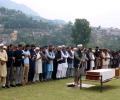
Sources have revealed that at least five hardcore terrorists affiliated with banned terror outfits Lashkar-e-Taiba (LeT) and Jaish-e-Mohammed (JeM) were killed in Indian strikes in Pakistan on May 7th. The strikes targeted nine terror sites in Pakistan and Pakistan-occupied Kashmir. Among the dead were Mudassar Khadian Khas, a LeT leader, and Hafiz Muhammed Jameel, the brother of JeM founder Maulana Masood Azhar. Other notable casualties included Mohammad Yusuf Azhar, a brother-in-law of Masood Azhar, and Khalid alias Abu Akasha, a LeT operative. The Pakistani military and government officials were present at the funerals of the slain terrorists.
A team from India's National Investigation Agency (NIA) has reached Pahalgam in Jammu and Kashmir to assist local police in investigating a deadly terrorist attack that killed 26 people, mostly tourists, on Tuesday. The NIA team visited the site of the attack, Baisaran meadow, known for its scenic beauty. Security agencies have released sketches of three suspected Pakistani terrorists involved in the attack, identified as Asif Fauji, Suleman Shah, and Abu Talha. The Resistance Front (TRF), a shadow outfit of the Lashkar-e-Taiba terrorist group, claimed responsibility for the attack.
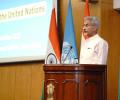
External Affairs Minister S Jaishankar criticizes Pakistan's attempts to protect a terror group at the UN Security Council, highlighting the need for urgent reforms within the global body.
