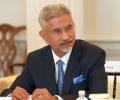
External Affairs Minister S Jaishankar says Operation Sindoor conveyed India's resolve to act against terrorism, following UN Security Council's call to bring Pahalgam attackers to justice.

Pakistan have sealed their spot in the ICC Women's Cricket World Cup 2025 after a flawless campaign in the Qualifiers - but their participation has already stirred controversy.
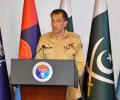
Lt Gen Ahmed Sharif Chaudhry, the spokesperson for the Pakistan Army, is the son of a nuclear scientist who was sanctioned by the United Nations and the US for providing information and expertise to al-Qaeda, according to Indian officials. Chaudhry's father, Sultan Bashiruddin Mahmood, allegedly provided insights into nuclear weapons infrastructure and raised funds for a fundamentalist organization linked to the Taliban. Mahmood was arrested in 2001 after admitting to meeting Osama bin Laden but was later released.
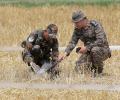
Metal debris was found scattered in three villages of Amritsar district, with some locals claiming them to be parts of missiles. Police are investigating the objects, while the Indian government claims to have foiled Pakistan military's attempts to attack 15 places in northern and western India using missiles and drones. Tensions between India and Pakistan have escalated after India launched missile strikes on terror targets in Pakistan and Pakistan-occupied Kashmir (PoK) in response to the April 22 killing of 26 people by terrorists in Kashmir's Pahalgam.
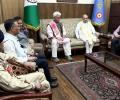
Union Home Minister Amit Shah arrived in Srinagar to review the security situation in Kashmir following a deadly terror attack in Pahalgam that killed 26 people, including tourists. Shah chaired a high-level meeting of security officials, including those from the Army, CRPF, and police. The attack, claimed by The Resistance Front (TRF), a shadow group of the banned Pakistan-based Lashkar-e-Taiba (LeT) terror group, is the deadliest in the valley since the 2019 Pulwama strike.
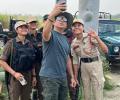
"Fearless in unity. Boundless in strength. India's shield is her people. There's no room for terrorism in this world. We're ONE TEAM! Jai Hind," Tendulkar posted
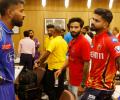
PBKS-DC game also uncertain, say BCCI Sources
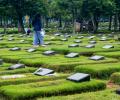
As many as 2,493 graves were identified as belonging to foreign terrorists who were killed in counter-insurgency operations.
These individuals often lacked identification to conceal their networks and maintain Pakistan's plausible deniability.

Former Pakistani Foreign Minister Bilawal Bhutto has acknowledged the country's tango with terror operatives, saying that Pakistan has a past.
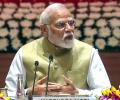
Prime Minister Narendra Modi hailed "Operation Sindoor" as a turning point in the global fight against terror, describing it as a symbol of India's growing strength and clarity of purpose. Addressing the nation through his monthly radio programme Mann Ki Baat, Modi said the operation reflects a changing and resolute India, and has inspired patriotism and self-reliance across the country.
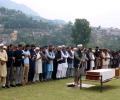
In trying to portray a globally sanctioned terrorist as a 'common man', Pakistan was exposed when its top official publically outed crucial details about Hafiz Abdul Rauf, including his national identity number which matched details in the database of the United States sanction list of terrorists.
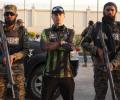
PSL match between Karachi Kings and Peshawar Zalmi in Rawalpindi rescheduled

A UN Security Council report states that The Resistance Front (TRF) claimed responsibility for the Pahalgam terror attack and published a photograph of the attack site. The report also cites assertions that the attack could not have happened without the support of Pakistan-based Lashkar-e-Tayyiba (LeT).
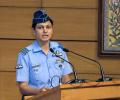
Wing Commander Vyomika Singh, an accomplished helicopter pilot in the Indian Air Force, was chosen to brief the nation about India's 'Operation Sindoor' strikes on Pakistan. She has flown a variety of aircraft and taken part in rescue operations in extreme conditions. Vyomika, who has logged over 2,500 flying hours, has operated helicopters across challenging terrains, from the high-altitude sectors in Jammu and Kashmir to the remote areas in the Northeast. She led a rescue operation in Arunachal Pradesh in 2020, flying in extreme conditions to evacuate civilians.
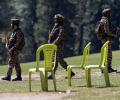
The officials said that intelligence agencies had been alerted about the possibility of a terror attack, but the inputs were utilised at another place, some 90 kilometres away from the site where the attack took place, resulting in a key security lapse.

One Pakistan terrorist belonging to the Lashkar-e-Taiba has been gunned down in the ongoing encounter.
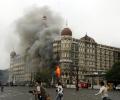
Mumbai 'Chai Wala' known as 'Chhotu' aka Mohammed Taufiq, whose alertness saved lives during the 26/11 Mumbai terror attacks stated that there is no need for India to provide Tahawwur Rana with cell and Biryani and facilities which were provided to Ajmal Kasab, one of the terrorists involved in Mumbai attacks.
It is also the first time that TRF has been mentioned in any UN document. This marks the first mention of the LeT and any other Pakistan-based terror group in the report since 2019.
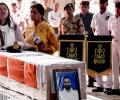
The family of Navy officer Vinay Narwal, killed in a terror attack in Pahalgam, expressed gratitude for "Operation Sindoor", the Indian military's retaliatory strikes against terror infrastructure in Pakistan and PoK. Vinay's wife, Himanshi, who was widowed during their honeymoon, called the operation a testament to her late husband's spirit and a strong message against terrorism. Vinay's father, Rajesh, said the strikes would make terrorists think twice before carrying out such attacks. The operation was lauded for its decisive response to the Pahalgam attack, which claimed the lives of 26 tourists.

From the 30-share Sensex firms, Tata Motors, Bajaj Finance, Eternal, Adani Ports, Tata Steel, Titan, Mahindra & Mahindra and Power Grid were among the gainers. Asian Paints, Sun Pharma, ITC, Nestle, Reliance Industries and HCL Tech were among the laggards.
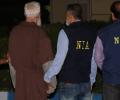
Tahawwur Hussain Rana, a Canadian national accused of involvement in the 2008 Mumbai terror attacks, has been extradited to India from the United States. Rana's interrogation is expected to shed light on the role of Pakistani state actors in the attacks, which claimed 166 lives. Indian authorities are particularly interested in his travels across India in the days leading up to the attacks, including visits to Hapur, Agra, Delhi, Kochi, Ahmedabad, and Mumbai. Rana's extradition follows a lengthy legal battle, with the US Supreme Court ultimately denying his application to challenge it. Rana is known to be associated with Pakistani-American terrorist David Coleman Headley, one of the main conspirators of the 26/11 attacks. The investigation into the Mumbai attacks has implicated senior members of terror outfits Lashkar-e-Taiba (LeT) and Harkat-ul Jihadi Islami (HuJI), as well as officials from Pakistan's Inter-Services Intelligence (ISI).

Sachin Tendulkar, Virat Kohli, and Shreevats Goswami spoke out-some demanding an immediate and total severing of sporting ties with Pakistan.
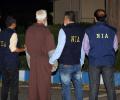
He was sent to judicial custody on May 9 and lodged in Tihar jail after his custodial interrogation by the NIA.
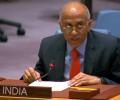
India's Permanent Representative to the UN Ambassador Parvathaneni Harish said that the Indian sub-continent offers a "stark contrast" in terms of progress, prosperity and development models.
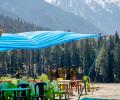
The entry and exit points are being closely scrutinised by the investigating NIA teams for clues to the modus operandi of the terrorists, the officials said.
Following the deadly Pahalgam attack, Michael Rubin, a former Pentagon official and senior fellow at the American Enterprise Institute, issued a strong statement and said that 'it is now the duty of India to do to Pakistan and to Pakistan's Inter-Services Intelligence (ISI) what Israel did to Hamas', calling for decisive action against Pakistan's intelligence agency for its alleged role in supporting terrorism.
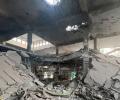
Pakistan claims it was a mosque and an educational complex that were hit in the strikes at Muridke, located at about 40 km from Lahore.

A firefight ensued after security forces landed a cordon and search operation in the Wanigam Payeen Kreeri area of Baramulla acting on specific intelligence about the presence of terrorists at the location.

From the Sensex firms, Eternal, Mahindra & Mahindra, Maruti, Bajaj Finance, Tata Steel, Bharti Airtel, Bajaj Finserv, Asian Paints, Power Grid and State Bank of India were among the laggards. Kotak Mahindra Bank, Axis Bank, Titan, HCL Tech, Tata Motors, Infosys and Tata Consultancy Services were the gainers.
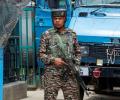
S&P Global Ratings on Thursday said the hostilities between India and Pakistan heighten risks to the credit metrics of both countries, and any escalation in clashes would put downward pressure on sovereign credit support.
In a strong retaliation to the Pahalgam massacre, India's armed forces early Wednesday destroyed nine terror sites including that of Jaish-e-Mohammad and Lashkar-e-Taiba in Pakistan and Pakistan-occupied Kashmir (PoK) using deep strike missiles in a 25-minute-long 'measured and non-escalatory' mission.
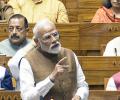
What was the aim of Operation Sindoor? Why was the operation halted so soon? asks Lieutenant General Prakash Katoch (retd).
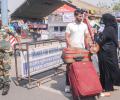
United States Charge d'Affaires Natalie Baker on Wednesday met Deputy Prime Minister and Foreign Minister Ishaq Dar as part of efforts to de-escalate tensions with India following the Pahalgam terror attack on April 22 in which 26 people were killed.
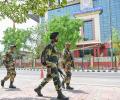
The 64-year-old Pakistani-origin Canadian businessman would also be questioned on his suspected links with the officials of Pakistan spy agency Inter-Services Intelligence (ISI) and his association with terror group Lashkar-e-Taiba (LeT), which had orchestrated the attacks.
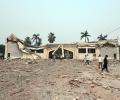
A former Pentagon official, Michael Rubin has said that India targeted terror infrastructure with precision, and it was able to blunt Pakistan's response following the recent strikes.
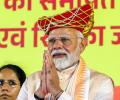
"In Pahalgam, terrorists not only shed the blood of Indians, but also attacked our culture. They tried to divide our society and the biggest thing is that the terrorists have challenged the women power of India," Modi said.
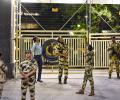
Tahawwur Hussain Rana, a Pakistani-born Canadian national accused of playing a role in the 2008 Mumbai terror attacks, has been extradited from the United States to India. Rana was arrested in the US in 2009 and convicted in 2011 for providing material support to the Lashkar-e-Taiba terror group, which carried out the Mumbai attacks. He had been fighting extradition since 2012, but the US Supreme Court ultimately denied his review petition, paving the way for his transfer to India. Rana will now face trial in India for his alleged role in the attacks, which killed 166 people.

The Director General of Air Operations said "whatever methods and whatever means we have chosen, it had the desired effects on the enemy targets",
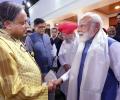
Prime Minister Narendra Modi's energy, dynamism and willingness to engage remains a 'prime asset' for India on the global stage but deserves greater backing, Congress MP Shashi Tharoor said on Monday, in remarks that are likely to irk his party and widen the growing cracks in his ties with its leadership.
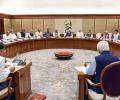
India has reached out to key global powers, including members of the UN Security Council, and apprised them about the reasons behind its military strikes on nine terror targets in Pakistan and Pakistan-occupied-Kashmir in retaliation for the Pahalgam terror attack. New Delhi also conveyed to the countries that it will retaliate if Islamabad escalates the already tense situation.
