
Tata Power has partnered with Norway's Ocean Sun to introduce innovative membrane-based floating solar technology to India. A 300 kWp pilot project will be undertaken at Tata Power's Mulshi reservoir in Maharashtra to evaluate the technology's performance, reliability, and cost-effectiveness under Indian conditions. This collaboration aims to leverage India's significant floating solar potential and contribute to its renewable energy goals.

The recipe for Indian higher education institutions to succeed in the global markets is excellence in academics, promoting contemporary socially relevant material, and enabling individuals (learners) to realise their full potential, suggests N Ravichandran.
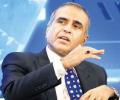
'The Rs 35,000 crore of capex every year, I don't get to sign 35 paise out of this.'

Researchers at BRIC-RGCB in Thiruvananthapuram have developed a novel nanopore-based sensing technology. This innovation allows for the early and highly sensitive detection of biomarkers associated with neurodegenerative diseases like Parkinson's and ALS, addressing a critical challenge in current diagnostic methods. The technology, published in Nature Nanotechnology, uses self-assembling dual-diameter nanopore sensors to identify disease-specific biomarkers even at low concentrations.

'In India, an MBA from a top college would have better opportunities as compared to an MTech from top colleges,' says rediffGURU Patrick D'souza.
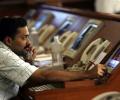
Indian benchmark stock indices, Sensex and Nifty, closed lower due to profit-taking, a spike in wholesale price-based inflation, and firm crude oil prices, despite some support from easing intraday crude oil prices and rupee appreciation.

Russian President Vladimir Putin has proposed a new investment platform, based on the New Development Bank (NDB), to fund projects in trade, infrastructure, logistics, and technology across BRICS nations, emphasising that the grouping's expanding economic cooperation is not 'against anyone' but aims to advance members' national interests.
HCL Group, a USD 14.8 billion conglomerate, has announced a new partnership with the DP World Professional Golf Tour of India (PGTI). This collaboration aims to leverage technology and innovation to strengthen India's professional golf ecosystem, broaden the sport's reach, and enhance experiences for players, fans, and partners.
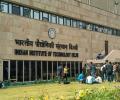
Researchers at IIT Delhi have successfully demonstrated the simultaneous transmission of quantum-entangled photons and classical data over a 50-km optical fibre link. This breakthrough addresses key challenges in integrating fragile quantum signals with existing telecommunications infrastructure, paving the way for more scalable and secure future quantum networks.

A first-year IIIT Ranchi student was found dead in his hostel room on Sunday, leading to student protests alleging negligence by college authorities in providing timely medical aid. Police are investigating the incident, which preliminary suggests suicide due to exam pressure.
Researchers at IIT-ISM Dhanbad have been granted an Indian patent for an electrochemical reactor designed to recover copper from industrial wastewater. This innovative technology offers an environmentally sustainable solution for resource recovery and wastewater treatment, particularly benefiting the mining and metallurgical sectors.
Veteran physicist Professor Umesh V Waghmare has been appointed as the Secretary of the Department of Science and Technology. Currently a professor at JNCASR, Bengaluru, his appointment was approved by the Appointments Committee of the Cabinet. He succeeds Professor Abhay Karandikar and brings a distinguished academic background from IIT-Bombay, Yale, and Harvard to the role.

The IIT Bombay Faculty Forum has expressed strong solidarity with Professor Suryanarayana Doolla, who was invigilating an exam where a student was found using a smartphone, an incident preceding the student's death by alleged suicide.
IIT Bhubaneswar and IIT (Indian School of Mines) Dhanbad have signed a Memorandum of Understanding to enhance research collaboration and academic interactions, particularly in semiconductor and basic sciences. The agreement facilitates joint research projects, doctoral student supervision, faculty and student exchanges, and shared experimental resources, aiming to advance knowledge and create lasting impact.
Researchers at IIT Delhi have successfully designed India's first working indigenous micro Graphics Processing Unit (GPU). This significant development aims to reduce the country's reliance on imported GPUs, which are crucial for AI, Machine Learning, and various embedded applications, and could help bridge the digital divide.

The Indian Institute of Management Ahmedabad (IIMA) has opened applications for the second batch of its two-year Blended MBA Programme in Business Analytics & Artificial Intelligence (BPGP: BA & AI). The programme, offered by the Krishnamurthy Tandon School of AI, aims to develop professionals who can integrate AI technology with management principles, addressing the industry's need for leaders capable of driving transformation and managing complex IT infrastructure, including data centres.

Mumbai police questioned IIT Bombay professor Suryanarayana Doolla for nearly 10 hours regarding the alleged suicide of student Sahil Wakode. Doolla denies allegations of harassment and caste-based discrimination. Wakode was found dead after being caught using ChatGPT during an exam. An FIR has been filed against Doolla, and the crime branch is investigating, having recorded statements from around 40 people.
Researchers at IIT Kharagpur, in collaboration with the University of Illinois Urbana-Champaign, have developed a highly sensitive sensor technology. This innovation allows ordinary smartphone cameras to detect extremely tiny, invisible objects, potentially leading to low-cost, portable medical testing and other applications requiring the detection of minute substances.

'...but could demotivate employees seeking US residency.'

Researchers at the Indian Institute of Technology (IIT), Guwahati, have developed an innovative nature-based wastewater treatment system utilising taro plants and an engineered "zig-zag flow" design. This low-energy, compact technology offers a promising solution for treating highly polluted swine wastewater in decentralised livestock farms, particularly in rural and resource-limited regions.
Prof Rajeev Ahuja, Director of IIT Ropar, has been awarded the National Systems Gold Medal by the Systems Society of India. This prestigious award has previously been conferred upon eminent scientists like Dr A P J Abdul Kalam and Dr K Sivan, recognising significant contributions to Systems Science and Engineering.

A Bihar Police sub-inspector has alleged that his 19-year-old son's death at IIIT Ranchi was a "cold-blooded" murder, not a suicide as claimed by the institute. He has demanded an SIT inquiry, citing inconsistencies like the absence of ligature marks and his son's normal behaviour just hours before his death. The institute has expressed sadness and called for a transparent investigation, while its director has been sent on leave.

The parents of IIT Bombay student Sahil Wakode, who allegedly died by suicide, have begun a hunger strike demanding action against those they accuse of tormenting their son due to caste discrimination. The institute has deferred mid-semester examinations and reissued an apology for an earlier statement regarding the circumstances of his death.

National Security Advisor Ajit Doval shared a pivotal moment from his early IPS career at IIT Roorkee's convocation. He recounted how a border surveillance team he dispatched was captured by the Chinese army, leading him to believe his career was over. Despite being cleared by an inquiry, the incident deeply distressed him, ultimately teaching him valuable life lessons from a Tibetan Sherpa.

A dozen companies, including major players like Jio Platforms and Zetwerk Manufacturing Business, are poised to launch Initial Public Offerings (IPOs) in October, continuing India's strong fundraising momentum in the primary market. These offerings span diverse sectors, reflecting sustained investor interest in businesses with robust growth prospects.

IIT Bombay has begun replacing ceiling fans with wall-mounted fans in its hostels following the recent death by suicide of a second-year B Tech student, Sahil Wakode. This move, which has drawn criticism from an NCP (SP) spokesperson, comes after a previous student suicide in July and aims to address the broader issue of student mental health and suicide prevention on campus.
Robotic surgery is poised to transform healthcare in Delhi, expanding access to specialised expertise through the Indian-developed SSI Mantra system. Delhi is emerging as a hub for advanced surgical care, with successful implementations at Rajiv Gandhi Cancer Institute, including pioneering telesurgery. This technology aims to make robotic surgery more accessible and sustainable, fostering an ecosystem for training and innovation.
A national study of top 75 Indian B-schools reveals a significant competency gap in AI skills among management graduates, with industry expectations far exceeding current MBA capabilities. A new framework by AIMS, EPSI, and IMC highlights the urgent need for management education to adapt to an AI-led workplace, emphasizing behavioural competencies alongside data fluency.

Police are investigating the suicide of IIT Bombay student Sahil Wakode, who died hours after being caught allegedly copying in an exam. The probe includes examining his phone calls expressing remorse and allegations of caste discrimination made by his family against a professor. Digital evidence and CCTV footage are being analysed to reconstruct the sequence of events.
Vice President CP Radhakrishnan launched Gnani Artha, an end-to-end sovereign AI stack for Indian enterprises and public institutions. He emphasised that new technologies, including AI, will enhance ease of work and create more jobs, drawing parallels with the IT industry's growth. The initiative, backed by the India AI Mission, aims for self-reliance and includes the Gnani Evon v3.3 language model and Gnani Plexus AI platform, offering cost-effective Indic language capabilities.
Vice President CP Radhakrishnan launched Gnani Artha, an end-to-end sovereign AI stack for Indian enterprises and public institutions. He emphasised that new technologies, including AI, will enhance ease of work and create more jobs, drawing parallels with the IT industry's growth. The initiative, backed by the India AI Mission, aims for self-reliance and includes the Gnani Evon v3.3 language model and Gnani Plexus AI platform, offering cost-effective Indic language capabilities.

Anup Saha, currently a Wholetime Director at Kotak Mahindra Bank, has been appointed as the new Managing Director and Chief Executive Officer for a three-year term, effective January 1, 2027, with the Reserve Bank of India's approval.

While no Indian institute features in the Top 100 of the QS World University Rankings 2027, IIT-Delhi improved its global standing by climbing from 123rd to 118th place to remain India's highest-ranked institution.
Researchers from IIT Guwahati and BHU have devised an eco-friendly biological method to treat textile wastewater, specifically targeting toxic azo dyes. Their novel bacterium, 'Brevundimonas sp. AJZ05', effectively degrades 98.50 per cent of Direct Blue-6 dye, producing non-toxic byproducts, offering a sustainable alternative to conventional chemical treatments.
The Indian Institute of Technology Roorkee has signed two technology transfer agreements with Cathion Energy Private Limited for the commercialisation of advanced lithium-ion battery electrode technologies.

rediffGURU Radheshyam Zanwar, founder of Zanwar Classes, clarifies doubts and guides young aspirants on eligibility for science, and engineering entrance exams.
The ICAR-Central Institute of Fisheries Technology (ICAR-CIFT) has secured an Indian patent for a novel technology designed to make live fish and aquatic animal transport safer and more efficient without the use of chemicals. This innovative system employs controlled hypothermic anaesthetisation, gradually cooling aquatic animals to prevent shock and improve survival rates during transit, offering a practical and affordable solution for the seafood industry.

Indian benchmark indices, Sensex and Nifty, experienced a significant downturn, with Sensex tanking 778 points and Nifty closing at a five-month low, driven by surging crude oil prices, geopolitical tensions, and fears of further interest rate hikes by major central banks.

An Indian-origin engineer couple, Anuradha and Vikas Sinha, have donated $20 million to the University of North Texas (UNT) to establish the Anuradha and Vikas Sinha College of Artificial Intelligence and Advanced Analytics. This significant gift aims to create new opportunities for students and faculty, focusing on building and deploying intelligent systems and understanding their operation within human contexts. The donation underscores the couple's belief in education and immigrant contributions to the American dream, supporting leadership, scholarships, professorships, research, and entrepreneurship.

The Crime Branch has taken over the investigation into the alleged suicide of a 22-year-old IIT Bombay student, Sahil Ravindra Wakode. Wakode was found dead after being caught using a mobile phone and ChatGPT during an exam. His parents have filed a complaint alleging institutional harassment and caste-based discrimination, leading to a protest by students. A professor has been named as an accused, and the Crime Branch is expected to summon them for questioning. This marks the third suicide at IIT Bombay in seven months.
