
Air India Express, Air India, Akasa Air, and IndiGo have cancelled flights to Riyadh, Saudi Arabia, following reported attacks by Houthi militants on Riyadh and Abha airports, with cancellations extended until at least October 9-10.

An IndiGo flight from Delhi to Chennai was diverted to Hyderabad on Sunday after a passenger's power bank caught fire in the overhead bin. The cabin crew quickly extinguished the fire, and the aircraft landed safely. All 180 passengers and seven crew members were unharmed. This is reportedly the third such incident on an IndiGo aircraft in about a year.
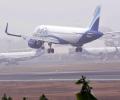
IndiGo, India's largest airline, has recently increased charges for several ancillary services, including infant travel and unaccompanied minors, citing rising operational costs and higher fuel prices. Domestic infant travel charges have risen to Rs 3,000, while unaccompanied minor services are now Rs 5,999 for domestic and Rs 12,999 for international flights.

An IndiGo flight from Patna to Lucknow sustained damage to its nose section upon landing at Lucknow airport on Wednesday. All 104 passengers were safe, and the damage was discovered by the airport team post-landing. An investigation is underway, with lightning during adverse weather being a preliminary possibility.

Air India secured the 57th spot worldwide, marking a notable rise from its 84th position in 2025. IndiGo, meanwhile, slipped to 61st, compared with 39th place a year earlier.

IndiGo, India's largest airline, experienced intermittent issues with its core reservation platform on Friday, affecting online services for customers. This follows a similar disruption on Wednesday, though the airline stated the issues have since been resolved.

IndiGo will have 74 of its 224 weekly international departures affected while Air India will relocate 33 of its 100 departures.
An IndiGo flight carrying 229 passengers from Goa to Delhi was forced to make an emergency landing back at Manohar International Airport after one of its engines failed mid-air. The aircraft landed safely, and alternative arrangements were made for the passengers.
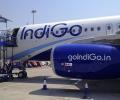
The Mumbai-Delhi air route, the country's largest and most lucrative, is witnessing an intense battle for supremacy between IndiGo and the Air India group, with Akasa Air emerging as a significant third player, according to recent data.

Willie Walsh, former IATA Director General and CEO of British Airways, has officially taken charge as the CEO of IndiGo, India's largest airline, with a mandate to drive global expansion and operational excellence.
Civil Aviation Minister Kinjarapu Rammohan Naidu stated that no decision has been made regarding allowing Delhi and Mumbai airport operators to own and run airlines, as the government is carefully considering the implications of relaxing cross-ownership restrictions, including potential conflicts of interest and the need for more airlines.

Air India has extended the cancellation of flights to Saudi Arabia until October 20, 2026, due to escalating tensions and Houthi attacks in the region. IndiGo and Akasa Air have also extended their flight suspensions to Saudi cities, with passengers offered full refunds.
Domestic air passenger traffic in India decreased by 4.80 per cent in July 2026 compared to the previous year, reaching 1.20 crore, with major airlines experiencing a drop in load factor, according to DGCA data. Despite the overall dip, IndiGo and Air India Group increased their market share.
IndiGo Managing Director Rahul Bhatia has stated that the airline has 'taken all the necessary steps' to learn from the operational disruption faced in December last year, while outlining a long-term vision focused on customer trust, international expansion, and establishing India as a global aviation hub.

India has advised its nationals in Saudi Arabia to 'remain calm and vigilant' due to an evolving security situation, including drone and missile attacks by Yemen's Iran-backed Houthi rebels, which recently resulted in the death of an Indian national and injuries to several others.
Follow these guidelines to reduce the potential of a power bank fire on a flight.


India's domestic air passenger traffic experienced a 6.34 per cent year-on-year decline in August, reaching 121.26 lakh passengers, according to data released by the Directorate General of Civil Aviation (DGCA).
Aviation watchdog DGCA has issued a warning letter to IndiGo for lapses in compliance with norms for handling dangerous goods and has asked the airline to review the relevant training programme to include more practical exercises as well as operational scenarios.

IndiGo, India's largest airline, has placed a record-breaking order with CFM International for over 1,000 LEAP-1A engines to power its 510 Airbus A320 neo family aircraft. This significant deal, announced at the Farnborough International Airshow, also includes extensive MRO support and material services, reinforcing CFM's commitment to the Indian aviation market.

Mumbai International Airport is set to reduce 265 weekly international flights from October 25 to facilitate the redevelopment of Terminal 1. This move, impacting 46 airlines including IndiGo and Air India, has raised concerns among carriers and global aviation bodies like IATA, who advocate for collaborative planning over mandated relocations.
IndiGo, India's largest airline, reported a net loss of Rs 238 crore for the June quarter, primarily attributed to a significant surge in fuel prices and operational constraints stemming from the West Asia conflict.

Air India has announced the appointment of Tewolde Gebremariam, former CEO of Ethiopian Airlines Group, as its new Managing Director and Chief Executive Officer, replacing Campbell Wilson. This strategic appointment comes as the airline navigates expansion amidst significant challenges.
Tewolde Gebremariam, a seasoned aviation professional with extensive experience at Ethiopian Airlines, has been named the new Chief Executive Officer and Managing Director of Air India. He is tasked with leading the airline's ambitious five-year transformation plan, Vihaan.AI, aimed at achieving significant growth and profitability, marking him as the second foreign national to helm Air India under Tata Group ownership.
The Airports Authority of India has received a request for a waiver from contractual restrictions that prevent airport concessionaires and their group entities from holding equity in scheduled airlines, Minister of State for Civil Aviation Murlidhar Mohol confirmed in the Rajya Sabha. This comes amid reports of the Adani group's interest in the airline business, despite their denial.

India has issued a new advisory for its citizens in Saudi Arabia, urging them to follow local instructions, stay indoors during aerial attacks, and be aware of ongoing flight disruptions. The advisory follows an October 10 attack on Riyadh airport that injured several Indians, with some still hospitalised. Major Indian airlines have cancelled flights to Saudi cities until late October, impacting travellers and Umrah pilgrims.
Multiple flights, including three Varanasi-bound domestic flights and one international Dubai-Pokhara flight, were diverted to Lucknow's Chaudhary Charan Singh International Airport due to adverse weather conditions at their original destinations. All diverted flights subsequently resumed their journeys.

Boeing has identified a software issue in some 737 MAX planes that could disengage the automated flight guidance system after a missed landing approach. The company is developing a permanent solution and has advised operators on interim procedures. Indian carriers Air India Express and Akasa Air operate these aircraft, with Akasa Air stating no impact on their safety.
India has issued an advisory for its nationals in Saudi Arabia, urging them to stay indoors during aerial attacks and follow local instructions, amidst ongoing tensions and drone/missile attacks by Houthi rebels. The advisory follows an attack on Riyadh airport that killed one Indian national and injured several others, leading to flight suspensions by Indian carriers.

India's duopoly in the domestic skies -- where IndiGo and Air India collectively control over 90 per cent of the market -- is highly skewed, leaving very little room for new players

China Southern Airlines is set to resume its Guangzhou-New Delhi passenger service from September 21, ending a six-year suspension. This move is part of a broader normalisation of India-China relations, following recent high-level diplomatic meetings and previous flight resumptions by other carriers.
GE Aerospace is set to significantly increase its supply chain spending in India, targeting USD 400 million by 2030, up from USD 200 million in 2025. This expansion reflects the company's commitment to India's burgeoning aviation market, driven by substantial aircraft orders and the strategic importance of its manufacturing and technology centres in Pune and Bengaluru.

An IndiGo aircraft at Kolkata airport was struck by lightning during a thunderstorm, causing a temporary power outage. All 141 passengers and six crew members were safely deboarded and later departed on an alternate flight. Two ground staff received minor treatment.

Economy passengers are paying more year-on-year while business travellers are paying less.
French aerospace and defence major Thales views India as a highly dynamic market for avionics, with significant growth potential as Indian airlines expand their fleets. The company, which has a substantial presence and MRO facilities in India, is also exploring opportunities to replicate India-developed solutions globally and sees increased use of AI in development.

Despite reporting a weaker-than-expected net loss of Rs 2,536 crore for Q4FY26, largely due to a significant non-cash forex loss, analysts remain optimistic about IndiGo's long-term prospects, citing strong demand trends, a favourable pricing outlook, and strategic cost-control measures.
IndiGo, India's largest airline, reported a net loss of Rs 2,536.9 crore in the March quarter of fiscal year 2025-26, primarily attributed to a significant foreign exchange loss of approximately Rs 8,100 crore, the impact of December flight disruptions, and expenses related to new labour laws.

The flights have been cut across sectors, particularly on high-demand, high-frequency routes, according to a DGCA statement.
Air India, IndiGo, and Air India Express are temporarily reducing their domestic flights due to surging jet fuel prices and lower travel demand. The airlines are cutting flights by 10 to 22 per cent in the coming months.

Noida International Airport has officially commenced flight operations with an IndiGo flight from Lucknow making the inaugural landing, followed by a takeoff to Lucknow, carrying 172 villagers whose land was acquired for the project.
