
Both Hindu and Muslim parties involved in the Gyanvapi dispute have rejected the Supreme Court's mediation initiative, stating that the matter should be resolved through judicial adjudication. This decision came during a session at a Varanasi court, where both sides expressed their preference for a court verdict over an out-of-court settlement.

Efforts to resolve three major religious site disputes in Uttar Pradesh - Gyanvapi, Sri Krishna Janmabhoomi-Shahi Eidgah, and Sambhal Shahi Jama Masjid - through out-of-court settlements have failed, with all parties insisting on judicial adjudication.
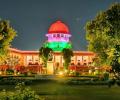
The Supreme Court has agreed to list for final hearing the pleas challenging the validity of certain provisions of the Places of Worship (Special Provisions) Act, 1991.

The Gyanvapi issue has been at the centre of a long-drawn legal battle with the Hindu side arguing that the Gyanvapi mosque was allegedly built on the remains of a pre-existing temple, while the Muslim side has contested the claim.
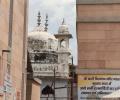
The Supreme Court's 2023 order refusing to stay a scientific survey at the Gyanvapi Mosque complex has sparked claims over several other disputed places of worship across India. This has led to several court cases, including one in Mathura where a survey of the Shahi Idgah Mosque complex was ordered, and another in Ajmer where a claim was made that a Shiva temple existed within the dargah of Sufi saint Moinuddin Chishti. The article also highlights a dispute over the Bhojshala in Madhya Pradesh, which Hindus consider a temple and Muslims consider a mosque. The Supreme Court's order has reignited debates about the Places of Worship (Special Provisions) Act, 1991, which prohibits the change of character of religious places as they existed on August 15, 1947.
'If at all human beings require a religion, the future religion will be Hinduism.'

The Anjuman Intezamia Committee Thursday filed a counter-affidavit before the Allahabad HC in the matter seeking a survey of the Wazukhana (or ablution area) by the ASI.

A bench headed by Chief Justice D Y Chandrachud also sought response of priest Shailendra Kumar Pathak Vyas by April 30 on the plea of the mosque committee.
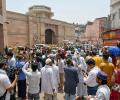
The Supreme Court on Friday agreed to hear an appeal of the Gyanvapi management committee against an Allahabad High Court order which held that lawsuits for "restoration" of a temple where the mosque stands in Varanasi are maintainable.
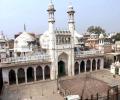
A Varanasi court on Thursday fixed February 28 as the date for hearing the Gyanvapi Masjid committee's plea against the recently allowed puja in a cellar of the mosque, the Hindu side counsel said.

Days after the district court ruled that a priest can perform prayers in a cellar of the Gyanvapi mosque in Varanasi, a petitioner on Monday filled a plea seeking an ASI survey of all other closed basements in the complex.

The petitions filed by the Anjuman Intezamia Masjid Committee (AIMC) and the Uttar Pradesh Sunni Central Waqf Board had also challenged a Varanasi court order of April 8, 2021 to conduct a comprehensive survey of the Gyanvapi mosque.
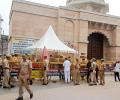
The Allahabad high court reserved its judgment on Friday in a petition challenging the maintainability of a suit seeking 'restoration' of a temple at the site of the Gyanvapi mosque in Varanasi.

A Varanasi court on Tuesday fixed February 15 for the hearing of a petition seeking a survey of all closed basements in the Gyanvapi mosque complex by the Archaeological Survey of India (ASI).

A Varanasi court on Thursday reserved till October 21 its order on a plea seeking inclusion of the Gyanvapi mosque's 'wazookhana' in the ongoing Archaeological Survey of India (ASI) survey of the mosque complex.

One of the main litigants from the Hindu side Jitendra Singh Visen has announced that he and his family are withdrawing from all cases related to the Gynavapi issue due to alleged 'harassment'.
The court fixed December 11 as the next date of hearing in the matter, Yadav said.

A bench of Chief Justice DY Chandrachud and Justices JB Pardiwala and Manoj Misra will hear the plea of Anjuman Intezamia Masajid Committee.

He also appealed to the Muslim side for a peaceful solution for all these three temples.
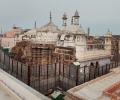
Advocate Madan Mohan Yadav, who is representing the Hindu petitioners, said, "The report in sealed cover was placed before the court by the ASI's standing counsel Amit Srivastava."
Earlier on Wednesday, the district court ruled that a priest can perform prayers before the idols in a cellar of the Gyanvapi Masjid, a significant development in the legal battle over the mosque adjacent to the Kashi Vishwanath temple.
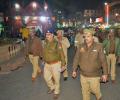
Shops in Varanasi's Muslim-dominated areas remained closed and the police sounded an alert in the entire district ahead of the Friday namaaz, following the district court order to allow Hindu prayers in a cellar of the Gyanvapi mosque.

In the appeal filed before the high court, it has been pleaded that the Hindu side's suit itself is barred by order 7 rule 11 of the Civil Procedure Code, Naqvi said.

The ASI is carrying out a scientific survey of the Gyanvapi mosque premises, next to Kashi Vishwanath temple here, to determine whether the 17th-century mosque was constructed over a pre-existing structure of a Hindu temple.
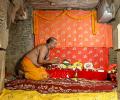
The plea filed by the Hindu side has stated that the cellar's roof is very old and weak.
Jain told reporters that copies of the survey report consisting of 839 pages were made available to the parties concerned by the court late Thursday evening.
District judge A K Vishvesh on Friday directed the ASI to conduct a detailed scientific survey -- including excavations, wherever necessary -- to determine if the mosque in Varanasi in Uttar Pradesh is built upon a temple.
In a major victory for the Hindu side, a Varanasi court on Wednesday allowed Hindu devotees to offer prayers inside the 'Vyas ka Tekhana' area inside the Gyanvapi mosque complex.

The Allahabad high court on Friday did not give any immediate relief to the Gyanvapi Masjid committee which had challenged the order of the Varanasi court allowing Hindu prayers in a cellar of the mosque.
The Archeological Survey of India (ASI) on Wednesday urged a Varanasi court not to make its Gyanvapi mosque complex survey report public for at least four more weeks, according to the lawyer for the Hindu side.
The Archaeological Survey of India (ASI) team surveyed the northern wall, the dome and basements of the Gyanvapi complex here on Tuesday, the fourth day of the court-mandated exercise to determine if the mosque was built over a temple.
The court said the parties shall give an affidavit to keep the report with them and not make it public after getting the report.

The committee had filed the petition in the high court against the order of the district judge of Varanasi in September last year that turned down its objections on the maintainability of the suit filed by the five Hindu women.
The Allahabad high court on Wednesday adjourned to February 12 the hearing on a plea challenging the Varanasi district court order allowing Hindu prayers in a cellar of the Gyanvapi mosque in Varanasi.
The Muslims side said that they have received the letter and it will be deliberated upon in a meeting.
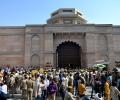
The ASI had on Wednesday urged the court not to make its Gyanvapi complex survey report public for at least four more weeks, citing the December 19 judgment of the Allahabad high court.
According to the counsel for the Hindu side Madan Mohan Yadav, the ASI sought more time due to non-availability of the technical report.

Amidst the controversy over the Gyanvapi Mosque complex in Varanasi, Uttar Pradesh Chief Minister Yogi Adityanath has said that labelling Gyanvapi as a mosque complex will only lead to controversy and that the Muslim side should accept its 'historical mistake' and offer a solution.
The ASI on Wednesday urged the court not to make its report public for at least four more weeks.
Prayers were performed in a cellar of the Gyanvapi mosque in Varanasi on Wednesday night following court orders allowing the resumption of a practice said to have been discontinued three decades back, Kashi Vishwanath temple trust president said.
