
The Varanasi district court on Tuesday ordered that seven cases of the same nature related to the Gyanvapi dispute will be heard together.

The Varanasi district court arrived at the decision of allowing 'puja' in a Gyanvapi mosque cellar in "haste", the All India Muslim Personal Law Board (AIMPLB) said on Friday, asserting it would pursue the matter right up to the Supreme Court.

The two men had been instructed to carry out a terror strike in a crowded Delhi location on Diwali, targeting a prominent mall and a public park.

After hearing arguments in the matter, Chief Justice Pritinker Diwaker posted it for further hearing on Wednesday.
Rakhi Singh has accused the Muslim side of destroying Hindu symbols on the Gyanvapi premises and demanded protection of the entire complex in order to ensure that these symbols are not lost.

Muslim body Anjuman Intezamia Masjid committee on Thursday moved the Supreme Court against the Allahabad high court order permitting an Archaeological Survey of India (ASI) survey at the Gyanvapi mosque.

The Archaeological Survey of India on Sunday conducted scientific tests of the area under the three domes of Gyanvapi mosque in Varanasi on the third day of the scientific survey to determine if the mosque was built over a temple.
The ASI, which was to submit the report of the survey by October 6, now has time till November 6 to do so.

A bench comprising Chief Justice D Y Chandrachud and Justices J B Pardiwala and Manoj Misra asked the ASI not to take recourse to any invasive act during the survey.
'During the nine years of BJP rule, not a single temple has been reconstructed.' 'They might have constructed the Ram temple as it is an emotional issue. But they are not much interested in issues like heritage.'
The committee argued that only the Waqf Board has the right to hear any matter pertaining to the mosque.
The suspected ISIS operatives are both named Adnan -- one from Sadiq Nagar in Delhi and the other from Bhopal, a senior police officer said.
The main litigant in the Gyanvapi-Shringar Gauri complex case has sought "permission for euthanasia" from President Droupadi Murmu, alleging that her fellow petitioners are spreading false propaganda to defame her.
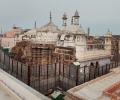
The Supreme Court on Wednesday revived a Gyanvapi panel plea it inadvertently disposed of on July 24 while staying an Archaeological Survey of India (ASI) survey on the mosque premises to determine if it was built upon a temple.
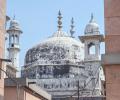
The plaintiffs submitted that the exact nature of the 'Shivling' can be determined after removing the artificial/modern walls/floors surrounding it and by undertaking a survey of the entire sealed area by excavation and using other scientific methods.
The Gyanvapi mosque management committee has objected to the Archeological Survey of India (ASI) seeking eight more weeks to complete the survey of the complex.

The high court has dismissed the Gyanvapi mosque management committee's appeal.
To maintain law and order, he said, the entire city has been divided into sectors which have been allocated police force as per their requirement.

The Allahabad high court on Thursday allowed the Archaeological Survey of India (ASI) to conduct a scientific survey at the Gyanvapi premises in Varanasi to determine whether the 17th-century mosque has been constructed over a pre-existing structure of a Hindu temple.

The ASI told the court on November 2 that it might take some more time to compile the report, along with the details of the equipment used in the survey work, following which additional time till November 17 was granted for the submission of the document.

A 30-member Archaeological Survey of India team halted a survey here of the Gyanvapi mosque -- just hours after beginning the exercise Monday morning -- following a Supreme Court order.

It also directed the Hindu parties to file their replies within three weeks on the appeal filed by the management committee of the Anjuman Intezamia Masjid challenging the Allahabad High Court order on the appointment of a survey commissioner.

Five members of the Muslim side also participated in the survey. Its advocate Tauheed Khan said advocates of the Intezamia Masjid Committee Akhlaq and Mumtaz accompanied the survey team.

The Archaeological Survey of India (ASI) began working on a scientific survey of the Gyanvapi premises in Varanasi on Friday to determine whether the 17th-century mosque was constructed over a pre-existing structure of a Hindu temple.

The Supreme Court agreed to hear on Friday a plea challenging the Allahabad high court order of conducting a 'scientific survey', including carbon dating, to determine the age of a 'Shivling' which was said to have been found at the Gyanvapi mosque complex in Varanasi.
Mishra said that the court has fixed July 7 for the next hearing.

The committee takes care of 22 mosques, including the Gyanvapi Masjid, in the city and it has been presenting the Muslim side in the Gyanvapi mosque-Shringar Gauri complex case.
The court will also decide on a plea by the Gyanvapi mosque management committee (Anjuman Intezamiya Masjid) seeking removal of Ajay Kumar Mishra as the court commissioner for the survey, lawyers said.

Glimpses of the Ma Shringar Gauri temple, located near the outer wall of the Gyanvapi mosque (western gate), in Varanasi on Wednesday, April 2, 2025. The doors are opened only once in a year -- on the fourth day of Chaitra Navratri.
The lawyers of the Hindu side sought time for filing their counter-objection, following which the court of district judge A K Vishvesha fixed November 11 as the next date of hearing in the matter.
The court had on May 24 fixed May 26 for hearing on the maintainability of the Gyanvapi-Shringar Gauri complex case.
In a relief to the Hindu side, the Supreme Court on Friday refused to stay the Allahabad high court order allowing the Archaeological Survey of India (ASI) to conduct a scientific survey at the Gyanvapi mosque complex to determine if the 17th-century structure was built upon a pre-existing temple.
A fast-track court on Monday postponed till November 17 its judgment on a plea seeking permission to allow the worship of a 'Shivling' claimed to have been found inside the Gyanvapi mosque complex in Varanasi.

The Muslims protested against the survey even as the mosque management committee moved a Varanasi district court seeking the appointment of a different court commissioner.
The Allahabad high court on May 12 ordered determination of the age of the structure claimed to be 'Shivling' using modern technology.
Jitendra Singh Visen, president of Vishwa Vaidik Sanatan Sangh, however, refused to divulge the reason behind the decision.
The plea also sought carbon dating of the 'Shivling' to ascertain its age.
The Allahabad high court on Wednesday fixed December 5 for further hearing on a Gyanvapi masjid management's revision petition challenging a Varanasi court order on the maintainability of a plea seeking permission to offer regular prayers to idols of deities in the mosque complex.
The Supreme Court on Monday agreed to hear a plea on a dispute involving the Gyanvapi mosque in Varanasi on November 10.

The apex court will hear the matter amidst an important development with a Varanasi court on Monday directed the district administration there to seal the spot of the survey inside the complex where allegedly 'Shivling' has been found by the surveying team.
