
Former Central Command chief David H Petraeus suggests the US and Iran are likely to extend their ceasefire beyond the initial two-week period, citing willingness from both sides to continue negotiations.

Direct plans of mutual fund schemes added nearly 21 million individual investor folios in FY26 (as of February), surpassing regular plans' 15 million net additions, marking only the second time direct plans have outpaced regular plans in annual folio growth, despite turbulent equity markets.

Bhabanipur is set to be the focal point of the 2026 West Bengal assembly elections, with Mamata Banerjee and Suvendu Adhikari preparing for a high-stakes political battle. The constituency will witness rival processions and symbolic gestures as both parties aim to assert their dominance.

The core issues to be settled -- access to Hormuz, Israel's aggression in Lebanon, the question of Iran's nuclear programme, sanctions relief and compensation -- are thorny enough to require weeks of patient negotiation. The most likely outcome of the opening sessions is that both sides take the measure of each other, establish what is and is not negotiable, and return home without having broken anything. That would count as progress.

Trump may strike. He may announce productive talks and extend again. He may do both at the same time. Iran will not open the Strait on someone else's terms, so no matter what happens, that problem will remain unsolved. And the IRGC will still be collecting its $2 million toll from every ship bold enough to ask permission to pass.

The purge in Washington does not pause the war. Strikes continue, Hormuz remains closed, and Brent crude is still dancing around $109 a barrel. For India, the command chaos in the Pentagon is another layer of uncertainty piled on five weeks of conflict that was already straining every buffer Delhi has.

In a further escalation of the assault on the heavily fortified site, a missile strike also reportedly targeted the "helipad" at the embassy, as documented by Al Jazeera.

The pause gives the US time to breathe, to regroup, to move its expeditionary force into position without risk of interception along the way. It gives Iran nothing -- on the ground, attacks against its infrastructure continue apace. Prem Panicker in his must read daily blog on the Gulf War.

By appearing to privilege ideological affinity over strategic balance, India risks eroding the trust painstakingly built across West Asia. Once the perception takes hold that India's friendship is conditional and transactional, rebuilding credibility will be difficult, warns Amberish K Diwanji.
It is important for India to pay close attention to both the tone and substance of authoritative remarks coming out of Pakistan, explains former foreign secretary Shyam Saran.

In a region increasingly shaped by competition and coercion, such collaboration strengthens security without confrontation, builds capacity without dependency and promotes order without domination, points out Dr Kumar.

Sensitive issues remain. Water sharing of the Ganga and Teesta rivers. Treatment of minorities, particularly Hindus. Border management. Trade imbalances. Connectivity projects.What happens next will shape not just bilateral ties, but the balance of South Asia itself, points out Ramesh Menon.
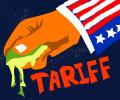
India must focus on building enduring national capabilities and economic sovereignty in the face of shrinking space for rules-based trading, anti-immigrant stance, weaponization of energy sources and growing use of export controls in critical sectors, the Economic Survey said on Thursday.

Indian security agencies have continued efforts to reinforce the Siliguri Corridor through improved infrastructure, faster mobilisation capability and diversified connectivity routes to the north east.
A trade deal makes sense only if it is fair and reciprocal. If the cost is strategic dependence or loss of policy space, waiting is the wiser option, asserts Ajay Srivastava.

Insurance intermediaries who receive disproportionately high commissions are likely to see a decline in their payouts, post the new Insurance Amendment Bill. The new Bill gives the Insurance Regulatory & Development Authority of India (Irdai) the power to disgorge unlawful gains made by insurers and intermediaries as well as the right to limit commissions paid to intermediaries.

For decades, the Siliguri Corridor was treated as a geographical vulnerability to be quietly managed. Today, it has emerged as a focal point of eastern geopolitics.

Kabir told reporters that "nearly 3 lakh people will gather across 25 bighas near Moradighi on Saturday", adding that religious leaders from several states had confirmed their presence.
'If all of us (all the 57 Shiv Sena MLAs) stand together we can change the dynamic. We are not afraid of anyone.'
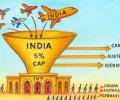
Trump's proposed policy limits undergraduates from any one country to 5% at select top US universities, raising concerns for Indian aspirants eyeing elite colleges.
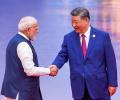
'Xi is an individual led by a harder calculus and would scoff at melting over gestures.' 'That we did not know this was our failure,' asserts Aakar Patel.

'However, we must implement a tit-for-tat approach -- reciprocating their conduct with precision.' 'If they demonstrate respect, we respond accordingly. If they adopt hostile positions, we mirror that hostility with equal intensity.'

The Bloomberg report suggests that this backchannel communication from President Xi has laid the groundwork for a broader thaw in relations. This overture has since translated into a series of tangible diplomatic actions leading up to the upcoming Shanghai Cooperation Organisation (SCO) summit.
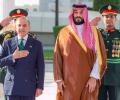
'Saudi-Pak defence pact is to anchor the defence and security of Saudi Arabia and not Pakistan, per se, with Islamabad being the junior partner.'

'If I have to go back, I would rather go back now because I don't want to face that situation when I'm in my 40s.' A young couple's journey through immigration uncertainty reveals not just the human cost of policy announcements, but a surprising rekindling of love for the homeland left behind.
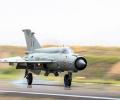
The MiG-21 episode demonstrates that procurement is always strategic.
Choices about what aircraft to acquire, who builds them, who supplies the spares, who trains the pilots and technicians are decisions with political consequences lasting for decades.
'If you fire two missiles at Jamnagar or ten missiles there, what do you think India will do?' 'India will fire 500 missiles on Tarbela and Mangla, destroy the Sukkur Barrage, destroy Karachi port.' 'When you start issuing threats, it should be with some sense and sensibility.' 'You shouldn't just shoot your mouth off just because you have appointed yourself field marshal.'

'If Washington has to balance Chinese power, she will have to turn to the third biggest power in the world which is India.' 'The United States and India will have to work together in order to keep Chinese ambitions in check.'
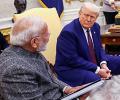
To those who ask, "Is all this really worth it? Why can't domestic demand fill the gap?", it is important to remind them that only 13 economies since the Second World War have grown at 7 per cent or more for 25 years -- like India needs to. They all had one thing in common: Strong export growth underpinned by strong global engagement, explains Sajjid Z Chinoy.
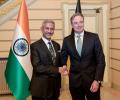
The era where nations thrived through rigid alignments is giving way to an age where the connective State defines power. For India, that era has arrived, points out Dr Nishakant Ojha.

The foreign degree no longer sells itself, families are doing the math, and for many, the numbers just don't add up.

India and the US have collaborated through the past one month on launching a powerful satellite; are commencing joint production of GE Aerospace's F414 jet engines in India; India is participating in a massive three week-long military exercise in the Western Pacific, observes Ambassador M K Bhadrakumar.

rediffGURU Dr Shyam Jamalabad offers advice on how to improve your dental health and hygiene.
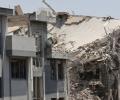
An inconclusive end to this war will pose high risk for Netanyahu of a cascading demand for a regime change in Israel, predicts Ambassador M K Bhadrakumar.

'India has gone some way to meeting its objectives because it has established a deterrent value that Pakistan will have to take into account when it plans future terrorist attacks.'

'India for its survival has to change its doctrine from no first use to a pre-emptive attack in case of any hostile move by Pakistan,' recommends Colonel Anil A Athale (retd).
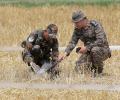
'India enjoys conventional superiority, but nuclear deterrence imposes clear boundaries.'
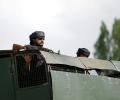
'Whatever we do, the purpose will be to re-establish deterrence.'
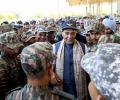
'Pakistan is no longer a front-burner issue for America.'
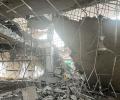
'India won't take anything from Pakistan lying down.'
 © 2026 Rediff.com - Advertise with us - Disclaimer - Privacy Policy - Sitemap - Feedback - About us - Terms of use - Grievances