
India and the US have collaborated through the past one month on launching a powerful satellite; are commencing joint production of GE Aerospace's F414 jet engines in India; India is participating in a massive three week-long military exercise in the Western Pacific, observes Ambassador M K Bhadrakumar.
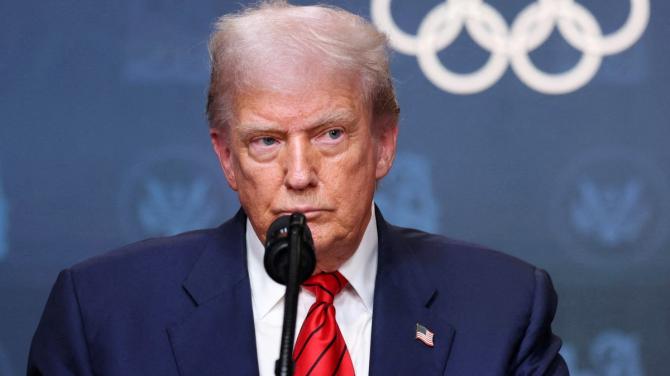
The American Nobel laureate Pearl S Buck handed down to the aspirant-Nobel American President Donald Trump a golden maxim but he seems oblivious of it -- although his life is made of a surfeit of fiction.
She wrote in her gripping historical novel The Living Reed: A Novel of Korea, 'It is easy to destroy but hard to create. Remember that, when you want to destroy something.'
Trump tore up two sacred covenants during his first presidency in 2018 out of sheer petulance or plain arrogance -- the US-Iran nuclear deal [known as the JCPOA] and the Intermediate-Range Nuclear Forces Treaty [INF Treaty].
Both were catastrophic decisions stemming out of his campaign promises in 2015 and in both cases, he gave them the colouring of reactive decisions by putting the blame respectively on Iran and Russia on patently spurious grounds.
Trump tried to establish that Iran violated the JCPOA but the Iranians scrupulously adhered to the treaty terms all the way till the US withdrawal, despite the coy refusal on the part of the Europe and the US to reciprocate, as expected of them.
Today, Trump is desperately keen to renegotiate the JCOPA but insists that Iran cannot have rights to enrich uranium as allowed under NPT.
Trump ordered air/missile strikes to 'obliterate' Iran's nuclear sites while talking peace. Unsurprisingly, Iran refuses to hold talks with the US.
The ensuing impasse is fraught with dangerous consequences. Most experts anticipate an eruption of military conflict sooner rather than later. In a nutshell, Trump achieved nothing by destroying the JCPOA and in the process engendered a dangerous regional security climate.
When we look at Trump's dismantling of the INF Treaty, an even more dismal picture emerges.
The 1987 INF Treaty (external link) marked the first time the superpowers agreed to reduce their nuclear arsenals, eliminate an entire category of nuclear weapons, and employ extensive on-site inspections for verification.
China criticised Trump's unilateral move to bury the INF Treaty as an attempt to 'seek military and strategic edge'.
Europeans were unhappy that they were not consulted by Trump although, as the then German foreign minister Heiko Maas put it, 'a piece of Europe's security has been lost'.
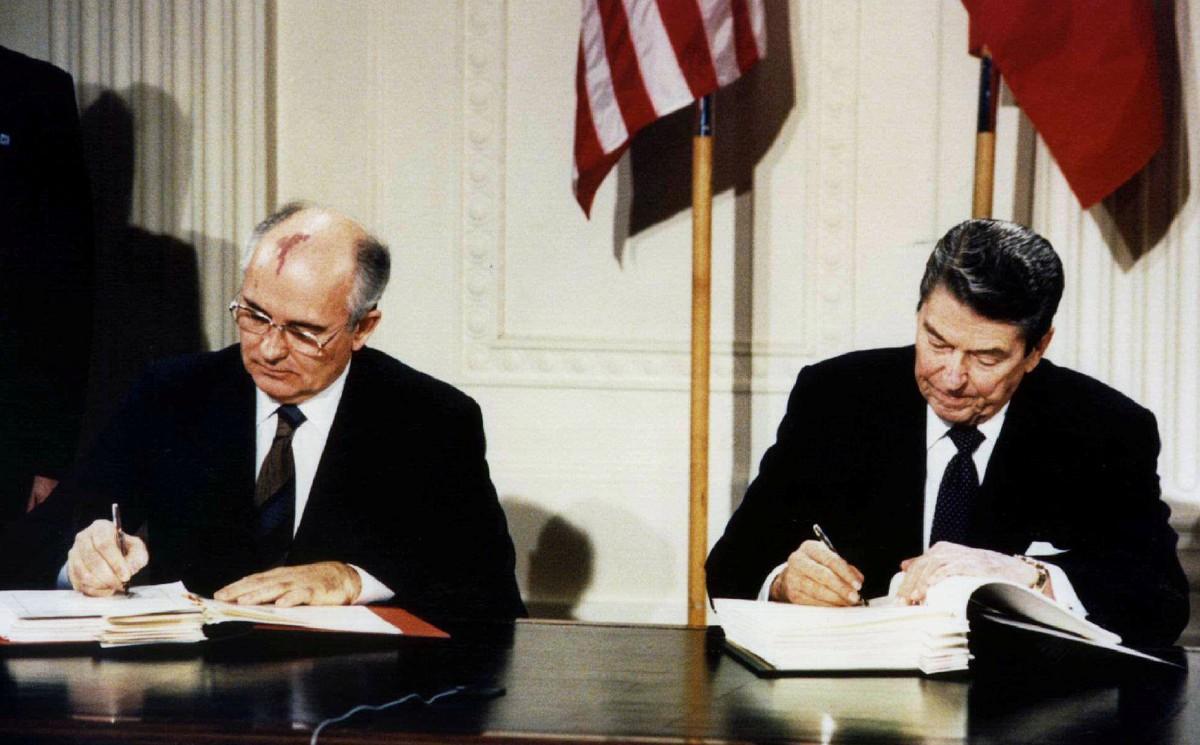
Trump's move was predicated on the false notion that post-Soviet Russia was in no position to challenge the US and, therefore, the time had come to realise the elusive American dream of 'nuclear superiority' that would establish US global hegemony in an American Century.
When he abandoned the INF Treaty in 2018, Trump was only following the footfalls of his predecessors per the strategic calculus set by the US Deep State.
It is worthwhile to listen to an interview by the Russia-hating late US senator John McCain with CNN some nine years ago that caught the spirt of the times. Curiously, McCain could foresee almost in its entirety the present-day proxy war in Ukraine within a complex Western strategy to dismember Russia -- NATO build-up; Ukraine as the launching pad for bleeding Russia; weaponisation of western sanctions against Russia; disruption of Russia's income from oil exports, etc.
Suffice to say, this hawkish interview by a pillar of the US Deep State will today be an eyeopener for the decision makers in Delhi, reminding them that history has far from ended.
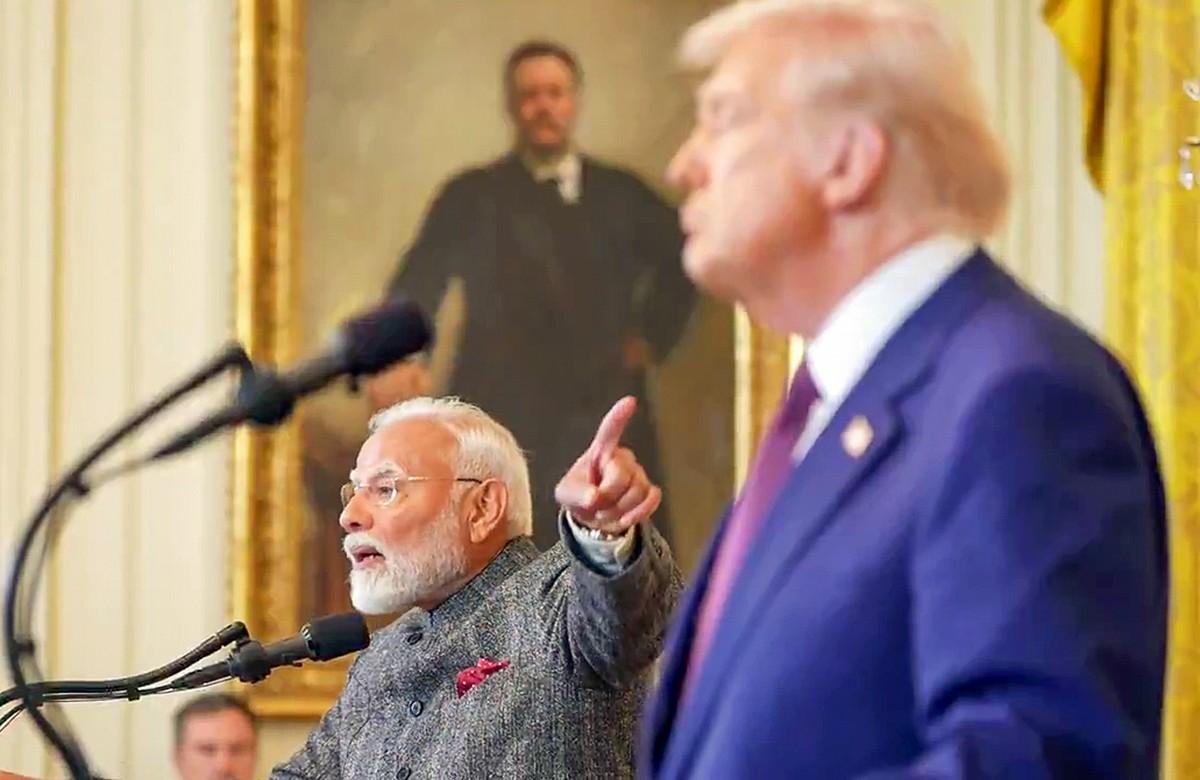
Alas, the Indian discourses on what Trump is doing to the Modi government today ought to be seen as part of a big picture.
On the contrary, a former foreign secretary deliberated on the paradigm as simply one of how to 'stand up to Trump'.
Aren't we are making croaking sounds from a well and our left hand doesn't even know what the right hand is doing?
India's strategic community is blissfully unaware of the country's first-ever participation in the US-led Talisman Sabre 2025 multilateral drills (external link) currently under way in Australia and Western Pacific.
Put differently, a proper awareness is lacking that Russia's oil trade with India is only one minor template of the West's containment strategy against Russia -- albeit a consequential one.
The Russian foreign ministry announced on August 4, 2025 that Moscow will no longer abide by its self-imposed moratorium on the deployment of ground-launched intermediate-range and short-range missiles (per the INF Treaty) since Washington not only refuses to reciprocate with a similar moratorium but is doubling down on forward deployment and employment of such weapons.
The MFA statement in Moscow (external link) hardly received attention in Delhi -- although India's travails with Trump are quintessentially emanating from the developments in Eurasia.
The Russian statement puts the Talisman Sabre 2025 multilateral drills in proper perspective on the following lines:
- 'The United States and its allies have not only openly declared plans to deploy US ground-launched INF-range missiles in various regions, but have also made significant progress in the practical implementation of their intentions.'
- 'Pentagon is forming and locating specialised units and commands in respective regions to enable the forward deployment and employment of such weapons; the requisite infrastructure is also being prepared to suit these purposes.'
- 'With regard to the Asia-Pacific, under the pretext of training activities, a Typhon mid-range missile system was employed this July in Australia during live-fire exercises as part of the Talisman Sabre 2025 multilateral drills. In the course of these drills, the US military personnel also deployed a Dark Eagle hypersonic intermediate-range system, marking its first overseas appearance. It was openly declared that this deployment was undertaken to project power, as well as underscored that such systems are rapidly re-deployable.
- 'Obviously, such weapon systems will be used as part of any integrated operations jointly planned by the US and allied militaries within relevant alliances and coalitions.
- 'In aggregate, the above-mentioned steps of the collective West entail the formation and augmentation of destabilising missile capabilities in the regions adjacent to the Russian Federation, creating a direct threat to the security of our country.'
That said, the Russians are having the last laugh. They have a perfect scenario now, thanks to Trump, to deploy their advanced Oroshnikov intermediate-range ballistic missile, characterised by its reported speed exceeding Mach 10 (12,300 km/hr) and multiple warheads, in the European theatre against which the Pentagon has no defence.
Putin has announced that Oreshnikov has entered serial production, which means its deployment will be keenly felt all over the world for a foreseeable future.
Trump's burial of the INF Treaty has turned out to be a strategic mistake of Himalayan proportions that is deeply troubling for thoughtful western expert opinion (external link).
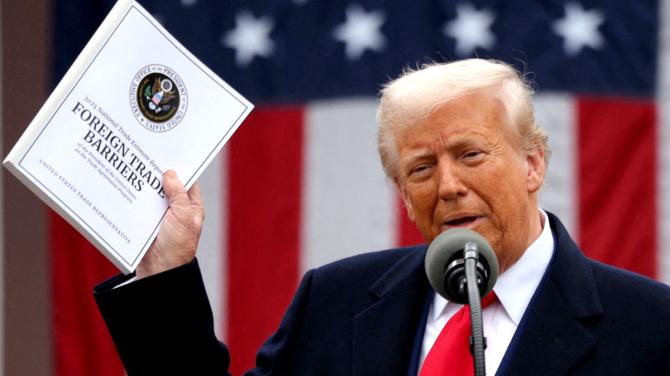
So, how does the strategic paradigm appear through the Indian looking glass? Simply put, Trump is berating Modi almost on a daily basis that: i. He mediates India's peace with Pakistan; ii. India contributes to Russia's war effort in Ukraine by buying oil and weaponry from Russia; iii. The US will impose punitive tariffs unless India terminates its business ties with Russia; and, iv. India must open its domestic market to American products or face curbs on its exports to the American market.
However, on the other hand, India and the US have collaborated through the past one-month period on launching a powerful satellite with a range of capabilities; are commencing joint production of GE Aerospace's F414 jet engines in India for its combat aircraft; and, India is participating in a massive three week-long military exercise in the Western Pacific that is geared to facilitate permanent deployment of advanced American missiles in the Asia-Pacific and put in place a US-led alliance system and coalitions with regional States, which are directed against Russia.
With the Indian participation in Talisman Sabre 2025 drills, all four Quad countries are now on board the US' grand strategy in the Western Pacific.
Quad is transforming as a military alliance. The Modi government should prepare well to give Trump a rapturous welcome when he arrives for the Quad summit.
Ambassador M K Bhadrakumar served the Indian Foreign Service for 29 years.
Feature Presentation: Rajesh Alva/Rediff








 © 2025