
General M M Naravane attended the Army Day parade for the first time as the Army chief. The Army Day is celebrated on January 15 every year to mark Lieutenant General K M Cariappa taking over as commander-in-chief of the Indian Army in 1949 from General Francis Butcher, the last British commander-in-chief of India.

The two sides have also agreed for a joint mechanism to verify the progress in the disengagement process through delegation meetings as well as using unmanned aerial vehicles.

Threatened with contempt action against the Indian Army and its chief Manoj Mukund Naravane by the Supreme Court over non-compliance of its earlier orders, the defence force agreed on Friday to grant permanent commission to all of its eligible women officers.
The commanders will also deliberate on the overall situation in Jammu and Kashmir besides delving into issues having national security implications, they said. However, the main focus will be on the situation in eastern Ladakh where Indian and Chinese troops are locked in an eyeball-to-eyeball face-off in Pangong Tso, Galwan Valley, Demchok and Daulat Beg Oldie, the sources said.
"Numerous rounds of talks have taken place with the Chinese counterparts to deescalate the situation without compromising on India's stand of 'complete disengagement and immediate restoration of status quo ante'," the defence ministry said.

The army chief said that India needs to broaden its understanding of national security and must examine non-traditional threats like pandemics "de-novo" as they have the potential to inflict severe damage on the country. "We need to act and prepare ourselves accordingly."
The military preparations underway show that the PLA may undertake operations this summer to achieve whatever objectives they could not achieve last May, asserts Jayadeva Ranade, the distinguished China expert and retired RA&W officer.
The military is 'totally prepared to stand up to the demands made by the government and the people.'

Gen Naravane said a "befitting response" was given to the "conspiracy" to make unilateral changes on the border and that the sacrifice of the Galwan heroes in eastern Ladakh will not go waste.
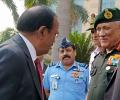
Gen Bipin Rawat's appointment, first as army chief superseding two other army commanders, and then as CDS, was the consequence of his close personal rapport with National Security Advisor Ajit Doval. Now, with General Rawat gone and nobody named to replace him as CDS, it is evident that no other top military officer enjoys that relationship with Doval, observes Ajai Shukla.
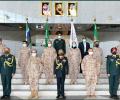
'The attacks made clear to all the Gulf States that Pakistan was the nursery and sanctuary of extremist violence and that this violence threatened all the countries in the region.'
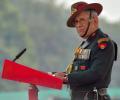
The CDS will have a significant role in higher defence planning and operational aspects of India's nuclear arsenal.
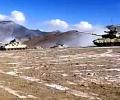
Once the tanks roll back, a zero-based assessment of future equations with China is necessary. Given the conflict situations that China is imposing on India time and again, the red, amber and green lines of interactions with China need to be laid down and communicated in no uncertain terms, asserts Srikanth Kondapalli, the leading China expert.
'Putting tanks on the Ladakh border is not enough to combat China, what is needed to ensure resilience against any cyber-attacks or attacks in outer space or China flexing its economic muscle, as it did with Australia.'
We do not know, because there has been no discussion, no transparency and most likely no real thinking on this matter at our end, observes Aakar Patel.

'The PLA has continued to do exercises and drills and recently carried out air exercises with fighter jets.'

The future can only get better if we continue to break silos and work as integrated teams focussed on promoting national interests, recommends Sanjeev Nayyar.

'India should be adequately prepared for further Chinese mis-adventures at any time in the next few years.'
The seventh round of military talks between India and China held on Monday was "positive and constructive", and both sides agreed to earnestly implement the understanding reached by their leaders to not turn differences into disputes, a joint statement by the two armies said on Tuesday.

Through the past 18-month period, peace has prevailed in the disputed border regions, which was immensely helpful in the difficult situation that the country was passing through, observes Ambassador M K Bhadrakumar.

'It is astonishing that such a serious issue be handled in so casual and cavalier a fashion, but this has become what is expected of this government,' observes Aakar Patel.
As the China factor enters the body politic of India with greater potency, its consequences will certainly be far-reaching, note Harsh V Pant and Vinay Kaura.

The navy finds itself fighting for relevance, with navy planners lamenting that its share of the budget has dropped dramatically.
The creation of a CDS has got the head right. Issues that were not talked about for years are now being discussed, points out Ajai Shukla.

We must seize the opportunity provided by the COVID-19 crisis to kick-start indigenous research efforts, recommends Colonel Anil A Athale (retd).
'For the moment in Eastern Ladakh, it is unlikely there will be any more escalation of this conflict,' observes Colonel S Dinny (retd) who served as Commanding Officer of an infantry battalion deployed in the Pangong Tso area.

Until last month more than two-thirds of the Indian Army was deployed against Pakistan. Of 14 army corps, just four-and-a-half faced China, while more than twice that number was ranged against Pakistan.

'Is the appointment of a CDS likely to achieve the creation of battle-ready, tri-service military commands, from the current 17 single-service commands?', asks Ajai Shukla.
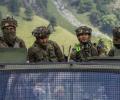
'A breakthrough in eastern Ladakh leading to disengagement and creation of a buffer zone will obviate the need of military deployment through the winter months ahead,' notes Ambassador M K Bhadrakumar.

Concern is growing among healthcare experts who believe that if people do not follow the lockdown or social distancing seriously, the situation can quickly go out of control.
'God will give you your due.' 'I don't want my due from people.'

'If you behave like a nail, the adversary will behave like a hammer.'
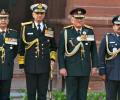
As India's international role expands, so must our capabilities, says Brigadier Gurmeet Kanwal (retd).
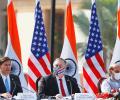
China is now the most significant strategic concern in Washington, as in most of the world's capitals, especially the democracies. Today, strategic autonomy has acquired a sharper definition: To ward off the Chinese challenge to India's territorial integrity, sovereignty and regional stature, observes Shekhar Gupta.

'The COVID-19 pandemic must push the military into a long-term reconsideration of its primary challenges.' 'There must be greater emphasis on humanitarian aid and disaster relief including the management of contagious illnesses and impending crises caused by climate change,' notes Ajai Shukla.

General Naravane's UAE and Saudi Arabia visits communicate India's long awaited arrival in the domain of integrated foreign policy where the diplomatic and the military domains both complement each other much more substantially, observes Lieutenant General Syed Ata Hasnain (retd).

Indian Army officers, serving and retired, will tell you that the one thing that makes the Indian soldier singularly unique is his josh and jazba.

'They know that India is no pushover.' 'We have to be extremely vigilant, remain ready and keep strengthening our positions.' 'We have to be militarily strong, whatever be the cost.'

'It could have moved from the use of small arms to artillery fire.' 'Anything could have happened like what happens on the LoC.'
'India is not the India of 1962. We are not carrying that baggage of history anymore.'
 © 2026 Rediff.com - Investor Information - Advertise with us - Disclaimer - Privacy Policy - Sitemap - Feedback - About us - Terms of use - Grievances