Denying the Pakistani investigators access to the Pathankot base on operational grounds would not, the government felt, compromise national security, reveals Rajeev Sharma.

'We often assume that Ayodhya is Ram's property and Hastinapur is Yudhishthira's property when, in fact, it is their responsibility.' 'A king exists, as per Hindu philosophy, only to ensure that other people's property is safe,' explains Devdutt Pattanaik.

'India's counter-terrorism network needs to keep potential jihadists under a scanner all the time,' says Rajeev Sharma.

India should put a check on its cheque book diplomacy with Nepal. Nepal must be made to bear the costs of its strategic provocations.

How the two South Asian neighbours will interact with each other in the coming months will be decided by the two prime ministers in Washington.
'The Modi government can't ignore the political symbolism that the perceived perpetrators are being allowed inside an Indian military base which was attacked by their puppets, either by tacit approval or compliance of the Pakistani military establishment,' says Rajeev Sharma.
'It is possible elements within the Pakistani establishment felt bad about eating humble pie and wanted to avenge the humiliation through a terror attack.' 'After all, lodging an FIR in Pakistan about the Pathankot attack amounted to an admission of Pakistani involvement,' says Rajeev Sharma.

'The bad dream can turn into a ghoulish nightmare for the BJP if the Gujjars in Rajasthan and the Patels in Gujarat, both BJP-ruled states, were to fish in troubled waters and relaunch their respective agitations for quotas in government jobs,' warns Rajeev Sharma.

A Chinese government newspaper accuses the Modi government of manipulating economic data to project the 'myth' that India has caught up with the US and surpassed China.

This is the first time since the Pathankot terror attack that the country's top security czar has spoken about India's strategy in dealing with terror, says Rajeev Sharma.

'If the Congress allows Arunachal Pradesh to slip out of its control, then it sends negative signals to its leaders and allies across the country,' says Rajeev Sharma.
'Now is the time for India, our biggest neighbour and oldest friend, to bring the full array of international policy instruments to bear.'

On his recent visit to China, the President made eminently sensible suggestions to improve relations except that they can't work in the present atmosphere.
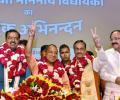
'It is for the first time that Modi has chosen someone as CM who happens to be a mass leader, a polarising figure, a vote catcher, a powerful orator and a Hindu mascot all at once -- qualities usually associated with Modi,' points out Rajeev Sharma.

'The Modi government knows that much cannot be expected of Pakistan till the Kulbhushan Jadhav issue is resolved,' says Rajeev Sharma.
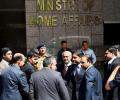
If Pakistan finally and officially rules out the possibility of an Indian investigation team's reciprocal visit for the Pathankot probe, it should also be seen as the Chinese "hidden veto" in the India-Pakistan bilateral context, says Rajeev Sharma.

'An authoritative source in the government tells me that India has emerged as the net security provider of the Maldives,' says Rajeev Sharma.
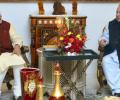
'The Pakistani game plan in making its envoy in India to perform the last rites of a fledgling peace process is madness with a method.'

India was U Thaung Tun's first port of call after his appointment, which should intrigue China and Pakistan, says Rajeev Sharma.

It is because of the feared domestic backlash that the Modi government is now stepping up pressure on Pakistan to accommodate Indian interests.

The Indian intelligence brass may have snared a key Pakistani spy and Jadhav's arrest is Pakistan's way of getting even with India, says Rajeev Sharma.

If Pakistan allows India to send its investigation team to question Azhar it would take the India-Pakistan camaraderie to a new level, says Rajeev Sharma.

It is quite likely that the Pakistanis are cleverly using the Jadhav card to derail the outcome of the JIT process.

'The Trump administration is on the same page as India that Pakistan is not the solution, but the problem itself,' says Rajeev Sharma.

'It is not possible for New Delhi to take sides between Beijing and Washington.'

'While China has been hiking its defence spending, India has done precious little in implementing the Manmohan Singh government's decision of raising a 90,000-strong China-centric Mountain Strike Corps,' says Rajeev Sharma.

US admiral's suggestion for a revival of a strategic maritime quadrilateral with Japan, Australia and India leaves China livid, says Rajeev Sharma.

'The BJP has everything to lose if it performs poorly in UP. It dreads a repeat of Bihar,' says Rajeev Sharma.
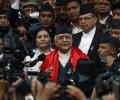
Within the SAARC framework, says Rajeev Sharma, Nepal's strategic importance cannot be overestimated as Nepal is a key member of the sub-SAARC group India has created to bypass Pakistan.

'If all goes well, Modi will visit the Maldives later this year. But two Indian concerns remain unaddressed: President Yameen's intentions about Mohammad Nasheed and China,' says Rajeev Sharma.

'There is a very serious terror threat to India in the run-up to Republic Day on January 26 and Beating the Retreat on January 29,' says Rajeev Sharma.

'In this Spy versus Soldier game,' says Rajeev Sharma, 'the two sides will size up each other like never before.'

'The Indian strategy is to rope in the powerful Pakistan army in the negotiating spectrum. This can be done at the level of General Janjua, a former army commander,' reveals Rajeev Sharma.

India's unpopularity coincides with China lengthening its shadows in Nepal, says Rajeev Sharma.
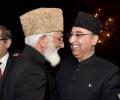
'The Modi government has turned the basic fundamentals of its Pakistan policy on its head.' 'It means an admission that its hands-off-Hurriyat policy was flawed and it is ready to engage with Pakistan without minding if the Kashmiri separatists talked to the Pakistani government,' says Rajeev Sharma.

'The Pakistani side was so cocksure of itself that it had come to the table with a pre-set agenda -- an agenda of unilateralism, knowing full well that nothing was going to come out of these talks,' says Rajeev Sharma.

'China knows the best way of twisting the knife in its dealings with India: By launching a major incursion into Indian territory,' says Rajeev Sharma.

Modi has been wrong in thinking that he can influence people and win friends in Pakistan through his high-octane brand of diplomacy. That is why his Pakistan policy that started off on the high note of saree-and-shawl diplomacy now threatens to end with a whimper with cloak-and-dagger games, says Rajeev Sharma.
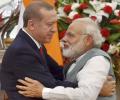
Turkish President Recep Tayyip Erdogan's has been trying to mollycoddle India with sweet nothings while having a very close relationship with Pakistan.
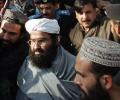
'India is currently waging a diplomatic war against Pakistan, to convey to Islammabad that each terror attack on India will come with huge diplomatic costs,' says Rajeev Sharma.
 © 2026 Rediff.com - Investor Information - Advertise with us - Disclaimer - Privacy Policy - Sitemap - Feedback - About us - Terms of use - Grievances