
The BRICS summit in New Delhi brings together leaders from major emerging economies to address global challenges like trade disputes, geopolitical upheavals, and the economic impact of conflicts in Ukraine and West Asia. India, as chair, aims to position BRICS as an economic growth engine, focusing on the Global South's food, energy, and supply chain security. The summit also highlights the grouping's expansion and its growing influence in global governance.

The Indian men's team continued its fine performance, defeating Spain 3-1, with World champion D Gukesh showing the way with a very clean victory over former world championship challenger Alexei Shirov.

India's current account deficit could widen to 1.7 per cent of GDP, or about $71 billion, if crude oil prices stay above $90 a barrel for a significant part of the second half of FY27.

Israel's Defence Minister Israel Katz declared that the Israeli military will not withdraw from its security zones in Lebanon, Syria, and Gaza, directly opposing the newly announced American-led diplomatic framework with Tehran. National Security Minister Itamar Ben-Gvir further asserted Israel's sovereignty, stating, "Trump's agreement does not bind us. Israel is not subject to the United States, and we are an independent and sovereign nation!"

US President Donald Trump on Sunday said that the Israeli strikes on Lebanon's capital of Beirut "should not have happened", warning that such escalation could jeopardise the peace agreement with Iran to achieve a complete solution to the West Asia conflict, which, according to him, is within reach.

The Kuwaiti Army reported intercepting hostile missile and drone attacks, while tensions escalate between the US and Iran with reported strikes and confrontations near the Strait of Hormuz.

Iran has dismissed US President Donald Trump's assertion that Iran was responsible for a drone attack on Indian ships in the Strait of Hormuz as 'simply baseless'. The Iranian embassy stated that Trump's comments were an attempt to deflect attention from recent US military strikes on merchant vessels in the Gulf of Oman, which resulted in the deaths of three Indian mariners.

US President Donald Trump has accused Iran of bringing down an American military helicopter near the strategically vital Strait of Hormuz, prompting a strong declaration that the United States 'must' respond to this significant incident.
A comprehensive schedule detailing the events and timings for Indian athletes participating in various sports at the Asian Games, including badminton, boxing, canoeing, equestrian, fencing, hockey, kabaddi, rowing, soft tennis, sepaktakraw, shooting, squash, swimming, table tennis, weightlifting, and wushu.

Pakistan's army chief held a series of engagements with Iranian leaders in Tehran as regional diplomacy remained in focus.

Iran's soccer team arrived in the United States for the first time at this World Cup on Sunday, landing at Los Angeles International Airport and holding a press conference on the same day that a peace deal between the two nations was announced.

Iran's Islamic Revolutionary Guard Corps (IRGC) has claimed to have targeted and destroyed hangars of F-35 fighter jets and struck 21 American air and naval bases across West Asia and the Gulf region, including the US Army's command and control centre at the Al-Azraq base in Jordan and the US Fifth Fleet headquarters in Bahrain.

Indian benchmark stock indices, Sensex and Nifty, extended their winning streak for a third consecutive day, driven by positive global market trends and a significant softening of crude oil prices following a peace deal between the US and Iran.

The Indian men's and women's chess teams delivered strong performances at the Chess Olympiad in Samarkand, with the men's team defeating Spain 3-1 and the women's team securing an identical 3-1 victory over Mongolia. World champion D Gukesh led the men's success with a clean win against Alexei Shirov, while Arjun Erigaisi also contributed significantly. In the women's section, B Savitha Shri and Divya Deshmukh were instrumental in their team's win.
Indian boxers are undergoing intensive training at a multinational camp in Patiala, featuring international medallists, before heading to Japan for a final preparatory stint ahead of the Asian Games. The team aims to build on its strong performance at the Commonwealth Games, despite anticipating tougher competition from boxing powerhouses like Uzbekistan and Kazakhstan at the upcoming continental event.

Mexican President Claudia Sheinbaum said on Monday her government agreed to allow the Iranian national football team to stay in Mexico during the World Cup, adding that the United States did not want to host the team.
A comprehensive schedule outlines the participation of Indian athletes across various disciplines at the Asian Games on September 23, including key events in badminton, boxing, shooting, hockey, and weightlifting, with several athletes vying for qualification and medal rounds.

US lawmakers are racing to amend the Russia sanctions bill before recess. One amendment specifically names India, China, and other countries as potential targets for 100% tariffs due to their oil trade with Russia. Another significant amendment proposes to scrap the tariff section entirely, while others address presidential waiver powers and aid to Ukraine.

A potential agreement between the United States and Iran, including a comprehensive ceasefire and gradual lifting of US sanctions, may be announced soon, according to reports. The agreement aims to de-escalate tensions and establish a framework for resolving disputes.

Iranian media reported an exchange of fire between Iranian and US forces near the Strait of Hormuz, amidst a shaky ceasefire between the two countries.
US President Donald Trump announced that a deal to end the war with Iran would be signed on Sunday, with the strategic Strait of Hormuz immediately becoming 'open to all'. This follows indications from Pakistan that negotiations were in their final stages, though Iran has yet to comment on the timeline.

Seattle's LGBTQ community members say they hope that this Friday's World Cup "Pride Match" between Egypt and Iran, two countries where homosexuality is criminalised, can be an opportunity to change minds.

China emphasises proper handling of differences and a long-term perspective for bilateral ties ahead of President Xi Jinping's visit to India for the BRICS summit and talks with Prime Minister Narendra Modi. The visit aims to stabilise relations following the 2020 Ladakh standoff and strengthen BRICS cooperation.

Chinese President Xi Jinping is in New Delhi for the 18th BRICS Summit, where he is scheduled to hold bilateral talks with Prime Minister Narendra Modi. This visit, his first to India in nearly seven years, comes amidst efforts to normalise India-China relations following the 2020 Eastern Ladakh standoff and is expected to have significant implications for bilateral ties and BRICS cooperation.

A lesson for India is to clearly define objectives beforehand, so that the adversary or other parties do not attempt to mitigate them midway.

Iran's football federation announced its World Cup ticket allocation has been revoked just days before the tournament, leaving many fans unable to attend.

Pakistan Prime Minister Shehbaz Sharif announced that a US-Iran peace deal is on the verge of finalisation, potentially within the next 24 hours, marking a significant diplomatic breakthrough after months of intense negotiations.
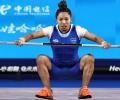
India experienced a day of mixed fortunes at the Asian Games, highlighted by Mirabai Chanu's historic silver medal in weightlifting, ending a long wait for an Asiad medal. The nation also secured several bronze medals in skeet shooting, men's badminton, and soft tennis. While Chanu shone, the shooting contingent faced challenges, and other sports like wushu, table tennis, squash, women's hockey, and kabaddi saw Indian athletes advance or dominate their events.

India's total goods trade with BRICS nations more than doubled from FY21 to FY26, reaching USD 417.5 billion, but a significant surge in imports, particularly from China and Russia, has caused India's trade deficit with the bloc to more than triple, reaching USD 226.1 billion.

'It is a blunt and dangerous attempt to pressure India to sign BTA on one-sided terms.'

The United States military and Kuwaiti air defence forces successfully intercepted multiple Iranian ballistic missile and drone attacks targeting Kuwait and Bahrain, with Iran's state broadcaster claiming American military installations in Kuwait were deliberately targeted.

New photographic evidence and a Pentagon inspector general's report confirm extensive damage to US military installations across the Middle East due to Iranian missile and drone strikes. The report details billions in financial costs, structural losses to hundreds of buildings, and damage to dozens of aircraft, contradicting previous assertions about US military readiness and ordnance stockpiles. The conflict also led to disruptions in the Strait of Hormuz, impacting global oil prices.

Indian benchmark equity indices, Sensex and Nifty, extended their rally for a fifth consecutive session, driven by optimism surrounding a potential US-Iran peace deal and a significant drop in crude oil prices. Despite hawkish remarks from the US Fed, investors remain hopeful that easing energy prices could temper inflationary pressures.

Iran's Foreign Ministry spokesperson Esmaeil Baghaei has accused the United States of frequently changing its positions and complicating efforts to reach an understanding, stating that these shifts disrupt diplomatic processes and prolong negotiations. He also linked any potential agreement with the US to an immediate ceasefire in Lebanon, accusing Israel of escalating conflict to derail diplomatic efforts.

Iran will play their final World Cup warm-up behind closed doors in Turkey on Thursday before departing for their tournament base in Mexico on Saturday.

Indian benchmark equity indices, Sensex and Nifty, traded marginally higher in early deals despite cautious global cues stemming from elevated crude oil prices due to geopolitical uncertainties and a sharp fall in US markets. Track Sensex, Nifty on August 21, 2026.

The US military carried out 'self-defence strikes' targeting Iranian missile launch sites and boats near the Strait of Hormuz, even as President Trump announced progress in ceasefire negotiations, stating Iran's enriched uranium will be 'turned over' or destroyed.

US President Donald Trump is reportedly considering military action against Iran due to stalled negotiations and Tehran's approach to its nuclear issue, according to CNN sources. Divisions within the Trump administration have emerged over the next course of action, with some officials advocating for a more aggressive approach through targeted military strikes.

Japan hosted a vibrant opening ceremony for the Asian Games in Nagoya, showcasing its technological advancements and cultural heritage. The event, themed 'Harmonic Heart Beat', welcomed 11,000 athletes from 45 nations, despite prior logistical challenges.

The Gulf countries on Monday welcomed a peace deal reached between the US and Iran to end their conflict and called for protection of maritime routes and freedom of international navigation, including the uninterrupted flow of traffic through the Strait of Hormuz.
