
Ukrainian President Volodymyr Zelenskyy addressed the UN General Assembly, accusing Russia of using citizens from over 40 countries, including India, to fight in its war against Ukraine. He urged these nations to prevent their citizens from being drawn into the conflict, highlighting that Ukraine has taken prisoners of war from these countries and that many have perished. Zelenskyy also called for limiting trade with Russia to cut off its war funding and criticised the weakening of sanctions.

Iran has conveyed seven conditions to the United States through Qatari mediators for starting negotiations to end the ongoing war, while warning that Tehran is prepared for a "decisive war" if Washington rejects its demands.

Kargil War veteran Group Captain Amit Kumar Gupta was allegedly attacked with an iron rod by a parking attendant in Gurugram, sustaining a serious head injury and fractured elbow. Gupta claims the hospital's MLC report is false and police assistance has been lacking, while an FIR has been registered against unknown accused.

External Affairs Minister S Jaishankar stated that India is in continuous dialogue with both Ukraine and Russia, seeking ideas and suggestions to mitigate or cease the ongoing conflict. Following his visit to Kyiv, Jaishankar reiterated India's stance that the war must end through dialogue and diplomacy, emphasising that trade decisions like oil purchases are not the solution to the conflict.

External Affairs Minister S Jaishankar visited Kyiv, reiterating India's readiness to assist in ending the Ukraine-Russia war. He emphasised that solutions would not emerge from the battlefield and highlighted Prime Minister Modi's call for an end to the conflict. Discussions also covered humanitarian aid, the impact on commercial shipping, and bilateral trade, with Jaishankar inviting his Ukrainian counterpart to India for further talks.

Prime Minister Narendra Modi urged Russian President Vladimir Putin to move from 'endless war to the end of war' in Ukraine, emphasising that a peaceful resolution is humanity's shared priority.

The ongoing US conflict with Iran has cost the Trump administration an estimated $45.1 billion, according to a Pentagon estimate provided to the US Congress on Friday, CNN reported, citing two sources familiar with the matter.

Chinese President Xi Jinping addressed the BRICS summit, urging the bloc to play a significant role in achieving peace and tranquillity in West Asia and the Gulf region. He highlighted BRICS' growth over two decades, its efforts in tackling global challenges, and its steadfastness in safeguarding the interests of the Global South. Xi called for opposing the Cold War mentality, strengthening multilateralism, and promoting cooperation in emerging domains like AI, as China prepares to chair the next summit.

Prime Minister Narendra Modi met Iranian President Masoud Pezeshkian at the SCO summit, advocating for dialogue and diplomacy to resolve the West Asia conflict and expressing India's desire to expand and diversify trade with Iran. Pezeshkian, in turn, urged India to leverage its contacts to promote peace.

US President Donald Trump has expressed strong support for the India-Middle East-Europe Economic Corridor (IMEEC), citing the necessity to move energy infrastructure away from Iranian checkpoints following attacks in West Asia. He made these remarks during a multilateral meeting with the Gulf Cooperation Council at the UN General Assembly, emphasising the corridor's role in overcoming regional challenges.

Ahead of President Vladimir Putin's visit to India for the BRICS summit, Russia has expressed support for New Delhi's peace initiatives to resolve the Ukraine conflict. Discussions between Putin and PM Modi will cover defence, energy, technology, and the repatriation of Indian nationals from the Russian military, alongside addressing trade and investment ties.

Fighting in Yemen has intensified as Houthi rebels advance on strategic government-held areas like Marib and Taiz, putting pressure on Saudi Arabia to respond. The conflict is also linked to wider US-Iran tensions affecting shipping in the Strait of Hormuz, with former US President Trump commenting on the situation.

The BRICS summit in New Delhi brings together leaders from major emerging economies to address global challenges like trade disputes, geopolitical upheavals, and the economic impact of conflicts in Ukraine and West Asia. India, as chair, aims to position BRICS as an economic growth engine, focusing on the Global South's food, energy, and supply chain security. The summit also highlights the grouping's expansion and its growing influence in global governance.
Torn between loyalty to their comrades and disillusionment towards the cause for which they are fighting, they are beginning to cave in. Morale has been the casualty, points out Vice Admiral Biswajit Dasgupta (retd).
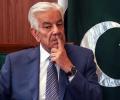
Pakistan's Defence Minister Khawaja Asif has reiterated the nation's unwavering commitment to the Makkah Joint Defence Agreement, underscoring its role in regional security following an attempted drone attack near the holy city of Mecca. The pact, signed by Pakistan, Turkiye, and Saudi Arabia, establishes a framework for collective deterrence against armed attacks.

From Lakshya to Shershaah, revisit 10 Hindi films and shows that captured the courage, sacrifice and emotional cost of the 1999 Kargil War.

For Ukrainian shuttlers Polina Buhrova and Yevheniia Kantemyr, competing at the ongoing World Championships in New Delhi is a way to showcase the resilience of a country battling the invasion by Russia.

Former Army chief General Manoj Naravane asserted that while India's immediate attention is on Pakistan due to terrorism, China will be New Delhi's primary long-term competitor across political, economic, trade, and military domains, necessitating a strong military deterrence alongside dialogue.

United States Secretary of War Pete Hegseth has rejected a CNN report claiming that the Pentagon's missile defence stockpiles have fallen to 'dangerously low levels' amid the conflict with Iran.

How the Indian Air Force's strategic deployment of Mirage 2000 jets and precision laser-guided bombs during Operation Safed Sagar delivered a 'decisive and crushing blow' to the enemy, playing a pivotal role in India's victory in the 1999 Kargil War.

The United States has announced a new round of trade measures against Canada, including bans on Canadian dairy, alcoholic beverages, and motorcycles, and reshuffled existing tariffs. This escalation comes after Canada imposed retaliatory tariffs on American goods. The US administration cited Canada's retaliatory actions as the trigger, contrasting it with other nations that chose negotiation over retaliation.

The US-Canada trade war has escalated sharply, with US President Donald Trump on Monday announcing that tariffs on Canadian cars, trucks, automotive parts and steel imports will be raised to 50 percent from January 2027, following the collapse of trade negotiations between Washington and Ottawa last week.

Heart Of The Beast may not tell a new story, but its old-fashioned storytelling makes these familiar elements work well enough for a heartfelt drama, notes Mayur Sanap.

South Korea's men's hockey team faced confusion when organisers mistakenly played North Korea's banned national anthem before their match, compounding earlier complaints regarding organistional issues at the Asian Games.

Marine war-risk premiums for West Asian shipping routes, particularly the Red Sea corridor, have surged by as much as 200 per cent due to renewed geopolitical tensions, with some high-risk transits seeing increases of over 1,000 per cent, according to industry brokers.

Yash's Toxic continues a fascinating trend in Indian cinema where a single star portrays both father and son, often leading to intense on-screen conflicts.

Ruling TVK legislators are advocating for Tamil Nadu Chief Minister C Joseph Vijay as their Prime Ministerial candidate for the 2029 Lok Sabha polls, a move dismissed by the Congress party which insists on Rahul Gandhi as their choice. This internal conflict within the alliance highlights a growing divide over national political ambitions.

Over 160 Irish sports personalities, including Olympians and former professionals, have signed an open letter urging the Ireland national football team to boycott upcoming UEFA Nations League fixtures against Israel.

China's communist party has expelled two senior military officials, including General Zhang Youxia, the highest-ranking People's Liberation Army officer, for serious discipline and law violations.

Brigadier Basant Kumar Ponwar (Retd), a distinguished veteran of the 1971 Indo-Pak War and the visionary behind India's modern jungle warfare strategies against Maoist insurgency, has passed away at 77. His extensive career spanned over five decades, contributing significantly to national defence through both the Indian Army and police forces, including founding the Counter Terrorism and Jungle Warfare College.

Putin has issued a stark warning to European nations, declaring that any deployment of troops to Ukraine would be met with 'war with Russia'.

On the 25th anniversary of that world-changing morning in New York, it is also for the rest of to reflect. Not only on those who were killed but also on why the event happened and what led to it and what came after it, asserts Aakar Patel.

Actor Arif Zakaria on directors, actors and movies he has done in a remarkable career spanning 40 years.

The US military has lost at least 45 MQ-9 Reaper drones during the conflict with Iran, representing a quarter of its fleet and a significant financial blow. These losses, some due to communication failures, raise questions as India recently signed an agreement to procure 31 of these drones.

The US House of Representatives has advanced a bill that would empower President Donald Trump to impose 100 per cent tariffs on countries, including India, that purchase oil and gas from Russia, and also extend sanctions on Iran. The legislation, which previously passed the Senate, aims to curb Russia's energy revenue amidst the Ukraine conflict.

Track the Asian Games 2026 medal table with live updates, countrywise rankings, gold, silver, and bronze counts. Stay updated on India's performance and overall standings.

US President Donald Trump has expressed interest to his advisers in setting up a meeting with Iranian officials present in New York for the UN General Assembly's 81st session, "if the conditions are right."

US President Donald Trump is expected to sign the Lindsey O. Graham Sanctioning Russia and Iran Act of 2026 later on Friday (local time). A White House official confirmed the development to ANI without revealing further details.

Ollie Robinson reached 100 Test wickets in just 24 matches and now boasts the best bowling average among 100-wicket bowlers since World War I.

Iranian President Masoud Pezeshkian delivered a strong address at the UN General Assembly, rejecting US allegations against Iran and accusing Washington and Israel of aggression and terrorism. He criticised US sanctions, defended Iran's peaceful nuclear programme, and highlighted the Palestinian issue.
