
Amidst escalating regional tensions, Sri Lanka is carefully considering its response after a second Iranian ship requested entry into its waters following a reported US submarine attack on an Iranian frigate near Galle.

Sri Lanka will repatriate the bodies of Iranian sailors killed on the IRIS Dena, which was reportedly sunk by a US submarine. The government is also addressing potential impacts on food security and fuel supplies due to the war situation.

At least 101 people are missing and 78 are injured after a suspected submarine attack on an Iranian naval ship off Sri Lanka's southern coast on Wednesday, Reuters quoted sources in Sri Lanka's Navy and defence ministry as saying.

Major General Amir Hatami, commander-in-chief of the Iranian Army, condemned the attack on the vessel, one of the country's newest warships, which occurred while it was returning from a military exercise.
Sri Lanka has completed the post-mortem examination of Iranian sailors recovered from the frigate IRIS Dena, which allegedly sank after a US submarine attack. Eighty of the 84 bodies have been identified by survivors, and an opposition protest was held against military aggression against Iran.

The Sri Lanka Navy rescued 32 Iranian sailors from a sinking naval ship off the southern coast, while also recovering several bodies. The incident occurred outside Sri Lankan waters but within its search and rescue zone.

Following the death of Iranian sailors in the Indian Ocean, Iran's navy has threatened 'deadly retaliation,' accusing the US of attacking its warship off the coast of Sri Lanka, escalating tensions in the region.
Sri Lanka is deliberating appropriate action after a second Iranian ship sought entry to its territorial waters, following an attack on an Iranian frigate near the island nation. The government is focused on safeguarding lives and regional peace.
Sri Lanka has allowed a second Iranian ship, IRINS Bushehr, to dock at Trincomalee port after it reported engine failure, following the sinking of an Iranian frigate. The move comes amidst heightened regional tensions and a joint US-Israeli attack on Iran.

Tensions escalated dramatically on March 5, 2026, as the United States and Israel launched coordinated strikes on Iran, triggering retaliatory explosions across Tehran, Sanandaj, and beyond.
Amid rising tensions, Iran threatens retaliation after the United States confirms sinking its warship, IRIS Dena, in international waters, escalating conflict in the region.

The vessel sank on March 4, 2026, approximately 20 nautical miles west of Galle, after reportedly being struck by a torpedo from a United States submarine.

It is for the first time that a senior minister has said that Iran requested permission for docking three of its ships in Indian ports.

Top government sources in India have dismissed claims that the Indian Navy provided intelligence to the US regarding an Iranian frigate that was sunk by a US submarine.
India granted emergency docking to an Iranian ship, IRIS Lavan, in Kochi due to technical issues, accommodating its crew amidst regional naval activity and tensions.

The BJP has criticised the Congress party for allegedly prioritising its vote bank and outdated ideologies over India's national interest and citizen safety in its foreign policy approach towards Iran.
'Torpedoes travel at more than 100 kilometres per hour, about 50-60 knots.' 'It must have been a matter of a few minutes before it detonated under the Iranian ship.' 'The Iranian ship would have probably got three, four minutes and wouldn't have known till they actually heard the whirr of the torpedo.'

For weeks, the war skirted the edge of catastrophe without tipping over. Missiles flew, there was much destruction, commanders were assassinated, cities across the Gulf and even in Israel struggled to absorb the shock. But one line held: Energy infrastructure, the arteries of the global economy, remained largely untouched. That is no longer true. Prem Panicker continues his must read daily blog on the Gulf War.

India has firmly denied allegations that the US Navy is using its ports to launch attacks against Iran, reaffirming its commitment to strategic autonomy and non-alignment in international conflicts.

India has expressed condolences over the death of Iran's Supreme Leader Ayatollah Ali Khamenei following a joint US-Israel strike, amidst rising tensions in West Asia and criticism over the sinking of an Iranian warship.

Iran is fighting a different war: Older, slower, and in some ways more dangerous. Iran doesn't need to shoot down an F/A-18. It only needs to make the Strait of Hormuz feel dangerous long enough for insurance markets, shipping companies, and oil futures traders to do the rest. Prem Panicker continues his must-read daily blog on the war in the Middle East.

'To suddenly give the impression of taking a position that is hostile to Iran, or, at least, not friendly to Iran, is not a good thing.'

Russia announces its withdrawal from a self-imposed moratorium on deploying intermediate-range missiles, citing escalating tensions with the US and the repositioning of American nuclear submarines.

A Russian Parliament member claims Russia has enough nuclear submarines to counter US deployments, following statements by Donald Trump and Dmitry Medvedev.

The US Navy aims at stationing 60 per cent of its surface ships in Indo-Asia Pacific region by 2019, catering to various missions including counter-terrorism, a senior naval official said on Monday.
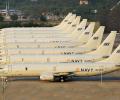
Boeing also won a $4.5-billion contract for 10 C-17 Globemaster III transport aircraft, and will soon start delivery of $3 billion contracts to supply 22 AH-64E Apache attack helicopters and 15 CH-47F Chinook heavy lift helicopters., reports Ajai Shukla.
 © 2026 Rediff.com - Advertise with us - Disclaimer - Privacy Policy - Sitemap - Feedback - About us - Terms of use - Grievances