
The EoI comes at a time when ISRO is working to enhance LVM3's payload capacity to five tonnes in GTO and is also evaluating the procurement of a Russian semi-cryogenic engine for the vehicle's second stage.

India's industrial production expanded at a slower pace of 4.9 per cent in April, primarily due to tepid growth in the energy sector amidst the West Asia crisis. This data marks the first release under the newly revised base year of 2022-23 for the Index of Industrial Production (IIP).

NASA's Artemis II mission, launched on April 1, 2026, marks humanity's return journey to the Moon with four astronauts aboard the Orion spacecraft. Commander Reid Wiseman, Pilot Victor Glover, Mission Specialist Christina Koch, and Canadian astronaut Jeremy Hansen are on an approximately 10-day mission around the Moon. Stunning images from Orion's windows capture breathtaking views of Earth after the historic translunar injection burn.

Steven Spielberg's latest sci-fi offering Disclosure Day attempts to blend political thriller elements with an alien narrative, but despite strong performances and moments of suspense, it ultimately leaves viewers with too many unanswered questions and a somewhat unearned climax laments Sreeju Sudhakaran.
The National Aeronautics and Space Administration (NASA) on Monday said the crew of Artemis II is preparing for a historic lunar flyby that will take humans farther from Earth than ever before.

NASA has announced three missions to the moon as part of efforts to establish a permanent base on the earth's natural satellite. The USD 20 billion plan includes lunar rovers and drones for experiments to help master skills to live and operate in the dangerous environment.

NASA's Artemis II crew offers a rare look at Earth shrinking into space and the Moon coming into view during humanity's return to deep space.

Indian-American scientist Amit Kshatriya's journey from watching rocket launches in Houston to becoming NASA's Associate Administrator is a testament to his dedication and expertise in space exploration.

Glimpses from Artemis II's dramatic return to Earth

Seen from Orion, a solar eclipse unfolds in silence -- the Moon crossing the Sun as Earth hangs in the distance.
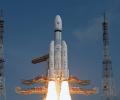
ISRO Chairman V Narayanan has emphasised the critical role of mission operations in ensuring the success of India's expanding space programme. He highlighted this at the Spacecraft Mission Operations conference, noting the importance of sustained teamwork and operational precision, particularly for long-duration missions like Chandrayaan-3 and the upcoming Gaganyaan programme.

US-Indian space company Pixxel has partnered with Bengaluru-based artificial intelligence firm Sarvam to build an orbital data centre satellite.

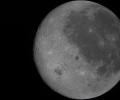
The Artemis II mission has made history as its astronauts journeyed farther from Earth than any humans before, conducting a lunar flyby and observing the moon's far side in unprecedented detail.

A crew of four astronauts boarded their spacecraft for the landmark flight, which represents a major milestone in lunar exploration.

One of the most striking features in this view is the Orientale Basin, a massive impact crater about 600 miles (965 km) wide.

While India's interplanetary ambitions remain significant, the current pace of financial and technical progress raises questions about whether the 2027-2028 timelines can be met.

The mission ferries four astronauts -- NASA's Reid Wiseman, Christina Koch and Victor Glover and Canada's Jeremy Hansen -- onboard the Orion spacecraft for a 10 day lunar flyby. Unlike the Apollo missions that aimed for landing, Artemis II is focused on testing. The crew will evaluate critical systems such as life support, navigation, and communication in deep space -- essential steps before humans can return to the lunar surface.
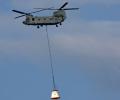
The successful Artemis II mission has boosted confidence in India's upcoming Gaganyaan mission, as both aim to demonstrate similar spaceflight capabilities. Experts highlight the collaboration between ISRO and NASA and the shared training programmes for astronauts.

After days of intense activity, this phase is about staying sharp and ready for the last critical steps.

From selfies to science, astronauts aboard Orion document life, work and discovery during their historic Moon flyby.

'If planets are, as many of your own geophysicists argue, bodies shaped by their own gravity and expressing internal processes, then by that measure, I am not an exception.'

The Axiom-4 mission astronauts, including Shubhanshu Shukla, have returned to Earth after a 20-day mission to the International Space Station. The crew splashed down off the coast of San Diego and are undergoing medical check-ups and rehabilitation.

'Today, as I look at our satellite -- tested, finished and ready to ship -- represents 1,642 days of grit and belief.'
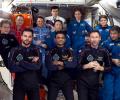
Astronaut Shubhanshu Shukla and the Axiom-4 mission crew successfully returned to Earth, splashing down off the coast of San Diego after an 18-day stay at the International Space Station.

The glimpses from NASA's Artemis II mission capture a historic moment -- preparations for humanity's return to the Moon for the first time since the Apollo 17 Moon landing in 1972.

Shukla said the first few moments after they got shot into the vacuum did not feel that great, but soon it was "an amazing feeling".

ISRO stated that the disengagement of at least one contact -- in both the main and redundant paths -- of a connector led to the failure of NVS-02.

For the first time, there will be an Indian connection to a crewed Moon mission.

India will now face a lower reciprocal tariff of 10 per cent, down from 25 per cent, after US President Donald Trump announced a new global levy on items imported into America in the wake of the Supreme Court verdict against his sweeping duties on several nations.
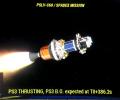
Dubbed as a prelude to ISRO setting up its own Space Station by 2035, the PSLV-C60 mission would also make India join an elite club in achieving this feat which is expected to take place in the coming days.

Astronaut Sunita Williams discusses how space travel changed her perspective on life, emphasizing the unity of Earth and the silliness of human conflicts when viewed from space.

Weighing 6,100 kg, the communication satellite would be the heaviest payload to be placed into the Low Earth Orbit (LEO) in LVM3 launch history from Indian soil.

NASA astronaut Sunita Williams retires after 27 years, completing three missions aboard the International Space Station and setting numerous spaceflight records. She is currently visiting India.

'A solid motor, once ignited, burns until the propellant is exhausted. It cannot simply stop mid-burn,' said a retired senior ISRO official. 'That is what makes this failure puzzling.' Venkatachari Jagannathan reports on the latest PSLV failure.

India is set to take its first steps towards its own human space flight when the uncrewed Gaganyaan mission soars to the skies later this year. Private players in the space sector are also gearing up for launching satellites on home-built rockets.

ISRO is set to launch its communication satellite CMS-03 from Sriharikota. The satellite, weighing 4,410 kg, will be the heaviest launched from Indian soil into a Geosynchronous Transfer Orbit (GTO).
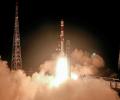
The Indian government has approved the construction of a third launch pad at Sriharikota, capable of sending heavier spacecraft into orbit. This new facility will support India's ambitious space program, including the Gaganyaan human spaceflight mission and a lunar landing. The launch pad will be built at the Satish Dhawan Space Centre and is expected to be operational within four years.

The satellite, weighing about 4,410 kg will be the heaviest to be launched from the Indian soil and into a Geosynchronous Transfer Orbit (GTO), the space agency said. The satellite will travel onboard a LVM3-M5 rocket, dubbed as 'Bahubali' for its heavylift capability.
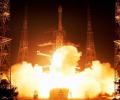
Indian Space Research Organisation is gearing up for one of its busiest times with seven more launches planned this financial year, even as India's first human spaceflight remains scheduled for 2027, its chairman V Narayanan said.
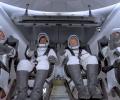
The Axiom-4 has successfully undocked and is making its way back to Earth, as observed by Axiom Space and the National Aeronautics and Space Administration (NASA) on Monday.
