
A brutal crackdown by Pakistani security forces on protesters in Pakistan-occupied Kashmir (PoK) over the last two days has reportedly left more than 30 civilians dead and over 33 injured, government sources said on Wednesday.
Clashes erupted during the first phase of legislative assembly elections in Pakistan-occupied Kashmir (PoK), with the banned Joint Awami Action Committee (JAAC) claiming 14 deaths, a figure disputed by law enforcement. India condemned the elections as an attempt by Pakistan to legitimise its illegal occupation and human rights abuses in the region, while ongoing JAAC protests highlight deep-seated grievances.

'The anger among the PoK public is unlikely to subside against Pakistani State in the near future.'

A Pakistan Army Mi-17 helicopter crashed near Muzaffarabad in Pakistan-occupied Kashmir due to a technical fault, killing all personnel on board. An inquiry has been ordered into the incident, which follows other recent helicopter crashes in the region.

Jammu and Kashmir Chief Minister Omar Abdullah has renewed his call for the restoration of special status and statehood to the region, asserting that the decision to accede to India 80 years ago was correct. He highlighted the importance of upholding India's federal structure and suggested that if Article 370 hadn't been revoked, PoK residents might be seeking reunification. Abdullah also criticised centralised governance models, arguing they erode state autonomy.

Terming protesters in Pakistan-occupied Kashmir (PoK) as "enemies" like India, Pakistan's Defence Minister Khawaja Asif has said there will be no dialogue with them, even as the death toll due to clashes between demonstrators and security personnel rose to 20 on Wednesday.

Shops and markets in Pakistan-occupied Kashmir remained closed following a protest call by the Joint Awami Action Committee (JAAC), amidst reports of over 20 deaths in recent police action. The JAAC, now outlawed, is demanding subsidised flour and electricity, and the abolition of "refugee seats." Authorities have offered a reward for the arrest of JAAC leaders, while the PoK "Prime Minister" has called for negotiations.

Tensions are escalating in Pakistan-occupied Jammu and Kashmir (PoJK) following violent clashes between Pakistani security forces and protestors, resulting in civilian deaths and a communications blackout. The situation has drawn international condemnation, with over 50 British Parliament members expressing concern and a former Indian police chief criticising Pakistan's actions.

An Mi-17 helicopter of the Pakistan Army Aviation crashed near Muzaffarabad in Pakistan-occupied Kashmir, killing all personnel on board. The military attributed the accident to a technical fault during take-off, and a board of inquiry has been ordered. Top Pakistani leaders expressed condolences.

The Union Home Ministry has designated 23 individuals based in Pakistan and Pakistan-occupied Jammu and Kashmir (PoJK) as terrorists under the Unlawful Activities (Prevention) Act (UAPA) for their involvement in infiltration, recruitment, logistics, financing, and operational planning targeting India.

Hamza Burhan, a key suspect in the 2019 Pulwama terror attack, was killed in Pakistan-occupied Kashmir. Burhan, a commander of the Al Badr terror group, had been living undercover as a teacher in PoK.
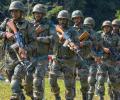
The Indian Army apprehended three individuals attempting to cross the Line of Control (LoC) into Pakistan-occupied Kashmir (PoK) in the Uri sector of Jammu and Kashmir. In a separate incident, a PoK resident was also apprehended after crossing the LoC.

India has strongly criticised Pakistan for its alleged brutality and human rights abuses in Pakistan-Occupied Kashmir (PoK), following reports of police violence against protesters. New Delhi has called on the international community to hold Pakistan accountable, while Pakistan's own human rights body has also expressed alarm over the situation.
A 22-year-old man from Pakistan-occupied Kashmir crossed the Line of Control (LoC) to meet his lover in North Kashmir's Uri sector but was apprehended by the Indian Army.
Delhi Police's Special Cell has arrested a suspected Lashkar-e-Taiba operative from the Ghazipur area. The accused, Shabbir Ahmad Lone, is suspected of working as a sleeper cell member and has alleged links to Pakistan's ISI.

Delhi Police have arrested a suspected Lashkar-e-Taiba (LeT) handler, Shabir Ahmed Lone, from the Ghazipur area. He is believed to have links with Pakistan's ISI and was allegedly involved in a terror module planning attacks in India.
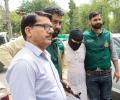
Delhi Police have arrested a suspected Lashkar-e-Taiba (LeT) handler, Shabir Ahmed Lone, in Delhi, uncovering a terror module with links to Pakistan's ISI. Lone is accused of running a network involved in pasting anti-national posters and planning terror activities across India.

In a major counter-terror operation spanning three states, the Delhi Police has dismantled a Lashkar-e-Taiba (LeT) module comprising eight operatives, including seven Bangladeshi nationals who had illegally entered India and procured forged identity documents, an official said on Sunday.
In 2025, India launched Operation Sindoor, a multi-domain combat mission against Pakistan in response to cross-border terrorism. The operation involved precision strikes, military retaliation, and diplomatic measures, marking a significant shift in India's security policy.

Pakistan-based terror groups Jaish-e-Mohammed (JeM) and Hizbul Mujahideen (HM) have begun relocating their bases to Khyber Pakhtunkhwa (KPK) province from Pakistan-Occupied Kashmir in the wake of India's Operation Sindoor, sources said.
The Pakistan Army has vowed to respond to Indian air strikes that targeted locations in Pakistan-occupied Kashmir and Punjab. The strikes were carried out from within Indian airspace, according to the army spokesman, who said that Pakistan will respond at a time and place of its choosing. The army is currently assessing the damage caused by the strikes.
As festivities for Independence Day begin, the Centre on Thursday awarded Vir Chakra to nine Indian Air Force officers for their brave contributions in the service of the nation during Operation Sindoor.
Markaz Taiba of Lashkar-e-Taiba (LeT) in Pakistan's Muridke, one of the nine terror camps struck by the Indian armed forces on Wednesday, is a site where terrorists including Ajmal Kasab involved in the 2008 Mumbai attack were trained, a senior military official said.
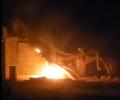
The nine targets struck under 'Operation Sindoor', four in Pakistan and five in Pakistan-occupied-Kashmir, were chosen by the IAF after receiving intelligence inputs about terror camps operating under the guise of health centres to evade detection at these sites, officials said on Wednesday.
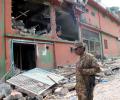
'If destroyed runways and burnt-out hangers look like victory, as the prime minister claimed, Pakistan is welcome to enjoy it.'
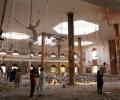
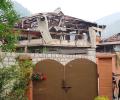
These photographs capture the immediate aftermath in Bahawalpur and Muridke near Lahore -- from damaged buildings to the scrambling of rescue workers.
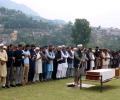
The Pakistan Army and members of the banned Jamaat-ud-Dawah (JuD) of Hafiz Saeed attended the funeral of three persons killed in the Indian military strikes on the terror group's headquarters in Muridke, some 40 kms from Lahore. The funeral prayer was held amid high security, with members of the civil bureaucracy also present. Qayyum, a JuD spokesperson, said the three persons were sleeping in a room adjacent to the mosque when the Indian attack occurred and the mosque was destroyed. He said Malik, Khalid, and Mudassir, believed to be members of the JuD, served as the mosque's prayer leaders and caretakers.

So, when to start, when to stop, how much to apply in terms of time, space and resources, and how much, what is the definition of calibrated action, all these things were something "we kept discussing at every time," Gen Dwivedi recalled.

The Indian Embassy in Beijing has warned China's state-run tabloid Global Times to verify information before spreading it on social media. The embassy accused the publication of spreading disinformation about Indian military strikes on Pakistan's terror infrastructure. The embassy's statement comes after the Global Times published articles based on Pakistan Air Force claims about the strikes, which were later debunked by Indian authorities.

The Indian Army and Indian Air Force jointly conducted the Operation Sindoor in the early hours of May 7, destroying nine terror camps in Pakistan and Pakistan occupied Kashmir in retaliation to the terror attack in Pahalgam.
The bus service was suspended on August 14 in the wake of violence in the Valley after five persons, including Hurriyat leader Sheikh Abdul Aziz were killed in police firing on a rally marching towards Muzaffarabad to end the 'economic blockade' enforced by Sri Amarnath Yatra Sangarsh Samiti in Jammu.
"We have intercepted wireless messages between some militant outfits planning to sabotage the peace process between the two countries by targeting the first Muzaffarabad-bound bus," a top army officer said, requesting anonymity.

Following the precision strikes, India reached out to several world capitals and briefed senior officials about its anti-terror actions against Pakistan.
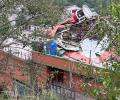
The military also claimed that 40 civilians, including seven women and 15 children, were killed and 121 others injured in strikes by India on the night of 6-7 May.
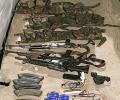
Security agencies have gathered evidence, including Pakistani government documents and biometric data, confirming that the terrorists involved in the Pahalgam attack were Pakistani nationals.
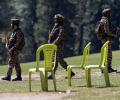
The officials said that intelligence agencies had been alerted about the possibility of a terror attack, but the inputs were utilised at another place, some 90 kilometres away from the site where the attack took place, resulting in a key security lapse.
Army spokesman Lt Gen Ahmad Sharif Chaudhry in a media interaction said at least 26 people were killed and 46 injured in the missile strikes on cities in Punjab and PoK. "The six locations that India attacked last night... Pakistan lost 26 people and 46 were injured," he said.
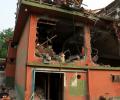
India on Wednesday dismissed claims on Pakistan social media about 'Operation Sindoor', saying the neighbouring country has unleashed a 'full-blown disinformation offensive' with 'lies' and digital theatrics to control the narrative.
