
From guns to handlooms. From forest trails to a public runway. Women who had once been associated with that conflict walked into the spotlight wearing Bastar's traditional textiles.

Senior surrendered CPI (Maoist) leader Tippiri Tirupati alias Devji plans to appeal to Union Home Minister Amit Shah to lift the ban on the outfit. He and other surrendered colleagues aim to work legally on people's issues and have also met Telangana DGP C V Anand regarding restrictions on their movements. Tirupati, a former top commander, surrendered in February due to health issues, vowing to work within a legal framework.

Maoist leader Azad alias Dana Keshab Rao has been released after spending over 15 years in jail as an undertrial prisoner, following his acquittal in all 49 cases registered against him in Odisha and Andhra Pradesh.

Ninety-two remote villages in Chhattisgarh's Bastar region, once a Maoist stronghold, will hoist the national flag for the first time since Independence on August 15. This historic event signifies the end of left-wing extremism in these areas, with the state government leading an extensive campaign to foster national pride.

Chhattisgarh Chief Minister Vishnu Deo Sai on Monday said Maoism was once considered difficult to eliminate, but the menace has now been wiped out, and this year the 'Tiranga Yatra' will also reach remote villages and schools in former Maoist strongholds of the state

Misir Besra, a banned CPI (Maoist) politburo member with a bounty of over Rs 1 crore and wanted in 141 cases, has been arrested from Jharkhand's Dhanbad district. His arrest is considered a significant achievement in anti-Maoist operations in the state.

Security forces in Odisha's Kandhamal district seized a significant cache of arms and ammunition from a Maoist dump. The operation was launched based on information obtained from surrendered Maoists, leading to the recovery of a self-loading rifle, guns, detonators, and a grenade. This follows a similar seizure along the Odisha-Andhra Pradesh border recently.

Senior Congress leader P Chidambaram responded to Prime Minister Narendra Modi's "dimagi naxal" remark by stating he is "proud to be a dimagi naxal". Modi had warned against "dimagi naxals" who manipulate policies and promote violence, despite the success in curbing armed Naxalism. Chidambaram's comment came after Modi's Independence Day speech where he highlighted the threat posed by ideological supporters of Naxalism.

Twenty-seven Maoists surrendered to police in Ranchi, Jharkhand, as part of 'Operation Navjeevan'. The rebels laid down their arms before senior officers, with authorities appealing to others to return to the mainstream.

Gadchiroli police recovered and destroyed items used in the manufacture of weapons, secretly buried by Maoists in a forest area.

Prime Minister Narendra Modi has cautioned the nation about "intellectual Naxals" who he claims are embedded in the system, manipulating policies and posing a threat to society. Speaking on Independence Day, Modi urged citizens to identify and isolate these ideological supporters of Naxalism, highlighting their historical influence in power corridors and their role in promoting violence and anarchy.
An encounter occurred between security forces and Maoists in a forest in Jharkhand's West Singhbhum district on Tuesday morning. No casualties were reported in the incident, which took place during a routine combing operation in the Porahat forest near Kedabir village.

A new satirical Instagram page, 'Dimagi Naxal Party,' has emerged following Prime Minister Narendra Modi's 'dimagi Naxal' remark.

Prime Minister Narendra Modi's 'dimagi Naxal' (intellectual Naxal) remark, made during his Independence Day address, has ignited a significant political debate, with Union Minister Kiren Rijiju clarifying that the comment targets those who support Maoists and separatists, not opposition leaders, while opposition figures like P Chidambaram have embraced the label in defiance.
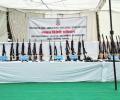
Police in Chhattisgarh's Bijapur district have recovered a cache of explosives, weapons, and equipment allegedly hidden by Maoists in a forested hill area.
Police in Chhattisgarh's Bijapur district have recovered a cache of explosives, weapons, and equipment allegedly hidden by Maoists in a forested hill area.

Security forces in Chhattisgarh's Kanker district have recovered a significant cache of firearms, ammunition, and explosives from Maoist hideouts during search operations.

A woman Maoist leader carrying a bounty of Rs 15 lakh was arrested in Kolkata, while another red rebel surrendered before the police, a senior officer said.
Security forces in Chhattisgarh's Bijapur district have recovered a significant amount of cash, arms, ammunition, and explosives from Maoist hideouts in the forests during search operations.

Brigadier Basant Kumar Ponwar (Retd), a distinguished veteran of the 1971 Indo-Pak War and the visionary behind India's modern jungle warfare strategies against Maoist insurgency, has passed away at 77. His extensive career spanned over five decades, contributing significantly to national defence through both the Indian Army and police forces, including founding the Counter Terrorism and Jungle Warfare College.
Wreaths were laid on the mortal remains of three of the four police personnel killed in an explosion in a gunpowder dump of Maoists in Chhattisgarh's Kanker district.

The Supreme Court has agreed to urgently hear the bail plea of advocate Surendra Gadling, who has been incarcerated for seven-and-a-half years in the 2018 Elgar Parishad-Maoist links case, with the hearing scheduled for next week.

The Chhattisgarh High Court has upheld the acquittal of ten accused in the 2010 Tadmetla Maoist attack case, citing lack of direct evidence and procedural lapses in the investigation.

Four Maoists were killed in a gunfight with security forces in Jharkhand's Hazaribag district on Friday, police officials said.

As the March 31 deadline arrives, a wave of Maoist surrenders suggests insurgency's end, but political and social concerns remain.

A former Maoist was allegedly beaten to death by suspected members of the proscribed outfit in Jharkhand's West Singhbhum district, police said on Saturday.

The Centre has announced the awarding of 1057 Gallantry and Service Medals to personnel from Police, Fire Service, Home Guard & Civil Defence, and Correctional Services on Independence Day, recognising their exceptional bravery and distinguished service.

The Chhattisgarh High Court has dismissed an appeal by the state government, upholding the acquittal of all 10 accused in the 2010 Tadmetla Maoist attack case due to lack of direct evidence and procedural lapses in the investigation.

Three District Reserve Guard personnel were killed and another injured in an IED blast in Chhattisgarh's Kanker district while attempting to neutralise it.
The Bombay High Court has granted bail to activist Surendra Gadling, who was arrested in 2018 in connection with the Elgar Parishad-Maoist links case. The bail was granted due to his long incarceration and the unlikelihood of a trial commencing soon.

A woman Maoist carrying a reward of Rs 5 lakh was killed in an encounter with security personnel in Chhattisgarh's Kanker district.

A CRPF jawan was injured in an IED blast during an anti-Maoist operation in Jharkhand's West Singhbhum district. The IED was planted by CPI (Maoists) in the Saranda forest.

Maoist leader Sabyasachi Panda, currently serving a life sentence in Berhampur Circle Jail, has successfully completed a Master's degree in Sociology from IGNOU. This achievement follows his earlier graduation through correspondence while incarcerated, highlighting his commitment to higher education despite his imprisonment.
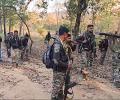
A Naxalite carrying a bounty of Rs 5 lakh was killed in an encounter with security personnel in Chhattisgarh's Sukma district, just days before the Centre's deadline to eliminate Left Wing Extremism.
Odisha's Director General of Police (DGP) YB Khurania announced that 77 Maoists have surrendered to police in the state between January 2025 and March 2025. He also noted that 23 Maoists from Odisha surrendered in Chhattisgarh during the same period, and 27 Maoists were killed in encounters with security forces.

Odisha Police have declared an end to the Left Wing Extremism (LWE) threat in the state, announcing the closure of the Maoist surrender window and a shift in focus to eliminating remaining insurgents in Kandhamal district.
Security forces discovered a country-made gun factory allegedly operated by Maoists in Odisha's Kandhamal district during a recent operation. The find included finished weapons and manufacturing equipment.
After more than four decades, Chhattisgarh's Bastar region has been declared free of Left-Wing Extremism (LWE), marking the end of the armed Maoist rebellion in the area. The decline is attributed to sustained security operations, improved governance, and socio-economic development initiatives.

The Lok Sabha will hold a discussion on efforts to eliminate left-wing extremism (LWE) in India, ahead of the government's deadline. The debate will cover the government's strategy, review of affected regions, and future plans, including potential withdrawal of security forces and launch of welfare schemes.

Union Home Minister Amit Shah criticised the Congress party for its alleged inaction in addressing Maoist violence during its long rule, while highlighting the Modi government's success in nearly eradicating Maoists from Bastar, Chhattisgarh.
