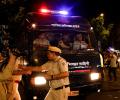
Tahawwur Rana, a Canadian citizen and native of Pakistan, was extradited to India to face charges related to his alleged role in the 2008 Mumbai terror attacks. The US Department of Justice said Rana allegedly commended the LeT terrorists who carried out the attacks and suggested they should be awarded Pakistan's highest gallantry award. Rana is accused of facilitating a fraudulent cover for his childhood friend, David Headley, to conduct surveillance in Mumbai for the Lashkar-e-Taiba (LeT) terrorist group. He is also accused of helping Headley submit false visa applications to Indian authorities. This extradition follows a lengthy legal process that began in 2020 with India's request for Rana's surrender. Rana, who was previously convicted in the US for providing material support to LeT, will now face trial in India on 10 criminal charges related to the Mumbai attacks.
The BJP has lauded the extradition of Tahawwur Rana, a key accused in the 26/11 Mumbai terror attack, as a testament to "New India's" zero-tolerance stance against terrorism under Prime Minister Narendra Modi. However, the Congress has countered the claim, stating that the extradition was the result of diplomatic efforts initiated during the UPA government's tenure. The BJP highlighted Rana's return as a tribute to security personnel who lost their lives fighting Pakistan-sponsored terrorism and a step towards justice for victims of the attack. The Congress, however, asserted that the Modi government did not initiate the extradition process but benefited from the UPA's groundwork. The exchange of accusations has added a political dimension to Rana's extradition, with both parties vying for credit for the development.
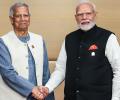
Bangladesh's interim government chief, Muhammad Yunus, has raised the issue of ousted prime minister Sheikh Hasina's extradition from India during a meeting with Prime Minister Narendra Modi in Bangkok. However, Indian officials have denied that the extradition request was discussed. The meeting has sparked controversy with differing accounts of the discussions.

Arms dealer Sanjay Bhandari has opposed the Enforcement Directorate's (ED) plea in a Delhi court seeking to declare him a "fugitive " in connection with a black money case. Bhandari claims his stay in the UK is legal as the London High Court denied his extradition to India. The court's decision was also cited by an English court in April to deny the Indian government's request to extradite another accused in a rice-buying scam. Bhandari's lawyer argued that the ED's application was "vague, misplaced and without jurisdiction " and that the value involved in the case was less than the required Rs 100 crore to declare someone a "fugitive. " The Delhi court has sought the ED's rebuttal to Bhandari's argument by May 3.
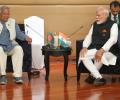
In his post, an official claimed that Modi had said: "We saw her (Hasina's) disrespectful behaviour towards you (Yunus).

Gupta, arrested in the Czech Republic on June 30 last year, is currently held in Prague's Pankrak prison.

Security has been heightened outside the Patiala House Court in Delhi ahead of the expected appearance of Tahawwur Rana, a key accused in the 2008 Mumbai terror attacks. Rana, who was extradited from the US, is likely to be produced in court on Thursday. The Delhi Police and paramilitary forces are carrying out thorough security checks to prevent any untoward incidents.

United States President Donald Trump will host Pakistan Army chief Asim Munir for lunch at the White House on Wednesday.

The Instagram video has drawn significant attention due to the controversial backgrounds of both Lalit Modi and Vijay Mallya.
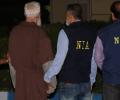
Tahawwur Hussain Rana, a Canadian national accused of involvement in the 2008 Mumbai terror attacks, has been extradited to India from the United States. Rana's interrogation is expected to shed light on the role of Pakistani state actors in the attacks, which claimed 166 lives. Indian authorities are particularly interested in his travels across India in the days leading up to the attacks, including visits to Hapur, Agra, Delhi, Kochi, Ahmedabad, and Mumbai. Rana's extradition follows a lengthy legal battle, with the US Supreme Court ultimately denying his application to challenge it. Rana is known to be associated with Pakistani-American terrorist David Coleman Headley, one of the main conspirators of the 26/11 attacks. The investigation into the Mumbai attacks has implicated senior members of terror outfits Lashkar-e-Taiba (LeT) and Harkat-ul Jihadi Islami (HuJI), as well as officials from Pakistan's Inter-Services Intelligence (ISI).
Tahawwur Hussain Rana, a Pakistani-born Canadian national accused in the 2008 Mumbai terror attacks, is likely to be lodged in a high-security ward in Tihar jail upon his extradition from the US. Rana, a close associate of David Coleman Headley, a US citizen who was also involved in the attacks, will be brought to India after his last-ditch attempt to evade extradition was rejected by the US Supreme Court. The attacks, which lasted nearly 60 hours, resulted in the deaths of 166 people and sent shockwaves across the country.
Tahawwur Hussain Rana, the key mastermind of the 2008 Mumbai terror attacks, is being interrogated for eight to ten hours daily by the National Investigation Agency (NIA) to unravel a larger conspiracy behind the strikes. Rana, who was extradited from the US, is being grilled by NIA investigators to probe a larger conspiracy behind the attacks, in which 166 people were killed and over 238 injured. He is being allowed to meet his lawyer and is being provided with basic necessities. The investigators hope to find some important leads on his travels in parts of northern and southern India days before the carnage in Mumbai on November 26, 2008.

Robert Vadra, husband of Priyanka Gandhi Vadra, appeared before the Enforcement Directorate for questioning in connection with the Sanjay Bhandari money laundering case.

Tahawwur Hussain Rana, a Pakistan-born Canadian national and close associate of David Coleman Headley, is set to be extradited to India from the US. Rana was involved in the planning and execution of the 2008 Mumbai terror attacks, which killed 166 people, including six Americans. He assisted Headley in obtaining a visa for India, established a front company in Mumbai, and helped in reconnaissance of targets in Mumbai and New Delhi. Rana was convicted in the US for providing material support to Lashkar-e-Taiba (LeT) and sentenced to 14 years in prison. His extradition to India will allow authorities to question him about his involvement in the Mumbai attacks and potentially uncover new information about the role of Pakistani state actors.
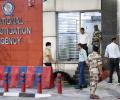
Tahawwur Hussain Rana, the mastermind behind the 2008 Mumbai terror attacks, has been taken into 18-day custody by the National Investigation Agency (NIA) in India. Rana was extradited from the United States after years of legal battles and will be questioned to unravel the complete conspiracy behind the attacks.

India's National Investigation Agency is probing into his role in the 26/11 attacks carried out by Pakistan-based Lashkar-e-Taiba terrorists in 2008.
India has exempted Bangladeshi exports to Nepal and Bhutan as such trade facilitation is mandatory for landlocked countries under the framework of provisions of the World Trade Organisation (WTO).

Filing the Writ of habeas corpus through his attorney, Rana, 62, challenged his extradition by the Government of India. Rana's extradition would violate the United States-India extradition treaty in two respects, his attorney argued.
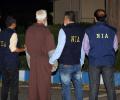
He was sent to judicial custody on May 9 and lodged in Tihar jail after his custodial interrogation by the NIA.

The closed-door luncheon meeting came amid escalating tensions between Israel and Iran with Trump exploring Washington's possible involvement.
A court in New Delhi has sent Tahawwur Hussain Rana, the mastermind behind the 2008 Mumbai terror attacks, to 18 days of National Investigation Agency (NIA) custody. The court cited the need for sustained interrogation to uncover the extent of the conspiracy and the involvement of multiple targets across India, including New Delhi. Rana, a Pakistani-origin Canadian businessman and close associate of 26/11 conspirator David Coleman Headley, was extradited to India after the US Supreme Court dismissed his review plea against his extradition.

India has strongly rejected Pakistan's claims on Kashmir, calling it a Union Territory and dismissing the Pakistan Army Chief's statement about it being the country's "jugular vein." India also rejected Pakistan's claim that Tahawwur Rana, a Mumbai terror attack accused, is a Canadian citizen and that it has nothing to do with him. India's External Affairs Ministry spokesperson stated that Pakistan's reputation as the "epicentre" of global terrorism will not diminish. Rana's extradition is a reminder that Pakistan needs to bring other perpetrators of the Mumbai terror attacks to justice, according to India.

Investigators suspect that similar terror plots were devised for multiple cities across India.To piece together the full scope of the conspiracy, officials may take Rana to various locations, retracing events from 17 years ago.
Tahawwur Hussain Rana, a jailed accused in the 2008 Mumbai terror attacks, has moved a court in New Delhi seeking permission to speak to his family. The 64-year-old Pakistani-origin Canadian businessman is currently in judicial custody and is accused of conspiring with David Coleman Headley and operatives of Lashkar-e-Taiba (LeT) and Harkat-ul-Jihadi Islami (HUJI) to carry out the terror attacks. Rana was brought to India after the American Supreme Court dismissed his review plea against his extradition.
Tahawwur Hussain Rana, a key accused in the 26/11 Mumbai terror attack case, had helped co-conspirator David Coleman Headley to obtain an Indian visa, a Mumbai police official familiar with the probe said. Rana was arrested by the National Investigation Agency (NIA) on Thursday evening following his extradition from the United States. Rana, who had served in the Pakistan Army medical corps, had emigrated to Canada in the late 1990s and started an immigration consultancy firm. He later moved to the US and set up an office in Chicago. Through his firm, Rana gave cover to Headley to carry out reconnaissance mission in Mumbai prior to the November 2008 attacks and helped him get a ten-year visa extension. During his stay in India, Headley used the front of running an immigration business and was in regular contact with Rana. There were more than 230 phone calls between the two during this period. Rana was also in touch with 'Major Iqbal', another co-conspirator of the attacks during this period, as per the NIA charge sheet. Rana himself visited India in November 2008. As per the charge sheet filed by Mumbai Police against Rana in 2023 in the 26/11 attack case, he lived in a hotel in Powai, and had a discussion about crowded places in South Mumbai with a person who has been listed as a witness in the case. Subsequently, some of these places were targeted by the Pakistani terrorists during the deadly attacks that claimed 166 lives.

Tahawwur Hussain Rana, an accused in the 2008 Mumbai terror attacks, has been extradited to India from the US. Former home secretaries believe he will be convicted and could face the death penalty. Rana was an associate of David Coleman Headley, who played a key role in the attacks. The extradition is seen as a significant achievement for India and a message to terrorists that they will face justice. Rana's testimony is expected to provide valuable information about the planning and execution of the attacks.

A federal United States court has allowed Pakistani-origin Canadian businessman Tahawwur Rana time till November 9 to file a motion against his extradition to India to face a trial in the 2008 Mumbai terror attack.
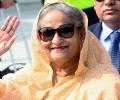
Bangladesh's interim government has requested India to extradite deposed Prime Minister Sheikh Hasina, who has been living in exile in India since August. The request comes after the Bangladesh-based International Crimes Tribunal issued arrest warrants for Hasina and several others for "crimes against humanity and genocide." The interim government has cited an existing extradition treaty between the two countries as grounds for the request. Hasina has accused the interim government of perpetrating "genocide" and failing to protect minorities since her ouster.

Nirav Modi, the fugitive diamond merchant wanted in India to stand trial on fraud and money laundering charges, on Thursday suffered another setback in his legal battle against his extradition as the high court in London denied him permission to appeal against his extradition order in the UK Supreme Court. In a judgment order pronounced at the Royal Courts of Justice in London, Lord Justice Jeremy Stuart-Smith and Justice Robert Jay ruled that "the Appellant's (Nirav Modi) application for permission to appeal to the Supreme Court is refused".

Pakistan's record on terrorism is "very clear" and the Pahalgam attack is only the recent example of cross-border terrorism, the ministry of external affairs said on Thursday.
Maharashtra Chief Minister Devendra Fadnavis said on Friday that the National Investigation Agency (NIA) and the Union Home Ministry will decide where 26/11 terror attack conspirator Tahawwur Rana will be taken for probe. Rana was extradited from the US.

A court in Mumbai has issued a non-bailable warrant against diamantaire Mehul Choksi in the Canara Bank-led consortium loan fraud case involving about Rs 55 crore. Choksi, a prime accused in the multi-million dollar Punjab National Bank (PNB) 'fraud', was arrested in Belgium on April 12 following an extradition request by Indian probe agencies.
Overriding the Biden administration's appeal, a US court has ordered a stay on the extradition of Pakistani-origin Canadian businessman Tahawwur Rana, to India where he is facing a trial for his involvement in the 2008 Mumbai terror attacks.
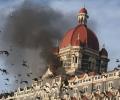
Devika Rotawan, a survivor of the 26/11 Mumbai terror attacks, has demanded the death penalty for Tahawwur Hussain Rana, a key accused extradited from the US. Rotawan, a key witness in the case, identified terrorist Mohammed Ajmal Kasab in court during the trial. She believes the extradition is a "big win" for India and called for further action against other conspirators in Pakistan.
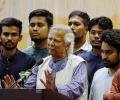
Yunus will meet King Charles and see Keir Starmer in Downing Street during his four-day visit to the UK from June 10-13.
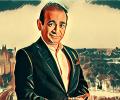
If his attempt to have his appeal heard in the Supreme Court fails, in principle, Modi can apply to the European Court of Human Rights (ECHR) to try and block his extradition on the basis that he will not receive a fair trial and that he will be detained in conditions that breach Article 3 of the European Convention on Human Rights, to which the UK is a signatory.
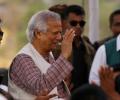
Bangladesh Chief Adviser Muhammad Yunus has said that his interim government wanted good relations with India, but 'something always went wrong'.

Tahawwur Hussain Rana, a key figure in the 2008 Mumbai terror attacks, has been extradited from the US to India and produced before a Delhi court. Rana, a close associate of David Coleman Headley, was brought to India after the US Supreme Court dismissed his review plea against extradition. The National Investigation Agency (NIA) has sought 20 days of custody to interrogate Rana, citing clinching evidence, including emails. The agency believes that Rana's interrogation is critical to understanding the larger conspiracy behind the attacks and his role in planning them.

'As Rana is not an Indian citizen, our leverage on the US system -- whether it's their judiciary or the executive -- is very limited in that sense.'
'He is the key to unravel the 26/11 conspiracy.'
