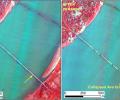
ISRO's Cartosat-3 satellite captured images of the damage caused by the 7.7 magnitude earthquake in Myanmar on March 28. The images show significant damage in Mandalay and Sagaing cities, including the complete collapse of the historic Ava (InnWa) Bridge near Inn Wa City. The earthquake also caused cracks and ground ruptures in the flood plains of the Irrawaddy River.

ISRO to launch a 6,500 kg communication satellite built by the US, marking a significant milestone in the Indian space program after the successful launch of the NASA-ISRO NISAR mission.
The Polar Satellite Launch Vehicle (PSLV) in its 63rd mission, would carry the earth observation satellite (EOS-09) which would be capable of capturing high-resolution images of the Earth's surface under all weather conditions.

CARTOSAT-3 is a third generation agile advanced satellite having high resolution imaging capability.

Cartosat-3 satellite is a third-generation agile advanced satellite having high-resolution imaging capability.

The space agency had earlier announced that the launch is tentatively scheduled at 09:28 hrs IST on November 25, subject to weather conditions.

The launch is tentatively scheduled at 09.28 hrs IST on November 25, 2019 subject to weather conditions, ISRO said.

The ISRO is strengthening 'eye in the sky', which helped the Indian army carry out surgical strikes last year, with the launch.

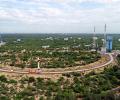
The image shows a part of Indore with the Holkar Cricket Stadium in the centre.

The Indian space agency has already begun work on the third generation of the earth observation satellite -- the first of which will be ready by 2018 and boost the capability to generate digital maps.

The camera was switched on at 10:05 am through a series of commands issued from the spacecraft control centre of ISRO Telemetry, Tracking and Command Network here.

ISRO said the upper stage of the Polar Satellite Launch Vehicle - C37 (PSLV-C37) re-entered the earth's atmosphere on October 6, 2024 and the impact point was the North Atlantic Ocean.

The subsidence zone is located at central Joshimath only including the Army Helipad and Narsingh temple, the satellite images revealed.

According to news reports, ground images for this operation were provided by the recently launched Cartosat 2C satellite.

Military use apart, the new satellite would be useful for urban and rural applications, coastal land use and regulation, utility management and various related applications.

Other than the Cartosat-2 series satellite, the PSLV is carrying 29 nano satellites from 14 countries - Austria, Belgium, Chile, Czech Republic, Finland, France, Germany, Italy, Japan, Latvia, Lithuania, Slovakia, the United Kingdom and the United States of America besides a nano satellite from India.
This is ISRO's new record of launching 20 satellites, including those from the US, Germany, Canada and Indonesia.

The launch of the crewed space mission, Gaganyaan, is being planned before the next Independence Day and this will be proceeded by two uncrewed missions, Lok Sabha was informed on Wednesday.

The successful orbiting of the satellites by the Polar Satellite Launch Vehicle PSLV C-40 comes four months after the Indian space Research Organisation's mission to launch backup navigation spacecraft IRNSS-1H onboard PSLV-39 ended in a rare failure.

The space agency launched 104 satellites, breaking the previous record of 37 by Russia.
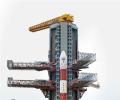
A 48-hour countdown began on Monday for the launch of record 20 satellites, including India's latest earth observation Cartosat-2 Series Satellite, onboard PSLV C-34 from Sriharikota on June 22.

Out of its 47 operational satellites, India currently has six to eight satellites which are used entirely for military purposes.
Delhi will be the first place to be mapped by Cartosat followed by Goa.

'Till date, 90-95 per cent of the mission objectives have been accomplished' 'Future programmes will go as planned' After the moon landing mishap, K Sivan, chairman, Indian Space Research Organisation spoke to T E Narasimhan/Business Standard of the future and the mood among his scientists. Edited excerpts:
Prime Minister Manmohan Singh on Monday hosted lunch for space scientists after the successful launch of an imaging satellite Cartosat-2B last week.

ISRO has released the footage of the injection of PSLV-37 which launched a record 104 nano-satellites overseas customers into the orbit in blocks in a series of separations.
The Indian Space Research Organisation will launch ten satellites, including eight from abroad, which will be carried by PSLV-C9, on April 28.The cluster of satellites to be lifted includes the Indian satellite Cartosat-2A, weighing 690 kg. The vehicle would also carry eight nano satellites of 16 to 27 kg from Canada, Netherlands, Denmark and Germany. Of the eight nano satellites, six are form a cluster called NLS-4. These satellites were built to test nano technoloy.
The satellite will give India the capability to keep tabs on missile launches in its neighbourhood.

This would be the 44th flight of the PSLV and the third launch by ISRO this year.

The year ended with the launch of the PSLV's 50th mission.
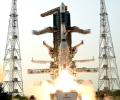
Over 32 missions -- satellites and rockets -- have been planned for the year.
ISRO's Polar Satellite Launch Vehicle-C6, carrying India's remote sensing satellite CARTOSAT-1 and a micro satellite HAMSAT, blasted off from the Satish Dhawan Space Centre in Sriharikota on Thursday.

India on Wednesday successfully launched a record 104 satellites -- all but three of them foreign--from Sriharikota and put them into orbit in a single mission onboard its most dependable Polar rocket.

The announcement comes two days ahead of the proposed historic launch of the ISRO's 100th satellite along with 30 others in a single mission from Sriharikota.
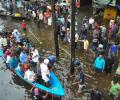
Data provided by the satellites helps experts predict the level of rains till then, what to expect in the next few hours and even about the situation in the forests and the water reservoirs.

The success of the PSLV-C34 mission is a result of ISRO's professionalism and the hard work put in by their scientists over the last many decades., says Ajay Lele.

India performed yet another space feat on Wednesday when the Indian Space Research Organisation launched a record 104 satellites into orbit from Sriharikota, Andhra Pradesh, something no other country has done before.

One spacecraft will be Indian Space Research Organisation's own Chandrayaan-2, while the other will be from India's first private moonshot Team Indus which is competing in the Google LunarXPrize challenge.

In the years to come, India's space assets will play a much bigger role if and when hostilities break out on our borders, says Pallava Bagla.
The Polar Satellite Launch Vehicle PSLV-C15 carrying five payloads, including India's remote sensing satellite Cartosat-2B, successfully lifted off from the spaceport in Sriharikota on Monday.
 © 2026 Rediff.com - Investor Information - Advertise with us - Disclaimer - Privacy Policy - Sitemap - Feedback - About us - Terms of use - Grievances