The NSAB is an advisory body that provides inputs to the National Security Council Secretariat.
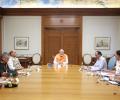
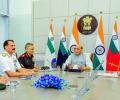
Defence Secretary Rajesh Kumar Singh met Prime Minister Narendra Modi on Monday amid escalating tensions between India and Pakistan following the Pahalgam terror attack. The meeting comes a day after the Chief of Air Staff met with Prime Minister Modi to discuss the security situation. Last Tuesday, Prime Minister Modi gave the armed forces "complete operational freedom" to respond to the Pahalgam terror attack, which killed 26 people.

US President Donald Trump claimed that "five jets were shot down" during the conflict between India and Pakistan in May and repeated his assertion that the fighting ended following his intervention. India has maintained that the two sides halted their military actions following direct talks between their militaries without any mediation by the US.
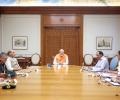
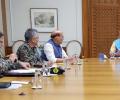
Prime Minister Narendra Modi chaired a meeting with top defence officials, including Defence Minister Rajnath Singh, National Security Advisor Ajit Doval and the chiefs of three services, amid India weighing its countermeasures following the Pahalgam terror attack which left at least 26 civilians, mostly tourists, dead. Modi has vowed to pursue the terrorists behind the attack and their patrons, a clear reference to Pakistan, to the "ends of earth" and inflict harshest punishment on them.

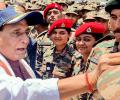
President Droupadi Murmu and Prime Minister Narendra Modi on Saturday led the nation in paying tributes to military personnel who fought valiantly in harsh conditions to hand Pakistan a crushing defeat in the 1999 Kargil conflict.
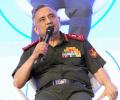
Chief of Defence Staff General Anil Chauhan on Saturday acknowledged losses of aircraft in India's recent military hostilities with Pakistan but dismissed as 'absolutely incorrect' Islamabad's claim of downing six Indian fighter jets.

Before assuming charge of the CDS, Gen Chauhan paid tributes to India's fallen soldiers at the National War Memorial in the India Gate complex.

The Congress party launched a scathing attack on the central government regarding the Pahalgam terror attack and Operation Sindoor, demanding accountability from Home Minister Amit Shah and clarification on the number of Indian jets downed during the operation.
In the wake of the recent hostilities, both sides have moved from weapons to words, with India dispatching several delegations to visit more than 30 capitals across the world. A similar effort by Pakistan is set to start on Jun 2.

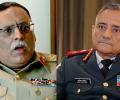
Top military officials from India and Pakistan highlighted their views at the Shangri-La Dialogue in Singapore, billed as Asia's premier defence forum, amid heightened tensions between the two sides following last month's military confrontation.
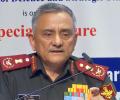
Pakistan's decision to talk to India on May 10 stemmed from realisation that it will suffer more if its operation continues, Gen Chauhan said.
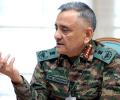
Chief of Defence Staff General Anil Chauhan on Saturday said India's Operation Sindoor has drawn a 'new red line' of intolerance against terror, and expressed hope that the military action has brought 'some lessons for our adversary also'.

The Congress on Sunday cited the reported comments of India's defence attache to Indonesia that the Indian Air Force lost fighter jets to Pakistan during Operation Sindoor and accused the government of having 'misled' the country.

The Chinese see no need to fight directly. They have an able and willing proxy in Pakistan, points out Shekhar Gupta.
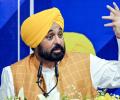
Punjab Chief Minister Bhagwant Mann took a jibe at the Bharatiya Janata Party over Operation Sindoor on Wednesday, saying this is the first time that Indian representatives have been sent abroad to convey about the country's victory in an armed conflict.

The CCS meet was held at the prime minister's Lok Kalyan Marg residence, a day after he held a meeting with the top military brass and accorded operational freedom to the armed forces on the "mode, targets and timing" of India's response to the April 22 attack that killed 26 people.
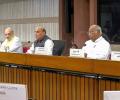
When the country has been at war, the Opposition has buried its differences with the government, points out Aditi Phadnis.
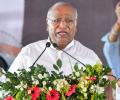
Congress president Mallikarjun Kharge on Saturday accused the government of misleading the nation on the India-Pakistan conflict and demanded holding a special session of Parliament immediately, following Chief of Defence Staff General Anil Chauhan's acknowledgement of aircraft loss in the hostilities.
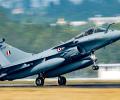
'We will see whether there were losses or not, and whether the war aims were achieved. When the truth comes out, some may well be surprised,' says Dassault CEO.
'With a military-led strategy to counter terrorism emanating from Pakistan, India has clearly signalled that it would respond decisively to future terrorist threats.'

Military affairs experts said his key challenge will be to build consensus among the three services for the theaterisation plan as the Indian Air Force has some apprehensions about its roll-out.
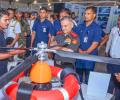
'The defence forces have come up with certain problems they face in the drone space.' 'Recently we had a meeting at which they presented the problems to many of our start-ups and faculty.' 'Some of the start-ups have started working on the problems.'
'Looking at how quickly the hostilities were escalating, the nuclear threshold did not seem that far.'

Congress leader Uttam Kumar Reddy said the country wanted to know whether any aircraft were downed during the conflict, especially in the wake of the CDS' "admission".

Defence Minister Rajnath Singh has assured the nation that India will respond strongly to the recent terror attack in Kashmir's Pahalgam, which killed 26 people. He stated that India will not be intimidated by such acts and will take every necessary step to trace those responsible and those who conspired behind the scenes. Singh described the attack as "extremely inhuman" and reiterated India's zero-tolerance policy against terrorism.
India has called Pakistan's nuclear bluff with Operation Sindoor and sent a psychological message to state-sponsored terrorists: nobody is untouchable and no place in Pakistan is safe for you, government sources said on Sunday.

'It brings precarious peace because the red lines have shifted. 'The next Pahalgam attack would mean a full scale war.'
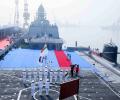
Prime Minister Narendra D Modi dedicated three Made in India frontline naval combatants -- INS Surat, INS Nilgiri and INS Vaghsheer to the nation on Wednesday, January 15, 2025, morning, noting that this is the first time that a destroyer, frigate and submarine were being commissioned together into the Indian Navy.

The Squad seeks to counter China's power assertions in the South China Sea region.
'You can be sure that the Pakistanis knew when the Indian Air Force aircraft took off, which type these were, and what their likely targets were.' 'The question was: How would they determine that the IAF wanted to fire, and when to bounce them?', notes Shekhar Gupta.

Chief of Defence Staff (CDS) General Anil Chauhan has highlighted the emergence of space as a new domain of warfare and emphasized the need for developing a "space culture" to prepare for future conflicts. He called for dedicated space warfare schools and research institutions to generate ideas, develop doctrines and strategies, and create new capabilities for space warfare. Chauhan believes that space will be crucial for future warfare, impacting all traditional domains of land, sea, and air. The CDS's remarks were made at the Indian DefSpace Symposium, where he also highlighted the importance of space research and its role in shaping the future of warfare.

'The lesson Beijing would have learned is that there is, cost-benefit wise, no better option than to keep the Pakistan military supplied with its most advanced armaments, certain that in hostilities with India these would be used for maximum effect.'
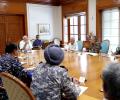
'One good outcome of Operation Sindoor -- perhaps, its best outcome -- could be that India has resumed meaningful contact directly with Pakistan at the military-to-military level,' observes Ambassador M K Bhadrakumar.
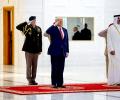
'He is intrigued by the intractability of Kashmir issue. With his interest in dealmaking and peacebrokering, he sees it as an exciting challenge to tackle.'
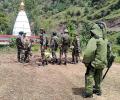
'Unfortunately, India and Pakistan could learn a 'lesson' from this conflict that will make them more likely to use these weapons against each other in the future.' 'Rounds of missile and drone attacks could be more routine features of their hostility, just like artillery fire has become a familiar fact of life along the Line of Control.'
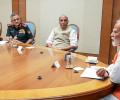
'If Pakistan has fired one bullet at us then we have to respond by firing 10 bullets at them. It is our right to do so.'

'Fears in Washington began to intensify when it was realised that subsequent Pakistani and Indian attacks on major military facilities -- which were significant in terms of geographic scope and intensity -- could rapidly take both sides to where neither actually wanted to go.' 'The US objective was to stop the fighting as soon as possible. Everything else was secondary.'

Defence Minister Rajnath Singh attended the Army Commanders conference at the Manekshaw auditorium in New Delhi on Tuesday, April 2, 2024.
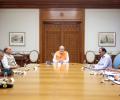
'The government has to explain (to the army, air force and navy chiefs) whether they want a punitive strike, a deep punitive strike, or whether they want limited war or an all-out war, will it be a circumscribed war or will it be a shallow attack along the border.'
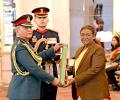
Three Thursdays after Nepalese President Ram Chand Poudel conferred the rank of honorary general of the Nepalese army on General Upendra Dwivedi in Kathmandu, President Droupadi Murmu conferred the honorary rank of general of the Indian Army on General Ashok Raj Sigdel, Nepal's army chief, at a special investiture ceremony at Rashtrapati Bhavan.
 © 2026 Rediff.com - Investor Information - Advertise with us - Disclaimer - Privacy Policy - Sitemap - Feedback - About us - Terms of use - Grievances