
Bangladesh assistant coach Mohammad Salahuddin criticizes former sports adviser Asif Nazrul for allegedly misrepresenting facts regarding the national team's exclusion from the T20 World Cup, stating that players were devastated by the decision.

The Bangladesh Nationalist Party (BNP) has reiterated its demand for the extradition of former Prime Minister Sheikh Hasina from India to face trial in Bangladesh, emphasizing the need for equal and respectful relations with all neighboring countries.
'Yunus' hostility to India is foolish and self-defeating in the extreme and reveals him for the weak monarch he is, unelected, chaotic, and dependent upon the support of extremist'

BNP chairman Tarique Rahman called for maintaining law and order and sought cooperation in building a safe and humane Bangladesh after his party's victory in parliamentary elections.
The chief adviser alleged elections held under Hasina's regime were "rigged blatantly and generations of young people grew up without exercising their voting rights."

Bangladesh's interim government has ordered a nationwide security clampdown following the shooting of a youth leader and election candidate, leading to renewed unrest.

Foreign Affairs expert Robinder Sachdev on Monday expressed serious concern over the current public sentiment and statements emerging from leaders in Bangladesh against India, describing them as 'threats' targeting Northeast India and warning that these elements in the neighbouring country are actively seeking ways to 'hurt' the nation.

Sharif Osman Hadi, a leader of the July Uprising in Bangladesh, died after being shot, sparking protests and political unrest. The interim government has promised action, while demonstrators have targeted media outlets and blamed India.


Unidentified miscreants smashed a window and threw "petrol or similar substance" inside before igniting the blaze
Muhammad Yunus proved that he was neither an armchair economist nor a slogan mongering political activist, but a doer destined to do what Mahatma Gandhi said -- to remove every tear from every eye, recalls Rup Narayan Das.
Bangladesh's chief advisor Muhammad Yunus introduced to an American audience in New York the "brains" behind the "meticulously designed" protests that led to the ouster of Sheikh Hasina from power.

India has stated it will wait for the outcome of the elections in Bangladesh and the resulting mandate before addressing any existing issues. The country also affirmed its support for free, fair, inclusive, and credible elections in Bangladesh.

Highlighting the party's broader stance on international relations, he added, "Friends to all, malice to none."
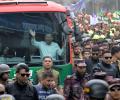
Bangladesh Nationalist Party (BNP) acting chairman Tarique Rahman has returned to Dhaka after 17 years in self-exile in the UK, amid political instability following the killing of a youth leader. His return is significant as BNP emerges as a forerunner in the changed political landscape.

One of the underground lines will head towards Bagdogra, a location of strategic importance due to its role in India's air defence infrastructure.
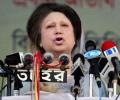
Khaleda Zia, Bangladesh's former first female prime minister and chairperson of the Bangladesh Nationalist Party, has died at the age of 80 after a prolonged illness.

A referendum on the implementation of a reform package in Bangladesh saw a 60.26 per cent voter turnout, with the 'yes' vote winning a clear majority, the Election Commission announced.

Funeral prayers were held for Bangladesh's former prime minister Khaleda Zia amid tight security. Millions joined the namaz-e-janaza of Zia, a three-time Prime Minister and political icon of Bangladesh.

T20WC Boycott: Broadcasters may move court against PCB

'China continues to perceive its relations with India through the prism of India-US relations, with the US using India to counter balance against China in the Indo-Pacific and beyond.'
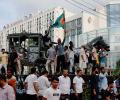
A key aide to Bangladesh's interim government has urged India to unequivocally recognize the July-August uprising that toppled Prime Minister Sheikh Hasina's regime, arguing that this is crucial for rebuilding bilateral ties. Mahfuj Alam, considered a de facto minister in the interim government, criticized India's portrayal of the uprising as militant, anti-Hindu, and an Islamist takeover, and called for a change in approach to understand the "new Bangladesh realities." He stated that bypassing the uprising would be detrimental to relations between the two countries. Alam, whose organization spearheaded the protests against Hasina's government, emphasized the democratic nature of the struggle, which he said was about a "generational and responsible struggle." His statement comes amid strained relations between Dhaka and Delhi, with India expressing concerns over the safety of Bangladesh's Hindu community.

'The people of Bangladesh have voted for a party that represents political interest.'
'It is a pro-Liberation party and it believes in the spirit of 1971, as opposed to the Jamaat-e-Islami, which was opposed to the Liberation struggle of Bangladesh in 1971.'

External Affairs Minister S Jaishankar handed over a letter from Prime Minister Narendra Modi to BNP leader Tarique Rahman, conveying condolences after the death of former Prime Minister Khaleda Zia. Jaishankar's visit comes amid existing tensions between India and Bangladesh.
Bangladesh will hold general elections on February 12, 2026, the first since the ouster of the Sheikh Hasina-led Awami League government. A referendum on reform proposals will be held simultaneously.
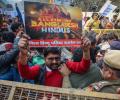
Bangladesh police are offering a reward for information on attackers who set fire to a Hindu-owned house. The incident is part of a series of arson attacks and mob violence that have raised concerns in the country.

As the controversy erupted surrounding the removal of Bangladesh fast bowler Mustafizur Rahman from the Kolkata Knight Riders squad, Congress leader Adhir Ranjan Chowdhury questioned whether this action would improve the security of Hindus in Bangladesh.
Sheikh Hasina, sentenced to death in absentia in Bangladesh, denounces the tribunal as biased and rigged, claiming the verdict reveals the murderous intent of extremist figures within the interim government.

Tarique Rahman, after 17 years in self-exile, has led the Bangladesh Nationalist Party (BNP) to a significant victory, becoming the country's Prime Minister. This marks a major turnaround for the BNP after years of being targeted by the Awami League government.
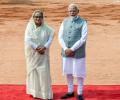
'If she hadn't left Bangladesh, the militants had planned on killing her'
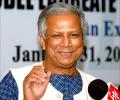
The other members of the interim government will be finalised after consultations with various political parties, the press secretary added.
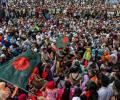
A key leader of Bangladesh's National Citizen Party (NCP), Mahfuz Alam, has distanced himself from the party's alliance with Jamaat-e-Islami, citing ideological differences and concerns over Jamaat's controversial history.

With these four, the strength of the members -- all equivalent to ministers -- in the interim government's advisory council rose to 21.

Bangladesh has expressed a potential interest in procuring JF-17 Thunder fighter aircraft from Pakistan, according to a statement from the Pakistan military. The development came during a meeting between the air chiefs of both countries, focusing on strengthening operational cooperation and institutional synergy.
Bangladesh descended into chaos on Monday as Prime Minister Sheikh Hasina surreptitiously resigned and fled the country in a military aircraft while the Army stepped in to fill the power vacuum.

'Should China's interest in the Teesta River projects be approved, it would likely result in heightened Chinese presence near the Siliguri corridor.'
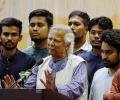
Yunus in his 26-minute speech did not give any deadline for the tenure of his interim government but acknowledged that "everyone is interested to know when our government will leave".

Life has come full circle for Nobel laureate Professor Mohammad Yunus, who faced persecution during Sheikh Hasina's regime for embezzlement, is now all set to head of the interim government in Bangladesh after she resigned and fled the country.

'In this situation, until further notice, it is requested by order to stop the broadcasting/telecasting of all matches and programs of the Indian Premier League (IPL).'

Muhammad Yunus on Thursday promised to deliver a government which assures safety to its citizens, as the Nobel laureate returned to the protest-torn Bangladesh from Paris to take oath as the head of the interim government following the ouster of Sheikh Hasina.
