
'I don't think the government will sacrifice such a fine institution for monetary gains.'

Buying a mature rocket technology gives companies the designs and hardware know-how, but not necessarily the decades of engineering wisdom needed to make it work.

'An instruction came from somebody in Delhi saying, "don't go with the launch".'

'He didn't touch upon the core questions raised by the nine employee associations.'

It is about proving that the agency can still deliver when the stakes are high.

Nine employee associations at ISRO have written to Chairperson V Narayanan, seeking official clarification on the proposed transfer of manufacturing and operational functions to private entities. They raised concerns about ISRO's future role, employee consequences, and recruitment, following comments by IN-SPACe chairperson Pawan Goenka regarding ISRO's eventual exit from launch vehicle manufacturing.

Their message is blunt: Public scientific wealth should not be transferred at what they describe as 'throwaway prices'.capability, recruitment, promotional avenues and the voice of its employees.

There is no answer to the question of how IN-SPACe invited EOIs for ISRO's mature rockets and whether it was based on any government policy decision.

'The prime minister has given us the task of taking at least 300 satellites to orbit in the next five to six years.'

ISRO has successfully launched EOS-05, India's first geo-imaging satellite, into a precise sub-geosynchronous transfer orbit using a GSLV rocket. This 2,367 kg satellite, the heaviest ever carried by a GSLV, will provide real-time imagery for applications in agriculture and disaster management from an altitude of 36,000 km.

'ISRO will not manufacture any launch vehicles. That will all be done by the private sector or public sector undertakings.'
'It is not economical to operate GSLV-Mk II due to its cost and complexity. Future launches to be managed with LVM3.'

The appointment comes as Agnikul prepares for Mission 02, a flight that will attempt, for the first time on Indian soil, the recovery of an orbital-class rocket booster and the extension of a rocket's upper stage into an on-orbit platform.

'The Indian private space sector is no longer a high-risk bet; it is a highly bankable, globally competitive asset class capable of easing the global small satellite launch bottleneck.'

The Department of Space has directed that requests for voluntary retirement or resignation from Group 'A' Scientific and Technical personnel associated with the prestigious Gaganyaan human spaceflight programme and other important missions should not be accepted as a matter of routine.

'With Vikram-1, we take our biggest step yet towards a reliable, high-cadence launch programme built in India, for India and the world.'

India's move to privatise PSLV rocket production through IN-SPACe has triggered debate over national security, ageing technology and the agency's role.

The EoI comes at a time when ISRO is working to enhance LVM3's payload capacity to five tonnes in GTO and is also evaluating the procurement of a Russian semi-cryogenic engine for the vehicle's second stage.

A high-level committee investigating the failures of ISRO's PSLV rockets, which have impacted strategic satellite missions, has yet to release its report and recommendations, raising concerns about the future of the ageing launch vehicle.

Astronaut Shubhanshu Shukla discusses the Gaganyaan mission and its potential to inspire other nations in space exploration, drawing on his experiences as an IAF test pilot and his time on the International Space Station.
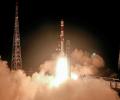
ISRO is preparing for the PSLV-C62 mission launch on January 12 from Sriharikota, carrying the EOS-N1 satellite and multiple other payloads.
The Indian government has approved the construction of a third launch pad at Sriharikota, capable of sending heavier spacecraft into orbit. This new facility will support India's ambitious space program, including the Gaganyaan human spaceflight mission and a lunar landing. The launch pad will be built at the Satish Dhawan Space Centre and is expected to be operational within four years.
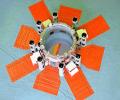
The Indian Space Research Organisation will open 2025 scoring a century orbiting the country's navigation satellite 2,250 kg NVS-02 with its rocket Geosynchronous Satellite Launch Vehicle (GSLV)-F15.

ISRO stated that the disengagement of at least one contact -- in both the main and redundant paths -- of a connector led to the failure of NVS-02.

While India's interplanetary ambitions remain significant, the current pace of financial and technical progress raises questions about whether the 2027-2028 timelines can be met.

Based on the broadcast visuals, a rocket expert said the failure appeared similar to the anomaly seen during the PSLV-C61 mission.
ISRO's PSLV-C62 successfully launched an earth observation satellite along with 14 other commercial payloads from Sriharikota, marking the first launch of the year.

The move follows a quiet visit by National Security Advisor Ajit Kumar Doval to the Vikram Sarabhai Space Centre in Thiruvananthapuram.
A Spanish startup, Orbital Paradigm, claims its payload, KID, survived the failed PSLV-C62 mission and transmitted data, despite ISRO's silence on the matter. The mission, carrying 16 satellites, failed due to issues in the rocket's third stage.

The satellite, weighing about 4,410 kg will be the heaviest to be launched from the Indian soil and into a Geosynchronous Transfer Orbit (GTO), the space agency said. The satellite will travel onboard a LVM3-M5 rocket, dubbed as 'Bahubali' for its heavylift capability.
'A solid motor, once ignited, burns until the propellant is exhausted. It cannot simply stop mid-burn,' said a retired senior ISRO official. 'That is what makes this failure puzzling.' Venkatachari Jagannathan reports on the latest PSLV failure.

India is set to take its first steps towards its own human space flight when the uncrewed Gaganyaan mission soars to the skies later this year. Private players in the space sector are also gearing up for launching satellites on home-built rockets.
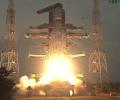
The heaviest communication satellite to be launched from the Indian soil onboard a new generation, homegrown 'Bahubali' rocket was successfully placed into the intended orbit on Sunday, the Indian Space Research Organisation said.

From a surge in startups to crewed mission preparations, 2025 marks a transformative year as India eyes $44 billion space economy by 2033.
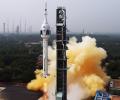
ISRO Chairman V Narayanan announces ambitious space program goals, including landing Indians on the Moon by 2040 and launching the 'Gaganyaan' mission in 2027. The agency is also working on a national space station and uncrewed missions.
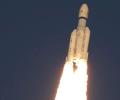
Indian Space Research Organisation scientists have carried out a new experiment on the indigenously developed C25 cryogenic stage of the LVM3-M5 rocket which successfully placed the Communication Satellite CMS-03 into the intended orbit on Sunday, said its Chairman V Narayanan.
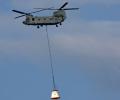
ISRO successfully conducted the first Integrated Air Drop Test (IADT-01) to validate the parachute-based deceleration system for the Gaganyaan mission, demonstrating a crucial step towards India's human spaceflight program.
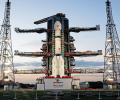
The imaging technology in Nisar can provide very high-resolution data on changes as small as one centimetre in size on the earth's surface.

ISRO is set to launch its communication satellite CMS-03 from Sriharikota. The satellite, weighing 4,410 kg, will be the heaviest launched from Indian soil into a Geosynchronous Transfer Orbit (GTO).

The Chandrayaan-2 mission has made the first-ever observation of the effects of the Sun's Coronal Mass Ejection (CME) on the Moon using its onboard scientific instruments. This observation would help understand the lunar exosphere and the impact of space weather on its surface.
