

Based on the broadcast visuals, a rocket expert said the failure appeared similar to the anomaly seen during the PSLV-C61 mission.

India's latest strategic space mission ended in failure on Monday, January 12, 2026, after the Indian Space Research Organisation's Polar Satellite Launch Vehicle, PSLV-C62, was unable to place a defence surveillance satellite into orbit.
The mission was intended to deploy Anvesha (EOS-N1), a spy satellite developed for the Defence Research and Development Organisation.
The rocket was also carrying 15 small satellites belonging to Indian and international customers.
ISRO Chairman Dr V Narayanan said the launch vehicle encountered a disturbance toward the end of the third stage operation, causing it to deviate from its planned flight path.
ISRO would undertake a detailed analysis of mission data before drawing firm conclusions, Dr Narayanan added.
Anvesha (EOS-N1) is a hyperspectral Earth observation satellite designed to capture data across hundreds of narrow spectral bands per pixel.
Unlike conventional imaging satellites, hyperspectral sensors can identify materials based on how they reflect light, enabling the detection of camouflaged objects.
The satellite was expected to significantly strengthen India's ability to monitor enemy troop movements, vehicles, concealed weapons and other military assets.
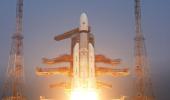
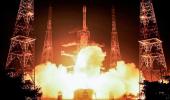
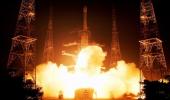
The 44.4-metre-tall PSLV-DL variant, designated PSLV-C62 and weighing about 260 tonnes at lift-off, was launched at around 10.18 am IST on Monday from the first launch pad at the Satish Dhawan Space Centre in Sriharikota.
This variant first flew in January 2019 to place the Microsat-R satellite into orbit, and Monday's mission marked its fifth flight.
Configured as a four-stage launch vehicle using alternating solid and liquid propulsion systems, the PSLV is equipped with six strap-on boosters to provide additional thrust during the early phase of flight.
After lift-off, the rocket climbed steadily, trailing a bright orange plume.
Around four minutes into the mission, the third stage ignited and later shut down.
Based on the broadcast visuals, a rocket expert said the failure appeared similar to the anomaly seen during the PSLV-C61 mission.
The setback adds to a growing list of failed strategic space missions in recent years.
On May 18, 2025, PSLV-C61 failed mid-flight while carrying EOS-09, a synthetic aperture radar satellite designed to enhance surveillance capabilities.
That satellite, similar to EOS-04 launched in 2022, was estimated to cost about Rs 850 crore.
Earlier, on January 29, 2025, GSLV-F15 failed to insert the NVS-02 navigation satellite --valued at around Rs 300 crore -- into its designated orbit due to a faulty pyro valve that prevented the flow of oxidiser despite normal fuel pump performance.
Taken together, these failures have resulted in financial losses running into several hundred crore rupees, apart from significant opportunity costs.
India has faced comparable setbacks in the past.
In 2021, the GISAT-1 strategic satellite was lost after the cryogenic stage of the GSLV-F10 failed to ignite.
In 2017, the IRNSS-1H navigation satellite was lost when the PSLV's heat shield failed to separate, trapping the satellite inside the rocket.
ISRO later attributed that failure to a malfunction in the pyro separation system.
Venkatachari Jagannathan can be reached at venkatacharijagannathan@gmail.com
Photographs curated by Anant Salvi/ Rediff
Feature Presentation: Ashish Narsale/Rediff




 © 2026