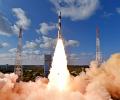
Andhra Pradesh will establish two expansive integrated space cities in Lepakshi and Tirupati, spanning around 33,000 acres.

Thursday's launch is the last one of 2020 for ISRO.

Skyroot Aerospace has become the first private company in India to give wings to the Indian space programme, after the sector was opened to private players by the Centre in 2020.
A PSLV rocket carrying Earth observation satellite EOS-09 failed to launch from the Sriharikota spaceport early on Sunday.

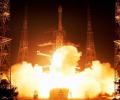
Indian Space Research Organisation's 101st mission from Sriharikota, an earth observation satellite onboard the agency's trusted Polar Satellite Launch Vehicle (PSLV) rocket, could not be accomplished on Sunday following a pressure issue in the third stage of the launch vehicle, the space agency said.
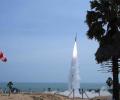
The fuel cost will come down if rockets are launched from Kulasekarapattinam as they will have a straight trajectory and need not have to avoid Sri Lanka, which is being done by rockets flown from Sriharikota.
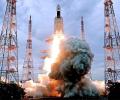
'You can observe a lot of things from space.' 'Another thing is communication, in real time, especially in war-like situations.' 'During Operation Sindoor, we could play our part well.'
'There's too much coincidence in back-to-back failures of missions critical to national security.'

India took another leap in space infrastructure with the foundation stone laid for a new launch pad at the country's second rocket port in Kulasekarapattinam.

The NASA-ISRO NISAR mission has entered its 90-day commissioning phase, involving rigorous checks and calibrations to prepare the satellite for Earth observation. Scientists highlight the collaborative benefits and technological advancements of the mission.
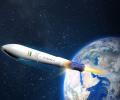
The Vikram-I rocket will fly with its maximum carrying capacity and put the satellites in a Low Earth Orbit.

Glimpses from India and around the world that will make you smile and cry.

Notably, four portfolio companies-- Agnikul, ePlane, CynLr, and GalaxEye -- of deep-tech investor Speciale Invest made it to the list.

Twice every 12 days, the NISAR satellite will scan nearly all of earth's land and ice surfaces to measure changes in the planet's ecosystems, growth and retreat of its land and sea ice, and deformation of its crust.
The Indian Space Research Organisation successfully launched its 100th mission on Wednesday, with a GSLV rocket carrying navigation satellite NVS-02.

With plans for 60 missions over the next five years, Indian Space Research Organisation will develop a third launch pad at its spaceport at Sriharikota in Andhra Pradesh to meet the growing demand.
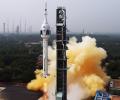
Chandrayaan-4 will involve at least two separate launches of the heavylift LVM-3 rocket that will carry five different components of the mission which will be assembled in orbit.
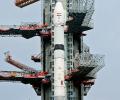
The main focus of the all weather RISAT-1B satellite will be to observe the Indian land with its C-band synthetic aperture radar.
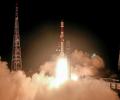
The two Space Docking Experiment (SpaDeX) satellites that the Indian Space Research Organisation is hoping to unite are at a distance of 1.5 km and will be brought much closer on January 11, the space agency said on Friday.
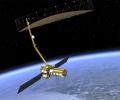
NISAR will not be used for surveillance and will be used to observe the earth.
'The satellite's condition is healthy.'
'The work is already on with various data being studied.'
The Indian Space Research Organisation (ISRO) on Sunday said the two satellites launched to perform space docking experiments were brought within three metres and then moved safely back in a trial attempt.
ISRO is part of an exclusive league which has forayed into the Moon and Sun.
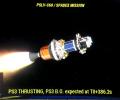
Dubbed as a prelude to ISRO setting up its own Space Station by 2035, the PSLV-C60 mission would also make India join an elite club in achieving this feat which is expected to take place in the coming days.
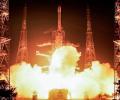
ISRO's vendor policy and quality control processes are under scanner.
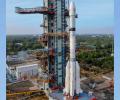
At 6.23 am on 29.1.2025, the 50.9 metre tall and weighing 420.7 ton Geosynchronous Satellite Launch Vehicle-F15 (GSLV-F15) is slated to blast off from the second launch pad carrying the 2,250 kg NVS-02 navigation satellite.

'We started AgniKul to show that space transportation should be as simple as road transportation.'

In terms of success rate, the PSLV rocket has an enviable record of 57 successful missions out of 58 commercial ones.
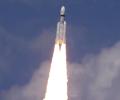
Currently, some of the rocket hardware for the human space programme has reached the Satish Dhawan Space Centre in Sriharikota and the integration of the crew module was going on at the Vikram Sarabhai Space Centre, Trivandrum, ISRO chairman S Somanath said.

President Droupadi Murmu addressed both Houses of Parliament, highlighting the government's achievements in various sectors, including economic growth, social welfare, and infrastructure development. She emphasized the government's efforts to lift the economy out of "policy paralysis" and create a more inclusive society. Murmu also acknowledged the challenges posed by digital fraud and cybercrime and stressed the need for a social infrastructure revolution. The President's speech is considered a policy statement, outlining the government's vision and roadmap for the future.
If it becomes a reality, the Chennai-based company will become the first private player from India to conduct such a mission to the lunar surface.
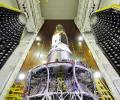
India will launch the PSLV-C56 carrying DS-SAR satellites from Singapore, along with six co-passenger satellites, from ISRO's Sriharikota spaceport on Sunday, July 30, 2023.

ISRO said the upper stage of the Polar Satellite Launch Vehicle - C37 (PSLV-C37) re-entered the earth's atmosphere on October 6, 2024 and the impact point was the North Atlantic Ocean.

Here is the timeline of the moon mission as undertaken by the Indian Space Research Organisation.

Preparations are in the final stages by the Chennai-headquartered space-tech startup Agnikul Cosmos for the maiden launch of India's first-ever private launchpad and the second rocket launch by a private sector player.

The Indian Space Research Organisation (ISRO) successfully launched its third and final developmental flight of Small Satellite Launch Vehicle here on Friday whose payloads can be used in applications like satellite-based surveillance, disaster and environmental monitoring, fire detection, volcanic activity among others.

The test vehicle development flight (TV-D1) is aimed at testing the crew module that will carry Indian astronauts during the human spaceflight late next year.
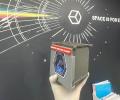
'To access our satellite, you don't need any IQ test, you don't need to write an examination.' 'You can be a Class 1 student, an engineering student, a 60-year-old person, anybody can access our satellite.'
