
A new report from the Stockholm International Peace Research Institute (SIPRI) indicates that India has expanded its nuclear arsenal and is developing long-range weapons capable of reaching targets across China, while also maintaining focus on its rivalry with Pakistan.

India is increasingly focusing on long-range weapons capable of reaching targets across China.

Pakistan has criticised India's recent remarks on Pakistan-occupied Kashmir (PoK) protests, asserting it is addressing issues democratically. Pakistan also warned India against blocking water, calling it an "act of war," and commented on India's nuclear capabilities and its own military strikes in Afghanistan.

Russian President Vladimir Putin has offered New Delhi Russia's fifth-generation stealth aircraft Sukhoi Su-57 and even suggested that the combat jet could even be jointly produced in India in line with the strong strategic partnership between the two countries.

Police in Jhansi have arrested four individuals involved in an online betting racket during Indian Premier League (IPL) matches, seizing transaction records worth approximately Rs 1.5 crore and uncovering cryptocurrency links.

A lesson for India is to clearly define objectives beforehand, so that the adversary or other parties do not attempt to mitigate them midway.

Two individuals have been arrested in Jhansi for allegedly operating an online betting racket during IPL matches. Police seized mobile phones with digital transactions exceeding Rs 8 crore and have frozen bank accounts linked to the accused.

India's defence expenditure surged to $92.1 billion in 2025, making it the world's fifth-largest military spender, according to SIPRI data. This 8.9 per cent year-on-year rise was primarily driven by operational and procurement needs following heightened regional tensions with Pakistan in May 2025.
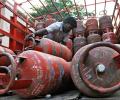
More than 500 filled LPG cylinders were allegedly stolen from a truck in Jhansi during the Holi festival, according to police reports.

A 19-year-old law student was found dead near a railway track in Jhansi, India, prompting a police investigation into the circumstances surrounding his death.
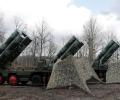
Russia continued as India's main arms supplier, the Stockholm International Peace Research Institute said.
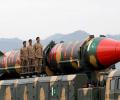
After Donald Trump became president of the United States, he unleashed economic weaponisation, upsetting the old world order, leading to much unrest. If that wasn't all, the threat of an imminent nuclear war was issued by the US, Russia, China, North Korea and Pakistan. In today's fractious times, Dr Paulos Mar Gregorios would have made a dent, notes His Holiness Baselios Marthoma Mathews III.

The increase in India's military spending was "mainly a result of growing personnel and operations costs" which made up almost 80 percent of the total military budget in 2023, the SIPRI report claimed.

Nearly all of the nine nuclear-armed States, including India and Pakistan, continued intensive nuclear modernisation programmes in 2024, upgrading existing weapons and adding newer versions, according to a report by a global think-tank.
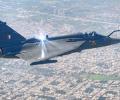
India's military expenditure in 2024 was nearly nine times that of Pakistan's, according to a study released by the Stockholm International Peace Research Institute (SIPRI). India's spending reached USD 86.1 billion, while Pakistan spent USD 10.2 billion. China's military spending continued to rise, reaching USD 314 billion, accounting for 50% of all spending in Asia and Oceania.

The nine nuclear-armed states -- the United States, Russia, the United Kingdom, France, China, India, Pakistan, Israel and the Democratic People's Republic of Korea (North Korea) -- together possessed an estimated 13,080 nuclear weapons at the start of 2021.
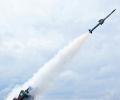
'There are only a few countries in the world that have deployed combat-ready laser systems.'

HAL, BEL and MDL feature on Sipri's list of the 100 largest arms producers in the world.
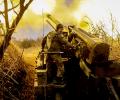
The five largest exporters of major arms in 2020-2024 were the US (43 per cent), France (9.6 per cent), Russia (7.8 per cent), China (5.9 per cent), and Germany (5.6 per cent).
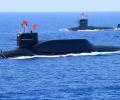
China has delivered a second advanced submarine to Pakistan, part of a larger deal to bolster the South Asian nation's naval capabilities in the Indian Ocean. The move underscores China's growing influence in the region and its strategic partnership with Pakistan.
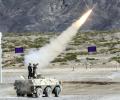
The Chinese military Thursday declined to comment on the performance of China-made weapons used by Pakistan in the recent conflict with India.
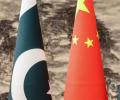
The Chinese military on Monday denied reports that its largest military cargo plane has carried arms supplies to Pakistan and warned legal action against those spreading such rumours.
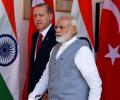
India-Turkiye ties are strained over Ankara's Islamabad tilt, its arms links with Pakistan, and fallout from the Pahalgam terror attack.

The report put India's 'stored' nuclear warheads at 172 in January this year while the number for Pakistan was 170.

India's defence sector presents an ordering opportunity worth $138 billion between fiscal years 2023-24 (FY24) and FY32, said a latest note by Nomura, which has initiated coverage on two defence-related players - Hindustan Aeronautics (HAL) and Bharat Electronics (BEL) - with a 'buy' rating. The research and broking house sees an upside potential of 28 per cent and 32 per cent, respectively in these two stocks from the current levels.
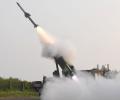
'China is in the middle of a substantial expansion of its nuclear weapon arsenal, which satellite images indicate includes the construction of over 300 new missile silos,' SIPRI's statement noted.

India spends significantly less on defence than could be expected from a country that faces simultaneous armed threats from two hostile neighbours -- China and Pakistan.

India remained the world's top arms importer, but its imports declined by 11 per cent between 2013-17 and 2018-22, according to a report released on Monday by Stockholm-based defence think-tank SIPRI.
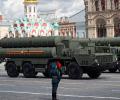
In contrast, India's arms imports from France increased more than tenfold, making it India's second largest arms supplier in 2017-21, it stated.

DRDO's failures over the decades have contributed significantly to India becoming the world's biggest weapons importer, points out Lieutenant General Prakash Katoch (retd).

With military expenditure of USD 81.4 billion (one billion=100 crore), India's spending was up by six per cent from 2021 and by 47 per cent as compared 2013.

The five biggest spenders in 2018 were the United States, China, Saudi Arabia, India and France, which together accounted for 60 per cent of global military spending, it said.

India's military spending of USD 76.6 billion ranked third highest in the world.

Both the Asian giants were among the top three countries spending more on armaments, according to a new report by the Stockholm International Peace Research Institute.
49.4 per cent of India's arms imports between 2016 and 2020 were from Russia.
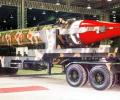
According to the report, Russia tops the table with 6,375 warheads, followed by the United States with 5,800, and the United Kingdom with 215 warheads.
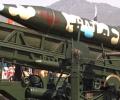
Pakistan is believed to have 140-150 nuclear warheads this year, 10 more than last year. In contrast, India is said to have 130-140 nuclear warheads, according to the annual nuclear forces data by Stockholm International Peace Research Institute.

Heavy overnight rains in Uttar Pradesh on Friday led to the deaths of at least 22 people, including nine labourers who were buried alive under the debris when an under-construction wall in the state capital collapsed on their huts.

In the last four months, the Centre has been reviewing all the "Buy-Global" cases that are in the contracting phase right now, Jaju said.
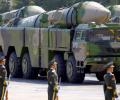
According to the experts, a lot of countries have little or no faith in Chinese companies because of poor after-sales support and equipment that rapidly declines into non-functional machinery.
