
The US House of Representatives has passed the Lindsey O Graham Sanctioning Russia and Iran Act of 2026, authorising President Trump to impose sanctions on Russia's energy sector and tariffs on countries like India and China that purchase Russian oil and gas. The legislation aims to curb Russia's ability to evade existing sanctions and reduce global dependence on its energy exports, despite some Democratic opposition to increased tariff authority for the President.

Analysts predict that crude oil prices, geopolitical tensions in West Asia, and upcoming inflation data will be the primary drivers of the Indian stock market this week, alongside foreign investor activity and domestic quarterly earnings.

Indian benchmark indices, Sensex and Nifty, closed lower, primarily due to a downturn in banking and financial stocks, coupled with crude oil prices remaining above USD 80 per barrel. Geopolitical uncertainties and new regulatory proposals for the non-bank lending sector also contributed to cautious investor sentiment.

Indian benchmark indices Sensex and Nifty opened higher, extending gains from the previous session, driven by a rally in global markets and a slight cooling in crude oil prices. Optimism around a potential meeting between US and Iranian presidents also contributed to positive sentiment.Later both indices pared gains and were trading in red. Track Sensex, Nifty on September 22.

State-run Oil and Natural Gas Corporation (ONGC) has made a significant gas discovery in the deep waters of the Mahanadi Basin off the Odisha coast, recording encouraging flow and sustained reservoir pressure, a breakthrough for India's deepwater exploration programme.

The US House of Representatives has advanced a bill that would empower President Donald Trump to impose 100 per cent tariffs on countries, including India, that purchase oil and gas from Russia, and also extend sanctions on Iran. The legislation, which previously passed the Senate, aims to curb Russia's energy revenue amidst the Ukraine conflict.

Foreign Portfolio Investors (FPIs) have withdrawn Rs 20,974 crore from Indian equities in September, driven by global uncertainties, higher US interest rates and bond yields, elevated crude oil prices, and a weakening rupee.

FPIs have already withdrawn Rs 2.6 trillion from Indian equities in 2026, exceeding the outflows recorded in any previous full calendar year.

Indian Oil Corporation Ltd (IOCL) plans to invest approximately Rs 1 trillion in petrochemical projects over the next five to six years, aiming to significantly increase its petrochemical intensity and production capacity to meet growing domestic demand.
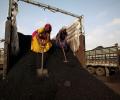
India's nine key infrastructure sectors recorded a three-month low growth of 4.8 per cent in August, primarily due to reduced production in coal, natural gas, crude oil, and fertiliser, according to government data.

Indian benchmark equity indices, Sensex and Nifty, rallied in early trade, driven by positive global market trends and easing crude oil prices, despite the US Federal Reserve's hawkish stance tempering overall sentiment. Track Sensex, Nifty on September 18.

India has stated its commitment to protecting its economic interests and ensuring energy security after the US House of Representatives passed a bill allowing the US President to impose tariffs of up to 100 per cent on countries, including India and China, for purchasing Russian crude oil. The Ministry of External Affairs affirmed India's resolve to maintain diversified energy sourcing and has articulated its concerns to US interlocutors regarding the bill's potential implications.

President Donald Trump is set to sign the Sanctioning Russia and Iran Act, which includes tariffs on countries buying Russian oil and gas, such as India. India has voiced concerns over the potential impact on its ties with the US and the global energy market.

Fast-moving consumer goods (FMCG) companies in India are committed to maintaining current prices through the festive season, despite facing increased commodity costs and geopolitical disruptions. This strategy aims to protect consumer demand and sustain volume growth, even as margins remain under pressure.

US lawmakers are racing to amend the Russia sanctions bill before recess. One amendment specifically names India, China, and other countries as potential targets for 100% tariffs due to their oil trade with Russia. Another significant amendment proposes to scrap the tariff section entirely, while others address presidential waiver powers and aid to Ukraine.

Foreign portfolio investors (FPIs) have withdrawn nearly Rs 5,109.21 crore from Indian government securities under the fully accessible route (FAR) in just three days, driven by global uncertainty, elevated crude prices, rising US Treasury yields, and a depreciating rupee.

Pakistan's government is exploring measures, including potential smart lockdowns and austerity, to reduce petroleum consumption. This comes after recent fuel price hikes driven by rising global oil prices and West Asia tensions, which have also raised concerns about oil supply disruptions. The government is also implementing a fuel relief scheme and faces public pressure over the price increases.

The US military has refuted Iran's Revolutionary Guards' assertion that an oil tanker struck a naval mine in the Strait of Hormuz. US Central Command stated the Panama-registered vessel, El Gaia, was previously hit by an Iranian missile and then a drone, highlighting ongoing Iranian attempts to impede commercial vessels in the crucial maritime trade route.

'It is a blunt and dangerous attempt to pressure India to sign BTA on one-sided terms.'

Indian benchmark indices, Sensex and Nifty, saw early gains driven by lower crude oil prices and buying in Reliance Industries, even as the Reserve Bank of India maintained its benchmark policy rate for the fourth consecutive meeting, reinforcing confidence in the domestic economy.

'If crude remains above $100 per barrel, with restricted retail-price increases, OMCs could face negative petrol and diesel marketing margins, higher LPG under-recoveries, higher crude-landing, freight and insurance costs, working capital and debt accumulation and inventory losses if crude subsequently corrects sharply.'

Chinese President Xi Jinping is set to visit the United States from September 23 to 25 for summit talks with US President Donald Trump, with discussions expected to cover critical economic and trade issues, including AI, and the recently signed US sanctions law targeting countries buying Russian oil and gas.
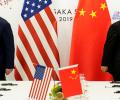
Top US and Chinese officials, including Vice Premier He Lifeng and Treasury Secretary Scott Bessent, held "candid, in-depth and constructive" talks in New York on economic and trade issues, with a specific focus on artificial intelligence. These discussions precede Chinese President Xi Jinping's anticipated visit to Washington and occur amidst new US sanctions targeting countries purchasing Russian oil and gas, and the US unveiling an "AI Force."

Indian benchmark equity indices, Sensex and Nifty, closed mixed on Friday. While a drop in crude oil prices offered some relief, weakness in IT stocks and several Tata Group counters, including a significant dip in Tata Chemicals and ongoing boardroom issues at Tata Sons, limited a broader market recovery.
Crude oil futures surged over 3 per cent, snapping a three-session losing streak, as renewed military escalation in West Asia revived fears of supply disruptions, driving prices higher on both domestic and international exchanges.

Indian-American Congressman Raja Krishnamoorthi voted in favour of a Russia sanctions act in the US House, diverging from his Democratic party and other Indian-American lawmakers. The bill, which passed, imposes tariffs on Russian oil and gas buyers, potentially impacting India and China, and exempts US uranium purchases from Russia.

Trump has enacted a new law imposing significant sanctions on Russia and Iran, which could lead to tariffs of up to 100% on major energy importers like India and China.

The Finance Ministry is set to commence its pre-budget meetings on October 12, initiating preparations for the Union Budget 2027-28, which will be the fourth budget of the Modi 3.0 government and the tenth for Finance Minister Nirmala Sitharaman.

Indian benchmark indices, Sensex and Nifty, saw an early rebound after significant losses, driven by value buying, though elevated oil prices and anticipation of the US Federal Reserve's policy decision tempered gains. Track Sensex, Nifty on September 16.

Indian benchmark indices Sensex and Nifty experienced significant declines in early trade, driven by soaring crude oil prices amidst escalating tensions in West Asia, coupled with weak global market trends and foreign fund outflows.

Karuveppilai Puli Sadam is a delicious South Indian rice dish with a wonderful balance of tangy, spicy and aromatic flavours.

US President Donald Trump is expected to sign the Lindsey O. Graham Sanctioning Russia and Iran Act of 2026 later on Friday (local time). A White House official confirmed the development to ANI without revealing further details.

India has expressed serious concern over Houthi attacks on Saudi Arabia's civilian infrastructure and economic assets, stating that such actions threaten regional stability and freedom of navigation through the Bab-el-Mandeb strait. External Affairs Minister S Jaishankar discussed the issue with his Saudi counterpart. India also condemned the targeting of commercial shipping after an Indian national went missing following an attack on a Panama-flagged ship off Oman.

Petrol pump dealers seek exemption from the proposed 5 UPI charge on fuel purchases above 2,000, citing pressure on their margins.

Indian benchmark indices, Sensex and Nifty, closed almost unchanged due to profit-taking in blue-chip stocks, geopolitical uncertainties, fluctuating oil prices, and weak Asian market trends, despite cooling US inflation offering some support.

India has condemned an attack on a Panama-flagged oil tanker off the coast of Oman, which resulted in one Indian seafarer going missing and 13 others being rescued. The Ministry of External Affairs is closely monitoring the situation and coordinating with Omani authorities for search and rescue operations, while also reiterating calls for de-escalation and safe navigation in the region.

Rishi Panchami Bhaji, also known as Rushichi Bhaji, is a traditional Maharashtrian and Konkan festive preparation made during Rishi Panchami, observed on the second day of Ganesh Chaturthi. The dish brings together seasonal vegetables, leafy greens and tubers, reflecting the simplicity and abundance of traditional cooking.

Indian benchmark indices, Sensex and Nifty, traded marginally higher in early trade despite the US Federal Reserve's recent rate hike and indications of further tightening, with the National Stock Exchange's much-anticipated Rs 22,569-crore IPO also opening for subscription.
Foreign Portfolio Investors (FPIs) withdrew Rs 13,138 crore from Indian equities in the first half of September, driven by heightened global uncertainty, rising crude oil prices, firm US bond yields, and a strong dollar, impacting risk appetite.

Indian benchmark indices Sensex and Nifty extended their losses for the fourth consecutive session, with the Sensex declining 363.66 points and the Nifty dipping 126.65 points, primarily due to a sharp jump in Brent crude oil prices to USD 98.32 per barrel amid escalating tensions in West Asia.
