
Jammu and Kashmir Lieutenant Governor Manoj Sinha terminated the services of five more government employees for suspected terror links, bringing the total number of employees sacked since 2020 to 85.

The officials found that his browsing history indicated an interest in the deployment of paramilitary forces in the Kashmir valley, prompting them to ascertain the purpose of his visit to the strategically important Zanskar region in Ladakh late last month.
In 2025, India launched Operation Sindoor, a multi-domain combat mission against Pakistan in response to cross-border terrorism. The operation involved precision strikes, military retaliation, and diplomatic measures, marking a significant shift in India's security policy.

The missile was showcased at the recent Dubai Air Show and drew huge interest from potential buyer countries.
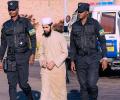
The Central Bureau of Investigation (CBI) has brought back Salman Rehman Khan, an alleged member of the Lashkar-e-Taiba, from Rwanda. Khan was wanted by the NIA for terror-related offences in Bengaluru. He was traced to Rwanda and returned to India on November 28, 2024. The return of Khan comes after similar operations in coordination with Interpol, where two other accused were brought back from Saudi Arabia.
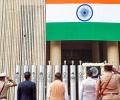
Maharashtra Chief Minister Devendra Fadnavis on Wednesday paid floral tributes at the city police headquarters to those who made the ultimate sacrifice while fighting terrorists during the 2008 Mumbai terror attacks.
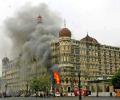
Lawyer Ujjwal Nikam says that while justice has been delivered to some victims of the 26/11 Mumbai terror attacks, their conspirators are still hiding in Pakistan. He criticizes Pakistan's handling of the trials of those arrested and calls for action against masterminds like Hafiz Saeed and Zakiur Rehman Lakhvi.

In a key revelation, former Central Intelligence Agency (CIA) officer John Kiriakou has said that Al Qaeda founder Osama bin Laden, who was the most wanted terrorist for the United States after the terrorist attacks of September 11, 2001, had escaped from the Tora Bora hills in Afghanistan in the guise of a woman.
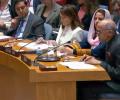
India told the UN Security Council that it calls for a pragmatic engagement with the Taliban, underlining that a focus on only punitive measures will ensure a 'business as usual' approach.

Terrorists opened fire at a popular tourist spot near Kashmir's Pahalgam town on Tuesday afternoon, killing 26 people, mostly holidayers from other states, in what is the deadliest attack in the Valley since the Pulwama strike in 2019.
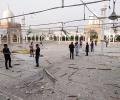
"Similarly, 60 launchpads are working in the other depth areas away from the border," BSF DIG Vikram Kunwar told reporters in Jammu.

A journalist in Karachi was killed by activists of an extremist Islamist group after making pro-Israel comments. Four suspects have been arrested.
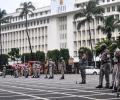
The Maharashtra Police are drafting a drone-use policy to strengthen security and surveillance in key cities, including Mumbai, as part of preparations against unconventional terror threats, a senior official said on Wednesday.

Indian authorities have requested additional information from the United States based on the interrogation of Tahawwur Rana, an accused in the 2008 Mumbai terror attacks. The request was made through the Mutual Legal Assistance Treaty (MLAT).
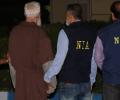
The National Investigation Agency (NIA) has begun questioning Tahawwur Hussain Rana, the mastermind behind the 2008 Mumbai terror attacks, to uncover the larger conspiracy behind the deadly strikes. Rana, who was extradited from the US, is being held at the NIA headquarters in New Delhi. The interrogation is focused on his possible connection with the Lashkar-e-Taiba (LeT) and his suspected links with the Pakistani spy agency Inter-Services Intelligence (ISI).
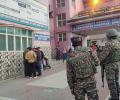
Jammu and Kashmir Lieutenant Governor Manoj Sinha dismissed two government employees, both teachers, for their alleged links with terrorists. The action is part of Sinha's zero-tolerance policy against terrorism and a broader crackdown on the terror ecosystem within Jammu and Kashmir.
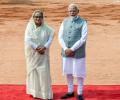
'If she hadn't left Bangladesh, the militants had planned on killing her'
The trial of Abu Jundal, accused in the 26/11 Mumbai terror attacks, is set to resume after the Bombay High Court overturned a lower court order requiring authorities to hand over confidential documents to the accused.
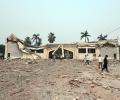
Months after India's precision strikes on nine terror camps across Pakistan and Pakistan-occupied Kashmir (PoK), a viral video of Lashkar-e-Taiba (LeT) commander Qaasim has surfaced.
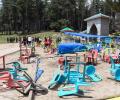
Records stretching back to 1947 suggest a consistent strategy by Pakistan's military and intelligence apparatus, the Inter Services Intelligence (ISI), of using terrorism as a state policy against India.

The search operation turned into an encounter after the terrorists fired on a search party of the forces, who then fired back, the official said.
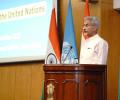
External Affairs Minister S Jaishankar criticizes Pakistan's attempts to protect a terror group at the UN Security Council, highlighting the need for urgent reforms within the global body.

Two suspected Lashkar-e-Taiba terrorists were killed when army troops scuttled an infiltration attempt along the Line of Control in Poonch district of Jammu and Kashmir, officials said on Wednesday.

Attacking the Congress, Union Minister Kiren Rijiju said that India has "paid a heavy price" for the sins committed by the Congress while Union Minister Pralhad Joshi has accused the Oppostion party of "mishandling" the situation after the 2011 terror attacks in Mumbai in under foreign pressure.
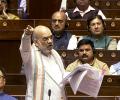
Home Minister Amit Shah stated in the Rajya Sabha that the terrorists responsible for the Pahalgam attack were killed in Operation Mahadev. He also criticized the Congress party's stance on national security.

Mumbai police have arrested a 50-year-old man from Noida for allegedly sending a threat message claiming 14 terrorists had entered the city with 400 kilograms of RDX to carry out blasts.

The officials said Usman, who was well familiar with the Valley terrain, was a significant figure in orchestrating numerous terror attacks since his initial activity in the early 2000s.

On Tuesday, August 5, 2025, on the 6th anniversary of the abrogation of Article 370 and Article 35A, Jammu and Kashmir Lieutenant Governor Manoj Sinha along with J&K Police Director General Nalin Prabhat and Chief Secretary Atal Dulloo handed over government job appointment letters to family members of terror victims in Srinagar.
'Another demonstration of strong India-USA counter-terrorism cooperation. Appreciate the Department of State for listing The Resistance Front (TRF) as a designated Foreign Terrorist Organization and Specially Designated Global Terrorist.'

In his address, Jaishankar warned that those who condone nations that sponsor terror will find that it "comes back to bite them".

As the police make security arrangements for Anant Chaturthi, the 10th day of the Ganesh festival, the traffic police control room on Thursday received a threat message on their WhatsApp helpline, the official said.

The deadly attack on the Uri garrison on September 18 nine years ago marked the end of India's policy against crossing the Line of Control to target Pakistan-based terrorists. It paved the way for the Balakot Air Strikes in 2019 and Operation Sindoor.
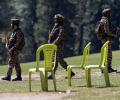
The terrorists chose Baisaran as the target due to its "high tourist presence", "relative isolation" and after considering that the "response (from the security agencies) would take time".
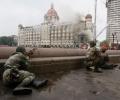
The Maharashtra government informed the Bombay High Court that Faheem Ansari, acquitted in the 26/11 terror attack case, was denied a police clearance certificate due to ongoing suspicion of being a member of a banned terror organization. Ansari sought the certificate to operate an autorickshaw.
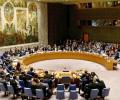
Pakistan and China have submitted a joint bid at the UN Security Council to designate the Balochistan Liberation Army (BLA) and its suicide wing - Majeed Brigade - as a terrorist entity under the Council's 1267 Al Qaeda Sanctions Committee.

Afghan Foreign Minister Amir Khan Muttaqi announced that Kabul will send diplomats to India as part of efforts to improve bilateral relations. He assured New Delhi that Afghan soil will not be used for activities detrimental to India's interests.

Trump also repeated his claim that seven fighter jets or more were shot down during the hostilities.

Lashkar-e-Taiba terrorist Razaullah Nizamani Khalid alias Abu Saifullah Khalid, who was the brain behind the 2006 attack on the Rashtriya Swayamsevak Sangh headquarters, was killed by three unidentified gunmen in Sindh province of Pakistan on Sunday, officials in New Delhi said.
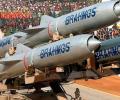
The Navy would be using the missiles for equipping its Veer-class warships while the Indian Air Force would be using them to equip its Russian-origin Su-30 MKI fighter jet fleet, the sources said.
According to the chargesheet, Rana played a crucial role in supporting terrorist David Coleman Headley, a Pakistani-American operative linked to Lashkar-e-Taiba, by facilitating his reconnaissance missions across Mumbai.
