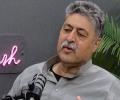
Former separatist leader Bilal Gani Lone has entered mainstream politics, aiming to represent his father's legacy and address the issues facing Kashmiri youth.
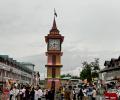
Lal Chowk in the heart of Srinagar was Kashmir's leading venue for protests where fortified defences had been set up by security forces. Today a group of youngsters dances at the Chowk and makes reels.
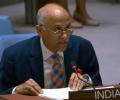
In a strong retort against Pakistan in the United Nations Security Council, India on Monday said its neighbour as a country that 'bombs its own people' and conducts 'systematic genocide'.

Janhvi Kapoor is having a golden moment at the Toronto International Film Festival, and she captures it perfectly by wearing a gown of the same colour.

Songs Of Paradise is the story of a female achiever that needed to be told, just as her songs of love and longing deserve to be rediscovered and shared with music aficionados, observes Deepa Gahlot.

...a time when his legacy ledger was still positive and before the debacle against China. With every subsequent election, our leaders tend to become weaker. India should consider passing a law that no person should hold the highest office in our country for more than two terms, points out Harishchandra.

'We were told that we would be taken care of when we reached Delhi. But we did not find a single Kashmiri government official who could guide us.'
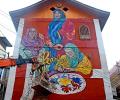
Lady artists led by Zoya Khan painted murals of Kashmir's women handicraft artists on a four storeyed building in Srinagar this week.

A strike in Pakistan-occupied Kashmir (PoK) over unfulfilled demands turned violent, resulting in one death and multiple injuries. Mobile and internet services have been suspended in the region.
Former separatist leader Bilal Gani Lone criticizes the Hurriyat Conference for its irrelevance and Pakistan for creating problems in Jammu and Kashmir, urging a new approach for the region's future.

'I'm sure those few terrorists who are continuing to operate in the Valley are not reading books.' 'Are they trying to tell us that there are certain people who first intellectualise themselves and then go about picking up guns?' 'It is absolutely absurd.'
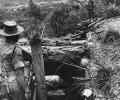
On November 18, 1962, 114 soldiers of the 13th Kumaon fought till the last man, and last bullet, in sub-zero temperatures, to beat back the huge Chinese army. We salute the Heroes of Rezang La.

In May, 40 Rohingyas were blindfolded and flown to the Andaman and Nicobar islands and then thrown into the sea and made to swim to an island in Myanmar. And after the Pahalgam attack, at least 300 Muslims were 'pushed back' to Bangladesh from Assam.
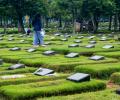
As many as 2,493 graves were identified as belonging to foreign terrorists who were killed in counter-insurgency operations.
These individuals often lacked identification to conceal their networks and maintain Pakistan's plausible deniability.

Two days after Kashmiri journalist Asif Sultan was released from a five-year detention, he has been rearrested in Srinagar in another case, officials said on Friday.

Superheroes, sleuths and Sara Ali Khan in love, catch all kinds of fun-sized action on OTT this week.
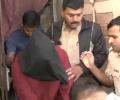
Javed Munshi, suspected to be a member of the outlawed 'Tehreek e Mujahideen' outfit in Kashmir Valley, was picked up from near Canning Hospital by a joint team of Jammu and Kashmir Police and West Bengal Police's Special Task Force, the officer said.

Visuals of Jammu and Kashmir Chief Minister Omar Abdullah scaling the gate of the Naqshband Sahib graveyard and jostling with securitymen deployed there have gone viral.

A social media influencer's video promoting communal harmony, featuring the purchase of a Ganesh idol from a Muslim seller, has sparked controversy, leading to its deletion and an apology from the creator.


The usual rush of devotees was missing this year, presumably due to the Pahalgam terror attack and the military action between India and Pakistan following it.

Yamuna floodwater caused massive traffic jams in Delhi, disrupting morning rush-hour traffic and leaving commuters stranded for hours. Key stretches like Kashmere Gate, Ring Road, and Kalindi Kunj were heavily congested.

'He is the same man who has won honours for the country across the world.'

Terror outfits in Jammu and Kashmir are now constructing elaborately-designed underground bunkers deep inside thick forests and elevated ridges instead of taking shelter in local houses, officials said. This tactical shift, fuelled by eroding local support, presents a new challenge to the Army and other security forces.
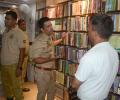
Bookstore owners were cautioned against keeping or distributing the books. Police personnel briefed the bookstore owners about the legal consequences of violating the ban.

Pakistan Army Chief Asim Munir has described terrorism in Jammu and Kashmir as a 'legitimate struggle', saying his country would always stand by the people of Kashmir in their struggle.

Looking for party starters for New Year?
The process for the takeover of the management of the schools began on Saturday morning as officials of district administrations, principals of the respective nearest high and higher secondary schools, accompanied by police teams, reached these schools, the officials said.
'Often people outside paint a wrong picture of us of Kashmiris. We are not like that. We are cool and bindaas,' said the lady, a teacher, caressing my cheeks in the pressing crowds.
'Tourism will get hit. Thousands of lives will suffer. Businesses will shut down.'

Police conduct raids at bookshops in Kashmir to seize banned books promoting false narratives and glorifying terrorism, following a government order. The ban and subsequent raids have drawn criticism from authors and political leaders.
Prime Minister Narendra Modi on Monday asserted that he would keep promises he had made to the people of Jammu and Kashmir, a statement seen as an oblique reference to the demand for restoration of statehood voiced strongly by Chief Minister Omar Abdullah.

Kashmiri farmers have begun to harvest tomatoes -- it is the tomato harvest season in the Kashmir Valley -- and we wonder if it will bring relief to consumers elsewhere in the Union deprived of the juicy tomato in their curries.

Hurriyat Conference chief Mirwaiz Umar Farooq condemned the Pahalgam attack, calling it an "act beyond belief" and "totally unacceptable." He also called for unity and condemned the communal narrative surrounding the incident, urging the government to allow him to visit the injured and offer condolences to the families affected.
The surge in radicalisation has even startled some ex-separatist groups as they are concerned that another religious extremism wave, forced from the other side of the Line of Control, will destabilise the Valley's centuries-old Sufi tradition.

Sonam Wangchuk is under tight surveillance within the three-tiered prison, with CCTV cameras monitored around the clock.

It was a dream-come-true moment for Kashmiri youth Nazim Nazeer on Thursday as Prime Minister Narendra Modi not only took a selfie with him but also referred to him as a 'friend'.
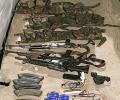
Security agencies have gathered evidence, including Pakistani government documents and biometric data, confirming that the terrorists involved in the Pahalgam attack were Pakistani nationals.

She's rewriting the rules of glam, one stunning look at a time -- all sophistication and serious slay!
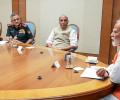
'If Pakistan has fired one bullet at us then we have to respond by firing 10 bullets at them. It is our right to do so.'
