
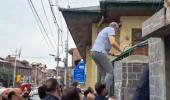
Visuals of Jammu and Kashmir Chief Minister Omar Abdullah scaling the gate of the Naqshband Sahib graveyard and jostling with securitymen deployed there have gone viral.

Abdullah, his father Dr Farooq Abdullah and other National Conference leaders reached the martyrs graveyard in Srinagar on Monday to pay tribute to the 22 Kashmiris killed while protest against the state's then maharaja on July 13, 1931.
On Sunday, the Abdullahs and other prominent Kashmiri leaders were reportedly kept under house arrest to prevent them from going to the graveyard.
Why has Kashmir's Martyrs Day observance become controversial? Syed Firdaus Ashraf/Rediff offers an explanation.
What is Martyrs' Day in Kashmir about?
On July 13, 1931, a group of men gathered outside Srinagar Jail in support of Abdul Qadeer Khan, who had urged the people of Kashmir to rise against Maharaja Hari Singh, the Dogra ruler. Khan had been arrested for sedition, and during the protest outside the jail, 22 people were shot dead.
Since then, July 13 has been marked as Martyrs' Day in the Kashmir Valley.
Why is this year's observance of Martyrs' Day significant?
This year's Martyrs' Day held special significance because for the first time in six years, Jammu and Kashmir has an elected government following the abrogation of Article 370 in 2019. People had hoped to return to the earlier tradition of paying respects at the martyrs' graveyard.
So, what happened?
The Government of India did not allow any public tributes.
Kashmiri political leaders were reportedly placed under house arrest on Sunday, although there was no official announcement confirming their detention.
Many viewed this move as a suppression of democratic expression and historical memory.
What did the police do?
The Jammu and Kashmir police stopped J&K Chief Minister Omar Abdullah from entering the martyrs' graveyard in Srinagar where he was reportedly pushed and blocked from entering.
Eventually, he climbed over the barricade to offer fatiha (prayers) for the martyrs. There was also a minor scuffle at the venue.
Abdullah later commented: 'The unelected nominees from New Delhi have locked up the elected leaders of Jammu & Kashmir.'
What did Omar Abdullah and his National Conference party have to say?
Chief Minister Omar Abdullah called it 'our Jallianwala Bagh'.
Posting on X, he stated: '13th July massacre is our Jallianwala Bagh. The people who laid down their lives did so against the British. Kashmir was being ruled under the British Paramountcy.
'What a shame that true heroes who fought against British rule in all its forms are today projected as villains only because they were Muslims. We may be denied the opportunity to visit their graves today but we will not forget their sacrifices.'
National Conference spokesperson Tanvir Sadiq added: 'We've always honoured the July 13 martyrs and will continue to do so. We've promised to restore the Martyrs' Day holiday and will work towards that.'
Removing the holiday, Sadiq said, is part of a broader attempt to erase J&K's political identity.
Why did the Indian government take this step?
After scrapping Article 370, the GoI removed Martyrs' Day from the list of official holidays in Jammu and Kashmir.
Instead, it introduced two new holidays.
September 23 -- Maharaja Hari Singh's birthday.
October 26 -- the day Maharaja Hari Singh signed the Instrument of Accession in 1947, making J&K a part of India.
Since 2019, July 13 is no longer an official holiday in Jammu and Kashmir.
What is the Instrument of Accession?
In 1947, as India gained independence, around 580 princely states had to choose between joining India or Pakistan, or remain independent. The decision to join India was formalised by signing the Instrument of Accession.
Maharaja Hari Singh initially wanted Jammu and Kashmir to stay neutral and signed standstill agreements with both nations.
However, after an invasion by tribal forces backed by Pakistan, he sought military help from India.
India agreed -- on the condition that J&K join the Indian Union. The Maharaja signed the Instrument of Accession on October 26, 1947.






 © 2025