
'We have not even used 0.1% of the available resources.'

A cyclonic circulation lies over the southeast Bay of Bengal and the adjoining south Andaman Sea extending up to middle tropospheric levels. Under its influence, a low pressure area is very likely to form over the southeast Bay of Bengal and neighbourhood during the next 24 hours.
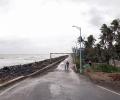
West Bengal Chief Minister Mamata Banerjee on Friday said that one person died in the state in cyclone Dana, even as the administration evacuated around 2.16 lakh people from the low-lying areas.

India received 41 per cent more rainfall than normal from October 1-21 with Uttarakhand alone recording more than five times its normal precipitation, IMD data showed on Thursday.

The IMD has issued a red-colour coded warning for the southern areas of Tamil Nadu Kerala in view of the brewing storm and said that these areas are expected to receive heavy to very heavy rainfall.

On May 15, the weather office had announced the onset of monsoon over Kerala by May 31.

A deep depression over the Bay of Bengal intensified into a cyclonic storm, named Remal, on Saturday evening and is likely to turn severe before making landfall between the coasts of West Bengal and Bangladesh on Sunday midnight, the India Meteorological Department (IMD) said.

Lakhs of voters will have to bear the searing heat when they step out to exercise their franchise in the second phase of the Lok Sabha elections on Friday.

The news will augur well for the country as large parts have been witnessing agriculture distress and water levels in reservoirs in west and south India have dipped to low levels.

Several deaths were reported across the country due to rain-related incidents like lightning strikes and drowning.

It is in more than a decade that the IMD has predicted 'above-normal' rains in the country.

At least 10 flights scheduled to land at the Delhi airport were diverted -- eight to Jaipur and two to Lucknow -- due to inclement weather conditions. Airlines also warned of the possibility of more flight disruptions.

Six weather stations across Delhi recorded over 100 mm of rain in a single day, the India meteorological department (IMD) said on Thursday, categorising it as an "extremely intense spell".

Heavy rains continued to lash several parts of Kerala on Thursday, leading to waterlogging in the low-lying areas of major cities, including Thiruvananthapuram, Kochi and Thrissur.
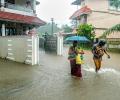
The heavy rains led to water level in various dams in the state rising to the red alert mark, prompting the government to open one of the shutters of Cheruthoni dam of Idukki reservoir in the afternoon.

The IMD director said, the cyclonic storm Tauktae in the Arabian sea is moving away from the Kerala coast and is now approaching the Karnataka coast.

The mercury in Delhi, which recorded its hottest day of the year so far at 45.6 degrees Celsius on Sunday, came down to 42.4 degrees Celsius, according to the India meteorological department.

Amid low growth elsewhere, gross value added (GVA) growth in agriculture and allied activities recovered during the second quarter of the current financial year (Q2FY25) to 3.5 per cent year-on-year (Y-o-Y) due to strong monsoon. Experts feel that the rains have laid the foundation of an even better GVA performance in subsequent quarters. GVA growth in the first quarter of FY25 was 2.0 per cent.

More than 39.8 lakh people in 27 of the 33 districts in the state were affected by the deluge on Thursday.

While the IMD had forecast a 'normal' monsoon for the entire season, Skymet stated that rain this year would be 'below normal', report Sanjeeb Mukherjee and Sahil Makkar.


Heavy falls at isolated places are very likely over Kerala on April 29 and 30. The system will not make landfall in Tamil Nadu, but may bring light rain in some northern parts, it said.
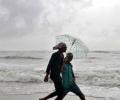
Southwest monsoon has furthered advanced into some parts of south Arabian Sea

Meanwhile, trains ran on time on the Main and Western lines of the Central Railway (CR) and Western Railway (WR) on Saturday.

Given IMD's past record on forecasts, the latest one could also go wrong.

This should augur well for the rabi crops as delayed withdrawal will leave enough moisture in the soil for early sowing.

A total of 435 people died in the country due to extreme weather events during the last three months of the southwest monsoon, according to the data compiled by the India meteorological department.

Heavy rains had battered the metropolis on Sunday and Monday as well.

He said scientists have noticed a trend of very deep cloud systems developing over the southeast Arabian Sea, and added that sometimes, these systems intrude into the land, like in 2019.

The India meteorological department (IMD) on Wednesday evening issued a red alert for Mumbai and its neighbouring districts, predicting "extremely heavy rainfall".

Cold-day conditions prevailed in parts of north India on Friday though the maximum temperatures rose slightly amid clear skies and sunshine during the day.

The India meteorological department predicted mainly clear skies with heatwave conditions in many parts of Delhi and severe heat wave conditions in other areas.

Incessant rain with intermittent heavy spells led to waterlogging on some roads and railway tracks, slowing down the public transport services.

The maximum temperature on Saturday settled at 18.1 degrees Celsius, two notches below the season's average, and the minimum was recorded at 3.6 degrees Celsius, four notches below the season's average, the IMD said.

The IMD has fancy weather-monitoring radars in the name of providing better forecasts.

Satellite imagery showed a layer of dense fog extending from Punjab and north Rajasthan to the northeast. Patches of fog were also visible along the east coast.
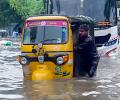
Heavy rain continued to lash Chennai and other parts of Tamil Nadu on Wednesday, bringing residential neighborhoods and roads under knee-deep water and leading to traffic congestion besides affecting public transport services.

Ten to 20 days of heatwave are expected against the normal of four to eight days in the entire April-June period.

A sudden downpour in Delhi caught citizens off guard and caused heavy waterlogging and traffic jams on Tuesday while Mumbai breathed a sigh of relief as showers stopped a day after heavy rain brought the metropolis to its knees.

To ensure immediate cooling of the body, the hospital has set up a first-of-its-kind heatstroke unit.
