
Six weather stations across Delhi recorded over 100 mm of rain in a single day, the India meteorological department (IMD) said on Thursday, categorising it as an "extremely intense spell".

Given IMD's past record on forecasts, the latest one could also go wrong.

Meanwhile, trains ran on time on the Main and Western lines of the Central Railway (CR) and Western Railway (WR) on Saturday.

This should augur well for the rabi crops as delayed withdrawal will leave enough moisture in the soil for early sowing.

Heavy rains had battered the metropolis on Sunday and Monday as well.

A total of 435 people died in the country due to extreme weather events during the last three months of the southwest monsoon, according to the data compiled by the India meteorological department.

Amid low growth elsewhere, gross value added (GVA) growth in agriculture and allied activities recovered during the second quarter of the current financial year (Q2FY25) to 3.5 per cent year-on-year (Y-o-Y) due to strong monsoon. Experts feel that the rains have laid the foundation of an even better GVA performance in subsequent quarters. GVA growth in the first quarter of FY25 was 2.0 per cent.

The IMD has fancy weather-monitoring radars in the name of providing better forecasts.

Cold-day conditions prevailed in parts of north India on Friday though the maximum temperatures rose slightly amid clear skies and sunshine during the day.

He said scientists have noticed a trend of very deep cloud systems developing over the southeast Arabian Sea, and added that sometimes, these systems intrude into the land, like in 2019.

The India meteorological department predicted mainly clear skies with heatwave conditions in many parts of Delhi and severe heat wave conditions in other areas.

The India meteorological department (IMD) on Wednesday evening issued a red alert for Mumbai and its neighbouring districts, predicting "extremely heavy rainfall".
The IMD chief also allayed fears of occurrence of an El-Nino.

The maximum temperature on Saturday settled at 18.1 degrees Celsius, two notches below the season's average, and the minimum was recorded at 3.6 degrees Celsius, four notches below the season's average, the IMD said.

The depression formed over Lakshadweep in the Arabian Sea would turn into a cyclonic storm in the next 24 hours and reach near the Gujarat coast on the morning of May 18, officials said.

Incessant rain with intermittent heavy spells led to waterlogging on some roads and railway tracks, slowing down the public transport services.

Satellite imagery showed a layer of dense fog extending from Punjab and north Rajasthan to the northeast. Patches of fog were also visible along the east coast.
El Nino is expected to occur in August-September, but it is unlikely to have any major impact on the monsoon, and the weatherman expects a positive Indian Ocean Dipole, which has a strong influence on rainfall in the country.

Ten to 20 days of heatwave are expected against the normal of four to eight days in the entire April-June period.

To ensure immediate cooling of the body, the hospital has set up a first-of-its-kind heatstroke unit.

A sudden downpour in Delhi caught citizens off guard and caused heavy waterlogging and traffic jams on Tuesday while Mumbai breathed a sigh of relief as showers stopped a day after heavy rain brought the metropolis to its knees.
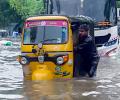
Heavy rain continued to lash Chennai and other parts of Tamil Nadu on Wednesday, bringing residential neighborhoods and roads under knee-deep water and leading to traffic congestion besides affecting public transport services.

Delayed by 10 days due to cyclone Biparjoy, southwest monsoon is likely to progress further and hit Mumbai between June 23 and 25, the India meteorological department said on Wednesday.

The met department said that rainfall in August is projected to be within the normal range at 97% of LPA. In August and September, India receives around 43 mm of rainfall.

The administration is geared up for more showers as the India meteorological department has warned of heavy to very heavy rains with isolated extremely heavy rains in several districts of the state till Thursday morning.

The weather office has issued a forecast of heavy to very heavy rains at isolated places in several districts of Gujarat over the next one week.

Sowing had started on a sluggish note in several parts of the country because of delay in the onset of the monsoon but has picked up pace subsequently as the rains progressed and performed appreciably well in August.

The IMD issued a 'red alert' for Pune district and asked people to take precautions.

The Met office has issued a "red" warning for Delhi, Haryana, Punjab and west Rajasthan, stressing the need for "extreme care for vulnerable people".

Villpuram district in north Tamil Nadu continued to reel under unprecedented flooding on Monday following extremely heavy rainfall, virtually blocking access to villages and residential colonies as bridges and roads overflowed, inundating huge acreage of standing crops and leaving passengers stranded as rail and road traffic was hit.
Gross Value Added (GVA) growth in agriculture and allied activities in the first quarter of the 2024-25 financial year (Q1FY25) dipped to 2.7 per cent at constant prices from 4.2 per cent in Q1FY24 due to a drop in output of some crops following heatwave in the main growing months. Low post-monsoon rains, which dried most of the reservoirs in several states across the country, also impacted the production of many crops. At current prices, the growth was estimated at 8.5 per cent as against 4.1 per cent in Q1FY24 due to a spike in food inflation during the April to June months of FY25.

As weather patterns grow more unpredictable due to climate crisis, India is taking a giant leap with "Mission Mausam" to improve weather understanding and forecasting through expanded observation networks, better modeling and advanced tools like AI and machine learning.

Amid the heavy downpour in Bengaluru, residents of many flood-affected areas have taken to social media to pour out their woes ranging from waterlogging to complaining about "crumbling" infrastructure.

The rains after arriving over Kerala will quickly cover Tamil Nadu and Karnataka, but then might slacken a bit, which could delay its arrival over Northwest India.

After making landfall near Puducherry on November 30, Cyclone Fengal weakened on Sunday, but torrential downpour under its influence paralysed the union territory, with the Army stepping in to evacuate stranded persons in inundated streets.

The official India Meteorological Department (IMD) and the private Skymet Weather Services have made widely divergent monsoon forecasts.

Delhi's air quality deteriorated significantly on Monday, with areas like Dwarka, Mundka and Najafgarh recording an AQI of 500, the worst this season. The city's overall AQI reached 491, triggering the implementation of the Graded Response Action Plan (GRAP) Stage-IV restrictions in Delhi-NCR. Doctors warned of health risks, urging people to wear N95 masks and avoid outdoor activities. The Supreme Court questioned the Delhi government on its anti-pollution measures and warned against scaling down preventive measures without its permission. Delhi Chief Minister Atishi accused the BJP-led central government of political maneuvering while neglecting stubble burning in states it governs. Meanwhile, the city enforced stricter pollution control measures, including a ban on truck entry and suspension of construction activities. Air purifier sales surged, reflecting the public's concern over the severe air pollution.


By now, monsoon should have reached the central India, including parts of Madhya Pradesh, Rajasthan, eastern Uttar Pradesh and Gujarat, but it is yet to reach Maharashtra.

The situation in rain-battered Gujarat improved slightly on Thursday as the rainfall activity subsided, but Vadodara and some other parts of the state are still reeling under a flood-like situation due to overflowing rivers while the authorities continue the rescue and relief operations.
