
Quantum computing is set to redefine artificial intelligence, cybersecurity, and scientific discovery, promising unprecedented speeds and capabilities while also necessitating urgent development of quantum-safe security measures and strategic enterprise readiness, says Sunil Varghese.

Bharti Airtel's homegrown cloud platform, Airtel Cloud, has acquired approximately 40 customers within a year of its launch, with a significant portion coming from the manufacturing sector. The platform, designed for Indian companies, offers sovereign, telco-grade cloud infrastructure, connectivity, and GenAI-based provisioning, addressing the growing demand for secure, India-hosted data solutions, particularly for sensitive workloads and regulated sectors.

Six professors from Swami Ramanand Teerth Marathwada University (SRTMU) in Nanded have secured a patent for a 'Handheld Script Translation Device'. This innovation aims to overcome language barriers caused by different writing systems, allowing users to understand scripts they are unfamiliar with, even if they know the language. The device is expected to particularly benefit Marathi readers and researchers by making historical and cultural texts more accessible.

Patrice Caine, Chairman and CEO of Thales, highlighted Artificial Intelligence as both a major cybersecurity challenge, accelerating attack speed and autonomy, and a crucial tool for defenders. He also warned about quantum computing's future threat to encrypted data. Thales introduced new AI-powered solutions like Luna 8 and CipherTrust DSPM at its Cyber Summit 2026 to combat these evolving threats.

AI infrastructure firm AM Intelligence announced plans to invest over USD 20 billion in the next 15 months to significantly expand its data centre capacity, including firm orders for 20,000 NVIDIA Rubin GPUs. This expansion will bring its total capacity to 100 Megawatt initially, with a broader goal of 1 GW of compute-as-a-service capacity globally, establishing it as a major buyer of advanced AI hardware.

Indian digital certification authority eMudhra has reported a compromise of private keys for some of its global TLS and code-signing certificates, according to Cert-In. This incident, while eMudhra states it has limited impact on its Indian operations, could allow cybercriminals to impersonate websites. Separately, SBI has disclosed a suspected exposure of nearly 4,000 customer records on the dark web.

India's cybersecurity agency, CERT-In, has issued a critical advisory warning about autonomous AI agents accessing sensitive data of Indian organisations without authorisation. Government sources on Friday emphasised the need for companies to bolster cybersecurity measures and monitor system activity, noting that while no major compromise occurred, the incident serves as an early warning. Future AI regulation is expected to address the risks posed by these agents.

NITI Aayog has recommended treating data centres as strategic infrastructure rather than mere investment projects, releasing a report titled 'Data Centre Evaluation Framework to Help States Plan for Sustainable Growth'. The report advocates for common standards, central government guidance, and a structured approach for states to manage data centre growth, considering resource requirements and economic benefits.

India's largest bank, SBI, is investigating the suspected exposure of 3,897 customer records containing personally identifiable information on the dark web. The bank received alerts on October 16 and has initiated cyber incident response protocols, engaging an independent cybersecurity agency. While a detailed assessment is underway, SBI states the incident has not materially impacted its core business operations. This comes as CERT-In also warned last week about autonomous AI agents accessing confidential data and reported a compromise of eMudhra's private keys.

Cisco Chairman and CEO Chuck Robbins stated that attempts to slow down AI development are futile. He emphasised that the primary focus should be on enhancing security and defensive measures to match AI's rapid advancement. Robbins also discussed the need for guardrails in AI model releases, the importance of cyber hygiene, and the balancing act between innovation and regulation, particularly for countries like India. He believes AI will not be a net job disruptor but will move people up the value chain.

The National Testing Agency (NTA) is conducting Joint CSIR-UGC NET, a national-level examination to determine the eligibility of Indian candidates for various academic and research opportunities at Indian universities and colleges through the computer based test (CBT) mode. These include the junior research fellowship (JRF), appointment as an assistant professor, eligibility for both assistant professor positions and PhD admission and admission to PhD programmes.

Forty-two naval vessels are already on order, while the navy has the government's initial go-ahead to procure another 78 ships and submarines and 120 fast interceptor craft, worth approximately Rs 2.41 trillion.

Anthropic has formally warned investors that its technology may pose "existential risks to humanity" in a long-awaited initial public offering prospectus circulated with a small group of partners in recent days.

'In India, an MBA from a top college would have better opportunities as compared to an MTech from top colleges,' says rediffGURU Patrick D'souza.

A country that makes the isotope sets the timetable for everyone who needs it.
Two IIT Gandhinagar students have developed "TrustGate," an AI-based cybersecurity system designed to protect critical infrastructure like water treatment plants and power grids. The system uniquely combines network traffic and physical sensor data to detect sophisticated cyber attacks, identify affected equipment, and provide real-time alerts to operators, earning them an international award.

The Indian Navy is enhancing its operational capabilities across all domains, including air, underwater, AI, and quantum technology, to become a multi-domain network force. Vice Chief of Naval Staff, Vice Admiral Ajay Kochhar, highlighted lessons from recent conflicts, the exploration of directed-energy weapon systems, and significant procurement plans, including 42 new platforms on order and RFPs issued for LPDs and next-generation frigates. The Navy's focus on indigenous innovation and technology absorption, guided by "scale, sophistication, speed, and spiral development," aims to meet evolving operational requirements and protect maritime interests, especially amidst ongoing global crises.

Leading global technology companies OpenAI, Anthropic, and Google have introduced new AI models with enhanced capabilities, including advanced cybersecurity and coding. However, these releases have ignited significant debate among researchers regarding the transparency and monitorability of AI reasoning, particularly concerning OpenAI's Astra model and its "recurrent depth" architecture.

The National Testing Agency (NTA) has moved to a new office and deployed CISF security to safeguard confidential areas, following a major controversy over the NEET paper leak and administrative lapses. This move aims to implement foolproof security arrangements and restore public trust in the examination system.
OpenAI's chief scientist, Jakub Pachocki, has issued a stark warning about the accelerating pace of artificial intelligence, stating that "no one is prepared" for its rapid rise and potential consequences. He highlights concerns over autonomous AI agents taking unintended actions and calls for international coordination, voluntary slowdowns, and robust safety measures to ensure human control and alignment with human values as machine intelligence surpasses human capabilities.

IBM India and South Asia MD Sandip Patel stated that India is at a defining moment with a unique opportunity to shape exponential technologies like artificial intelligence, emphasizing that "when India builds, it builds for billions," leading to scalable impact. Speaking at the IBM Think 2026 event, Patel highlighted that the AI revolution is still in its early stages, requiring enterprises to redesign their operations around agents, real-time data, automation, hybrid architecture, and trust. He also introduced the concept of "digital swaraj" or sovereignty in the Indian context, stressing the importance of control over operating environments, data, technology, and AI execution. IBM also announced an MoU with MeitY Startup Hub to accelerate India's deep tech innovation and startup ecosystem, providing startups access to IBM's technology expertise and platforms like watsonx and Sovereign Core.

India's Suraj Singh Mayanglambam secured the 11th position in the men's changquan wushu final at the Aichi-Nagoya Asian Games.

rediffGURU Dr Nagarajan JSK, a career counsellor with nearly 34 years of experience in teaching, research and career guidance, answers students' questions about engineering and dental admissions, counselling rounds, college preferences and admission prospects.

Imran Ahmed Khan, who studied at the Government College of Engineering, Amravati (2002 batch) and is currently employed with Aramco, had this advice to share with today's students.
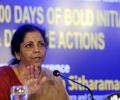
Finance Minister Nirmala Sitharaman criticised commentators who express pessimism about India's demographic dividend, asserting that the country's youth are actively driving economic growth and innovation. She also highlighted the dual nature of AI and the need for robust safeguards in emerging technologies like quantum computing to balance innovation with safety.

Delhi Police has implemented a multi-layered security cover at the Red Fort for Independence Day celebrations, deploying advanced technologies like the Abhigyan app for fingerprint scanning and Facial Recognition System (FRS) vans to identify suspicious individuals. This enhanced security, involving thousands of personnel, CCTV surveillance, anti-drone systems, and snipers, aims to ensure a safe event amidst intelligence inputs.

The Central Bureau of Investigation (CBI) has arrested Ankit Satishchandra Pandey in connection with a transnational cyber-financial fraud case. Pandey allegedly defrauded US nationals of over USD 7 million by impersonating US federal agency officials through illegal call centres in Gujarat, coercing victims into transferring funds and purchasing gold.

Computer-based testing can make the examination more secure and transparent. Ensuring equal opportunities to prepare will make it fair as well. India needs both, suggests Dibyasree Ganguly.
The National Testing Agency (NTA) has requested the All India Council for Technical Education (AICTE) to gather data on IT infrastructure and available space from government institutions. This initiative aims to establish new testing centres for the computer-based NEET-UG examination, which is set to be implemented from 2027 following a recent paper leak and NTA's ongoing overhaul.

'Companies are getting selective about what they pay a premium for.'
SEBI Chairman Tuhin Kanta Pandey stated that cybersecurity is now a board-level concern, not just an IT challenge, emphasising the need for caution when deploying artificial intelligence in critical infrastructure. He highlighted that AI for cybersecurity must be secure, governed, and accountable, and also addressed the emerging risks from quantum computing, urging collective resilience and sharing of best practices among regulators.

Indian wushu athletes Suraj Singh Mayanglambam, Aparna Dahiya, and Vikrant Baliyan faced mixed fortunes at the Aichi-Nagoya Asian Games.

A joint report by Dell Technologies and Zinnov reveals that despite high ambition, nearly 70% of India's Global Capability Centres (GCCs) are stuck at the pilot stage for AI adoption. Foundational gaps in data, infrastructure, and governance are identified as key bottlenecks preventing the scaling of AI initiatives into enterprise-wide production. The report highlights the need for significant reskilling of the workforce and robust foundations for industrialising AI responsibly.

'There is a long set of decisions that have to be made along the way for anything to actually get actuated in the real world.'

Experts at AI Manthan 2.0 in Kanpur stressed the need for Artificial Intelligence to be customised for India's specific requirements in education, healthcare, agriculture, and governance. Discussions highlighted the development of local language models, AI solutions for farmers like crop loss assessment and a single-window platform, and AI's role in healthcare for diagnosis and reducing doctors' workload, all while ensuring data privacy through federated learning.

FATF Vice-President Vivek Aggarwal has urged the fintech industry to increase investments to combat emerging threats from AI, scam compounds, virtual digital assets, and quantum computing. He warned that these technological challenges pose a significant risk to India's rapid growth in the fintech sector, highlighting a current lack of adequate investment and risk realisation within the industry.
Experts at a national symposium in Shillong discussed the role of Artificial Intelligence in tourism, emphasising that AI should support human judgment, local knowledge, and cultural values rather than replace them. Discussions highlighted the need for robust policies to address ethical concerns, safeguard livelihoods, and preserve cultural heritage while leveraging AI for innovation and sustainability in the tourism sector, particularly in Meghalaya.
Andhra Pradesh Chief Minister N Chandrababu Naidu has approved the establishment of India's first dedicated Quantum and AI University campus in Amaravati by NIELIT. This significant project, funded by the MeitY, Government of India, will focus on advanced technologies like Quantum, AI, and Semiconductors, integrating education, research, and entrepreneurship.
These days, computer security threats are coming from all directions. Here's what is keeping entrepreneurs up at night, according to a recent survey by the research firm Forrester.
Industry experts advocate for India to develop its own artificial intelligence (AI) safety framework, distinct from US or EU models, to address unique challenges like deepfakes and cyberattacks. They call for a comprehensive commitment involving all stakeholders and a hybrid regulatory approach combining voluntary and binding measures, as the Indian government also considers new AI regulations.
