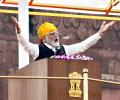
The invitation cards for the 79th Independence Day celebration also carry the Operation Sindoor logo, and the water mark of Chenab bridge to exemplify the rise of 'Naya Bharat'. Floral decorations at the venue will also be based on 'Operation Sindoor'.

Shehbaz emphasised that water was a lifeline for Pakistan, and no compromise would be made on the country's rights under international agreements, as per Geo News.

Celebrations broke out in Mithun Manhas' ancestral village in Jammu on Sunday after the former Delhi captain's ascension to BCCI presidency, with the people terming it a moment of pride for the region.

The Centre is planning to undertake a study to look into ways to maximise the use of the quantum of water from the three rivers that Pakistan had earlier used under the Indus Water Treaty, now that the agreement has been suspended, officials said.
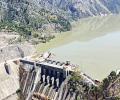
India has suspended the Indus Waters Treaty with immediate effect, accusing Pakistan of breaching the pact by refusing to negotiate modifications and engaging in sustained cross-border terrorism. The decision follows a recent terror attack in Jammu and Kashmir that killed 26 people. Pakistan has rejected India's move, calling it an "act of war."

"Not only that, Pakistan is also the enemy of poor's bread and butter. What happened on April 22 in Pahalgam is an example of that. Pakistan attacked 'insaniyat' and Kashmiriyat in Pahalgam.

Over 5,000 people have been evacuated from flooded areas in the Jammu region following heavy rains and flash floods. Rescue and relief operations are underway to restore essential services and provide assistance to those affected.
Weeks after India placed the 1960 Indus Waters Treaty (IWT) in abeyance following the April 22 Pahalgam terror attack, Pakistan has signalled its willingness to discuss New Delhi's long-standing concerns about the treaty, sources said.
Experts discuss the Indus Waters Treaty, highlighting its engineering aspects and addressing criticisms of unfairness to India.
India's measures announced against Pakistan on April 23 will remain effective, the sources said.
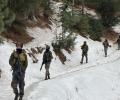
Two terrorists, including a top commander of the Pakistan-based Jaish-e-Mohammad (JeM) outfit, were killed in an ongoing operation in a snow-bound area of Jammu and Kashmir's Kishtwar district. The operation began on Wednesday following a brief encounter and continues. A separate operation to track down three other terrorists has also been underway in Udhampur district since Wednesday.

AIMIM chief Asaduddin Owaisi slammed Pakistani politician Bilawal Bhutto-Zardari for his "blood would flow in rivers" remark and called former cricketer Shahid Afridi a "joker" for his comment on the Pahalgam terror attack. Owaisi also supported India's decision to suspend the Indus Waters Treaty and called for Pakistan to be placed on the FATF grey list. He also advocated for cyber attacks against Pakistan.

Heavy rains battered Jammu and Kashmir, triggering floods, damaging infrastructure, and disrupting normal life. Authorities issued advisories and rescue operations were conducted.

Political parties, cutting across affiliations and ideologies, Friday welcomed the Kashmir rail link inaugurated by Prime Minister Narendra Modi, hoping for a boost in trade and tourism in the valley.

The Indus system of rivers comprises the main river -- the Indus -- along with its five left bank tributaries, namely, the Ravi, the Beas, the Sutlej, the Jhelum and the Chenab. The right bank tributary, the Kabul, does not flow through India.

Relentless heavy rain led to a landslide on the route to the Mata Vaishno Devi shrine atop the Trikuta hill on Tuesday afternoon, killing at least five people and injuring 14, officials said.

After record rains wreaked havoc in Jammu and Kashmir over the past two days, the death toll in related incidents rose to 41, most of them victims of the landslide on a Vaishno Devi pilgrimage route, while there was some let-up in the showers on Wednesday, allowing relief efforts to pick up pace.

Dr Singh, who arrived at Jammu airport by a special plane from New Delhi on Friday afternoon, flew in a helicopter to the Chenab bridge site, about 27-km from Jammu, and dedicated it to the nation. Governor Lt. Gen. (retd) S K Sinha, Chief Minister Ghulam Nabi Azad, Deputy Chief Minister Muzaffar Hussain Baig and former chief minister Mufti Mohammad Sayeed were among others who received the prime minister at the airport and also accompanied him to the bridge site.
'Anybody who says one critical word can be branded as somebody who's glorifying terrorism.'

Former Pakistan foreign minister Bilawal Bhutto had acknowledged his country's tango with terror operatives, saying that Pakistan has a past.
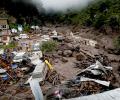
Jammu and Kashmir Chief Minister Omar Abdullah briefed Prime Minister Narendra Modi on a devastating cloudburst in Kishtwar district that claimed 60 lives and injured over 100. Abdullah expressed condolences and assured assistance, while also questioning potential administrative lapses.
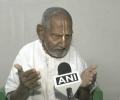
Swami Shivanand Saraswati, known as the world's 'oldest saint', claims to be 129 years old and has been attending the Kumbh Mela for 100 years.
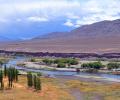
'Militarily, it risks escalating tensions with Pakistan, potentially triggering conflict due to Pakistan's heavy reliance on the Indus.'

The delayed timing of J&K Lieutenant Governor Manoj Sinha's admission has more to do with deflecting the thrust of the Opposition attack on the prime minister and Union home minister during the monsoon session of Parliament, points out Mohammad Sayeed Malik, the distinguished commentator on Kashmir affairs.
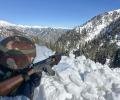
The exchange of fire occurred even though the directors general of military operations of India and Pakistan spoke over the hotline on Tuesday amid rising tensions between the two countries over the Pahalgam terror attack on April 22.
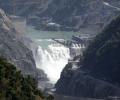
Pakistan has raised objections to four power projects being built by India on the Chenab river on the ground that they allegedly violate the Indus Waters Treaty.
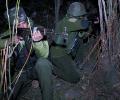
For the ninth consecutive night, Indian and Pakistani troops engaged in small arms fire along the Line of Control (LoC) in Jammu and Kashmir, continuing a pattern of heightened border tensions. The skirmishes, initiated by Pakistani troops in violation of the ceasefire agreement, have led to a tense situation along the LoC and International Border (IB). The incidents come in the wake of the April 22 terror attack in Pahalgam, which claimed the lives of 26 people, mostly tourists. Civilians residing near the border have begun preparing their bunkers, anticipating potential escalation. Despite a recent hotline conversation between the Directors General of Military Operations (DGMOs) of India and Pakistan, where India cautioned Pakistan, the ceasefire violations persist.

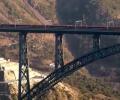
The much-awaited world's highest railway bridge spans the Chenab river at a height of 359 metres (1,178 feet) above the river, which is 35 metres taller than Paris' Eiffel Tower.
A red alert has been issued by the administration as the mighty river was flowing two to three degrees below the danger\nmark in Pul-Doda, Ramban and Akhnoor belts of the division.

Pakistan's ambassador to Russia, Muhammad Khalid Jamali, has warned that Pakistan will respond with "full spectrum of force", including nuclear, if it is attacked or its vital water flow is disrupted. The warning comes amid heightened tensions between Pakistan and India following a terrorist attack in Jammu and Kashmir. Jamali also reiterated Pakistan's stance on the Indus Water Treaty, saying any attempt to stop or divert water flow would be considered an act of war. He urged de-escalation, emphasizing the potential danger given both countries possess nuclear weapons. Jamali further called for a neutral investigation into the Kashmir attack, suggesting the involvement of China and Russia. He also highlighted the need to address the root causes of the conflict, pointing to the unresolved Kashmir issue and its potential for resentment.
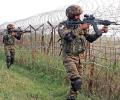
Pakistan troops have violated the ceasefire agreement for the 11th consecutive night, firing on Indian posts along the Line of Control (LoC) in Jammu and Kashmir. The firing began in Kupwara and Baramulla districts and spread to other sectors, including Poonch, Rajouri, Mendhar, Naushera, Sunderbani, and Akhnoor. The Indian Army responded promptly and proportionately. The ceasefire violation comes despite a recent phone call between the Directors General of Military Operations (DGMOs) of India and Pakistan on April 29. This marks the latest escalation of tensions between the two countries, following a terror attack in Pahalgam in April.
While the BJP went back to the drawing board to recraft its political and governance outreach and regained momentum by notching up surprisingly big wins in a string of assembly polls, the burst of fresh optimism in the main opposition Congress and other INDIA bloc parties fizzled out.
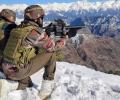
Pakistan's troops have engaged in unprovoked firing along the Line of Control (LoC) and International Border (IB) in five districts of Jammu and Kashmir, prompting retaliation from the Indian Army. This marks the eighth consecutive night of such incidents, following heightened tensions stemming from a recent terror attack in Pahalgam. Civilians residing along the LoC and IB are preparing their bunkers in anticipation of potential escalation.

Since signing of the treaty, a total of 118 such tours on both the sides have been undertaken.
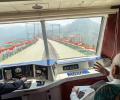
The train, on its maiden trial run, arrived at Srinagar station in the Nowgam area on Srinagar's outskirts from Katra in Jammu.

Terrorism and insurgency in J&K had subsided when India demolished East Pakistan -- for the simple reason that Pakistan understands power. We need to follow Chanakya's dictum of Saam, Daam, Dand, Bhed for strategising against Pakistan, asserts Lieutenant General Prakash Katoch (Retd). The ground truth is that unless we are prepared to acknowledge our shortcomings, including massive intelligence failures, punish those responsible and take corrective actions, we will continue in the same vein, asserts Lieutenant General Prakash Katoch (Retd).
Pakistan has halted the construction of contentious canals in Punjab province after India suspended the Indus Waters Treaty following a deadly terrorist attack in Kashmir. The decision to suspend the canals project was made after Prime Minister Shehbaz Sharif met with PPP chairman Bilawal Bhutto-Zardari and agreed to address the concerns of Sindh province, where the project had sparked protests. The canals project, aimed at irrigating the desert region in Punjab, was seen as a threat to water resources in Sindh. Both sides have agreed to seek consensus on the issue in the Council of Common Interests (CCI), a high-powered inter-provincial body. Meanwhile, Pakistan has reiterated the importance of the Indus Water Treaty for its water security and economy, and condemned India's move to suspend it.
'India's letter to Pakistan on April 24 (2025; two days after the Pahalgam terrorist attack) didn't tear up the treaty -- but it did put it on ice.'
According to Pakistan, India will violate the Indus Water Treaty by constructing a hydropower project on Chenab.
