
India and China have agreed to advance discussions on an "Early and Substantial Harvest" of boundary delimitation and border management during the 25th round of Special Representatives talks between National Security Advisor Ajit Doval and Chinese Foreign Minister Wang Yi in Beijing. Both sides reached an eight-point consensus, committing to the 2005 Agreement on Political Parameters and Guiding Principles for Settlement. Key outcomes include enhancing border management, improving understanding of the Line of Actual Control, establishing new meeting points and hotlines, and continuing cooperation on trans-border rivers and pilgrimage.

China emphasises proper handling of differences and a long-term perspective for bilateral ties ahead of President Xi Jinping's visit to India for the BRICS summit and talks with Prime Minister Narendra Modi. The visit aims to stabilise relations following the 2020 Ladakh standoff and strengthen BRICS cooperation.
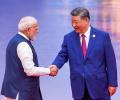
Ahead of Xi Jinping's visit, National Security Advisor Ajit Doval and Chinese Foreign Minister Wang Yi held extensive talks in Beijing on August 25 on the boundary issue and reached an eight-point consensus.

Chinese President Xi Jinping is set to visit the United States from September 23 to 25 for summit talks with US President Donald Trump, with discussions expected to cover critical economic and trade issues, including AI, and the recently signed US sanctions law targeting countries buying Russian oil and gas.

China has strongly rejected a US bill that would impose tariffs on countries, including India, for purchasing Russian oil and gas. Beijing views the "Lindsey O Graham Sanctioning Russia and Iran Act 2026" as an act of "long-arm jurisdiction" and interference in its sovereign trade relations, asserting that its economic cooperation with other nations is based on equality and mutual benefit.
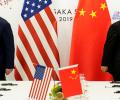
Top US and Chinese officials, including Vice Premier He Lifeng and Treasury Secretary Scott Bessent, held "candid, in-depth and constructive" talks in New York on economic and trade issues, with a specific focus on artificial intelligence. These discussions precede Chinese President Xi Jinping's anticipated visit to Washington and occur amidst new US sanctions targeting countries purchasing Russian oil and gas, and the US unveiling an "AI Force."

National Security Advisor Ajit Doval engaged in Special Representatives talks with Chinese Foreign Minister Wang Yi in Beijing, focusing on the India-China boundary question and enhancing bilateral relations. These crucial discussions precede Chinese President Xi Jinping's anticipated visit to New Delhi for the BRICS summit, aiming to address persistent border differences and stabilise ties strained by past conflicts like the Galwan Valley clash.

The Ministry of External Affairs (MEA) has issued a warning against 'malicious' and 'misleading' social media posts concerning the health of world leaders, specifically Chinese President Xi Jinping and South African President Cyril Ramaphosa, who attended the recent BRICS Summit in New Delhi. The warning comes amidst unverified claims about Xi's health and an official statement from Ramaphosa's office confirming his withdrawal from public engagements due to ill health.

Chinese President Xi Jinping's upcoming visit to India for the BRICS summit is a pivotal diplomatic event poised to significantly impact bilateral ties and global cooperation amidst ongoing international instability.

Chinese President Xi Jinping is in New Delhi for the 18th BRICS Summit, where he is scheduled to hold bilateral talks with Prime Minister Narendra Modi. This visit, his first to India in nearly seven years, comes amidst efforts to normalise India-China relations following the 2020 Eastern Ladakh standoff and is expected to have significant implications for bilateral ties and BRICS cooperation.

India and China are in what experts call 'a cooperation-versus-competition situation'.

Prime Minister Narendra Modi, in bilateral talks with Chinese President Xi Jinping, emphasized that both nations must show sensitivity to each other's core issues and be guided by mutual respect, sensitivity, and interest. Modi highlighted the critical importance of peace and tranquillity along the Line of Actual Control for the development of India-China relations, while also addressing concerns regarding Taiwan and Tibet.

China has called for stronger global governance of artificial intelligence, advocating for international cooperation to develop the technology for humanity's benefit while preventing it from getting out of control. This comes amidst warnings from leading AI researchers in the US about potential existential risks, with China emphasizing both rapid development and robust safeguards, including its new AI Safety Governance Framework 3.0. The issue is expected to be a key topic in upcoming US-China talks.

US President Donald Trump received a red carpet welcome in Beijing for talks with Chinese President Xi Jinping on trade, the Iran war, and other key issues. The visit underscores the importance both nations place on their relationship amid ongoing tensions.

Prime Minister Narendra Modi cautioned against the 'weaponisation' of technology and critical minerals at the BRICS summit, advocating for cooperation to foster shared prosperity. Concurrently, Chinese President Xi Jinping announced plans for an open-source AI ecosystem for BRICS nations, positioning Beijing as a key technology partner amid global AI competition.

Dhaka and Beijing on Thursday agreed to strengthen cooperation on the management of the Teesta and other rivers and signed 13 agreements to bolster bilateral ties following talks between Bangladeshi Prime Minister Tarique Rahman and Chinese Premier Li Qiang.

The escalating crisis in West Asia and its impact on the global energy supply chain are expected to dominate deliberations at a two-day meeting of BRICS foreign ministers to be hosted by India.

The Beijing summit may have reduced immediate diplomatic uncertainty, but it did not resolve the deeper structural contest between the United States and China. That contest appears likely to define the coming decade, notes Varun Arya.

Donald Trump says several issues were settled during the final day of talks with Xi Jinping covering trade, tariffs, and diplomacy.

China has called on Iran to reopen the Strait of Hormuz and expressed appreciation for Tehran's commitment not to develop nuclear weapons, a key demand of the US to end the conflict.

US President Donald Trump and Chinese President Xi Jinping met in Beijing to discuss a range of issues, including trade frictions and the war in Iran.

Chinese President Xi Jinping has arrived in Pyongyang for his first official visit in seven years, meeting with North Korean leader Kim Jong-un to reaffirm their long-standing friendship and pledge further development of bilateral relations amidst Pyongyang's deepening military ties with Moscow and China's assertions against Japan's 'new militarism'.

US President Donald Trump is set to visit China for talks with President Xi Jinping on trade, global issues, and the Gulf war. The visit aims to address trade frictions and other key issues, with high expectations for progress.

The US-China rapprochement, however tenuous, is not without implications for India. Both China and Pakistan have become closer to the US, notes Ambassador T P Sreenivasan.

Chinese President Xi Jinping warned US President Donald Trump that mishandling the Taiwan issue could trigger conflicts between the two countries during wide-ranging talks on trade, Iran, and energy security.

US President Donald Trump will visit China from May 13 to 15 at the invitation of President Xi Jinping. The visit occurs amidst global tensions, including the war in West Asia and trade disputes between the US and China. Discussions are expected to cover China-US relations, world peace, and economic issues.

Two senior Chinese ministers attended India's Independence Day reception in Beijing, signaling a potential improvement in relations ahead of Prime Minister Modi's expected visit to China for the Shanghai Cooperation Organisation summit.

Chinese foreign ministry spokesperson Mao Ning said that the country believes that dialogue and negotiation are the only viable solutions to resolving disputes and that the continued escalation of the conflict serves no one's interests.

China's week-long mediation between Pakistan and Afghanistan concludes without a formal agreement, though Beijing claims progress in exploring solutions to resolve their differences.

There are enough people at the top decision-making level in Tehran who are still willing to negotiate, provided Trump can create the right setting for the negotiation to acquire a dynamic of its own, points out Ambassador M K Bhadrakumar.
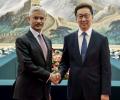
India and China should build on 'good progress' in normalising the bilateral ties to address border-related issues including de-escalation, and it is essential to avoid 'restrictive trade measures and roadblocks', External Affairs Minister S Jaishankar said on Monday during talks with his Chinese counterpart Wang Yi.
Praising the Indian students awarded at the function, he said the young generation is the hope of the two countries.

The enduring relationship between the two countries have survived the disintegration of the erstwhile USSR in 1991, the end of the Cold War and the regime change in both countries, points out Rup Narayan Das.

China and India were able to "reduce differences" and build "some consensus" on disengaging troops from friction points to end the standoff in eastern Ladakh and agreed to maintain dialogue to reach a resolution acceptable to both sides at an "early date", the Chinese defence ministry said on Thursday.
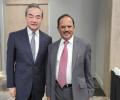
Doval is in Beijing for the 23rd round of the Special Representatives' talks being held after a gap of five years.

The United States and China on Wednesday failed to reach a consensus on how to resolve Beijing's territorial disputes with smaller nations in South China Sea, as Secretary of State Hillary Clinton held talks with top leaders in Beijing but not 'President-in-waiting' Xi Jinping who cancelled a meeting at the last minute.
India and China have agreed to take measures to further ease the situation at the borders while continuing to implement the October agreement to resolve the standoff in eastern Ladakh comprehensively. The two sides held the 32nd meeting of the Working Mechanism for Consultation & Coordination on China-India Border Affairs (WMCC) in New Delhi, agreeing to maintain communication through diplomatic and military channels and safeguard sustainable peace and stability in the border areas. This meeting follows the October 21 agreement between the two countries to resolve the over four-year-long military standoff in eastern Ladakh.

Gor, 38, was among 107 nominees confirmed by the Senate in a single en bloc vote on Tuesday, with 51 senators voting in favour and 47 against.
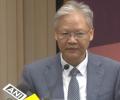
China firmly opposes the Trump administration's 50 percent tariffs on India as it is "unfair and unreasonable" and New Delhi and Beijing should scale up economic ties to jointly counter the challenge, Chinese ambassador Xu Feihong said on Monday.

China has expressed surprise over India's clarification regarding its stance on Taiwan, following reported comments by External Affairs Minister S Jaishankar. Beijing claims India's position is inconsistent with facts and undermines China's sovereignty.
