
China has made serious inroads into Latin America, which the US may now be hinting is simply not ok: Stay in your lane, Xi! In simple terms, China will no longer have access to Venezuelan oil, points out Rajeev Srinivasan.

If Xi Jinping can establish control over the PLA Ground Force, relations between India and China will settle down to an even keel. The next few weeks will show whether Xi has finally succeeded in gaining control over the PLA Ground Force. That could bring about the substantive shift in India-China relations that both our leaders have been working for, observes Ambassador Prabhat Shukla.
Dar also said Pakistan views Russia as an important player in the West, South and Central Asia, and strengthening mutually beneficial cooperation with Russia remains an important priority for Pakistan's foreign policy.

The Meeting of BRICS and BRICS Plus High-Level Security Officials is scheduled to be held in St Petersburg from September 10-12.
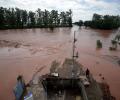
Pakistan has urged India to fully adhere to the Indus Water Treaty (IWT), expressing concerns about the level of detail in flood information shared through diplomatic channels.
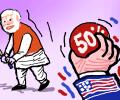
'Things may get much worse before they get better,' predicts Ajay Chhibber.

"We will examine the latest developments and make a determination about our future engagement with BRICS," Baloch said.

Prime Minister Narendra Modi visited Ethiopia on a bilateral visit, engaging with Ethiopian leadership to strengthen partnerships in various sectors. He was warmly welcomed by Prime Minister Abiy Ahmed Ali and participated in cultural events, highlighting the strong ties between the two nations.
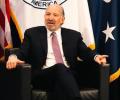
"So I think what happens is it's all bravado, because you think it feels good to fight with the biggest client in the world, but eventually your businesses are going to say you've got to stop this and go make a deal with America."
India has called for a ceasefire, release of all hostages, and peaceful resolution of the Israel-Hamas conflict through dialogue and diplomacy. The Centre informed Parliament that India welcomed the agreement on the first phase of the Gaza Peace Plan. The article also covers India's energy sourcing strategy and the release of Indian fishermen by Pakistan.
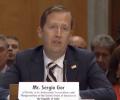
Gor underlined that President Trump has a "deep friendship" with Prime Minister Narendra Modi, and that is something that is unique.
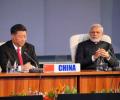
China on Thursday said Beijing views the BRICS as an "open and inclusive" platform and it backs moves to expand the five-member grouping with "like-minded partners".

In August, the top BRICS leaders at the grouping's summit in Johannesburg approved a proposal to admit six countries, including Argentina, into the bloc with effect from January 1.
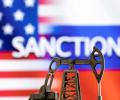
Russia has a "special mechanism" to confront any challenge arising out of the US slapping punitive measures against India for its procurement of Russian crude oil, Russian charge d'affaires Roman Babushkin said on Wednesday.

Argentina, Egypt, Ethiopia, Iran, Saudi Arabia and the United Arab Emirates have been invited to join the grouping.

A meeting with Chinese President Xi Jinping on the sidelines of the SCO summit is being planned.

Lavrov, who addressed the UN General Assembly shortly before External Affairs Minister S Jaishankar's speech at the high-level General Debate, said India and Russia share a "particularly privileged strategic partnership".

'While the President has been critical of India, he has gone out of his way to compliment PM Modi. They have an incredible relationship.'

Consensus remained elusive on a common BRICS currency as business leaders from the five-bloc nations debated the pivotal issue at a business forum on the periphery of a summit of the five-member bloc being hosted here by South Africa. In their two addresses at the Summit so far, the leaders of Brazil, Russia, India, China and South Africa have made no or scant references to the issue either. "The BRICS Business Forum discussed the international payments system in detail. "Participants also debated the question of whether a BRICS currency is possible or desirable, with strong views expressed both for and against and little consensus reached," Sim Tshabalala, chief executive of Standard Bank Group, told several hundred captains of industry from the partner countries and over 40 other nations across the globe at the Summit.

Modi held a "productive meeting" with his Ethiopian counterpart Abiy Ahmed Ali on a day when BRICS (Brazil, Russia, India, China and South Africa) leaders officially endorsed Ethiopia's entry into the bloc.

New Delhi 'will have to take a call which supply source suits us the best,' the finance minister said, pointing out that crude oil accounts for the bulk of India's foreign exchange spend.
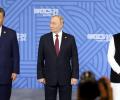
China has expressed its support for Russia's initiative to revive the Russia-India-China (RIC) troika, emphasizing its importance for regional and global security and stability.
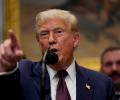
India would neither succumb to the Americans on issues of national security, such as its defence ties with Russia, nor cede ground on its domestic interests in the agriculture and dairy sectors.

"We are waiting for our good friend Modi and best regards to him," the Russian media quoted Putin as saying in the meeting with Doval.

Self-styled godman Chaitanyananda Saraswati, accused of molesting 17 women students, has been remanded to judicial custody. Police have added a charge related to threatening a witness.

India has cautioned against 'double standards' regarding its energy procurement from Russia, asserting that it is based on national interests and market dynamics, following a threat of secondary sanctions from NATO Secretary General Mark Rutte.

India and China will resume direct flight services by the end of this month after a five-year gap, signaling an effort to rebuild ties strained by the border standoff in eastern Ladakh.
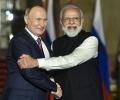
Russian President Vladimir Putin will travel to India in December, Kremlin foreign policy aide Yuri Ushakov said. Putin will meet Prime Minister Narendra Modi on the sidelines of the Shanghai Cooperation Organisation (SCO) Summit in China's Tianjin city to discuss the preparations for his visit to India.
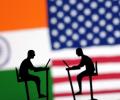
An Indian commerce ministry team will soon visit Washington for another round of talks on the proposed trade agreement with the US to iron out differences in sectors, like agriculture and automobiles, a government official said on Thursday.
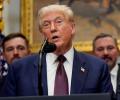
The United States announced a 25 per cent tariff on India as the White House released an expansive list of duties that Washington, DC will impose on exports from countries around the world.

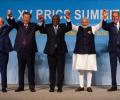
Showing respect to the Indian flag, Prime Minister Narendra Modi on Wednesday immediately picked up the tricolour placed on stage at a BRICS meeting here to mark the standing place of every leader so as not to step on it.
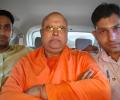
Earlier, police froze Rs 8 crore linked to Saraswati and parked in multiple bank accounts and fixed deposits.

A senior Russian diplomat has called the US pressure on India for its procurement of Russian crude oil "unjustified," expressing confidence in continued energy cooperation between India and Russia despite external pressures.

Prime Minister Narendra Modi and Chinese President Xi Jinping are set to meet in Tianjin on Sunday, their first in about 10 months, for wide-ranging talks aimed at improving relations.

President Putin and Prime Minister Modi greeted each other with a warm hug, after which they walked towards the stage for a family photo of the SCO members.
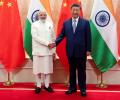
Prime Minister Narendra Modi and Chinese President Xi Jinping vowed to work towards a "fair, reasonable, and mutually acceptable" resolution of the festering boundary issue and pledged to work towards stabilising global trade.
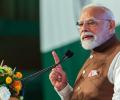
Prime Minister Narendra Modi on Friday said it is important for India and China to work together to bring stability to the world economic order as he asserted that New Delhi is ready to advance bilateral ties from a strategic and long-term perspective based on mutual respect, mutual interest and mutual sensitivity.

'Prime minister is expected to hold some bilateral meetings on the sidelines of the SCO summit.'

'America holds about 16% of IMF voting rights, giving it crucial influence over Pakistan's desperately needed bailout loans.'

Describing the visit as "productive" in a post on X, the PM said he emphasised India's position on key global issues during his engagements.
