

China has made serious inroads into Latin America, which the US may now be hinting is simply not ok: Stay in your lane, Xi!
In simple terms, China will no longer have access to Venezuelan oil, points out Rajeev Srinivasan.
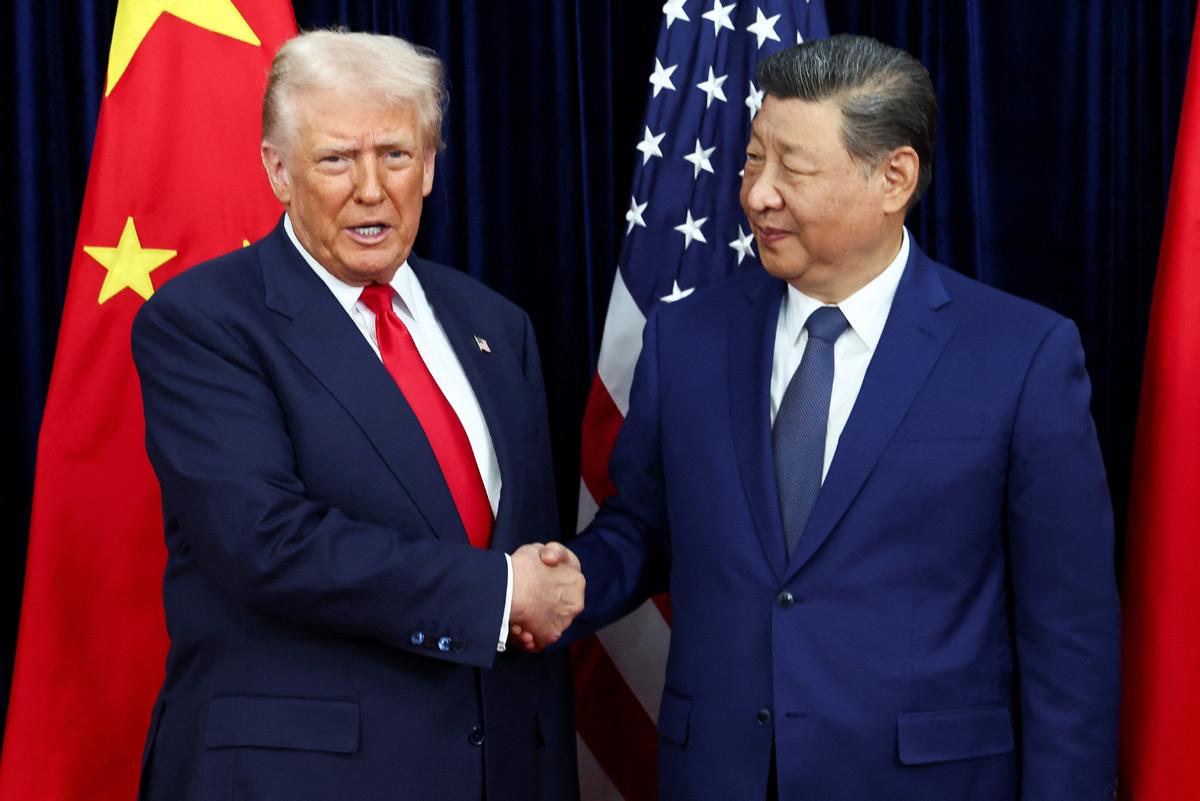
Is it geopolitics then?
The most interesting thing about the extraction of former Venezuelan president Maduro was not the dramatic flair with which it was done, though that was indeed very YouTube-ready.
The helicopter gunships, the silenced air defences, the Cuban bodyguard eliminated (by a sonic weapon?): All the elements of a pretty exciting Hollywood film. I'm sure one is coming up soon.
What was even more interesting, though, was that a delegation from the Chinese Communist party had met him just a few hours before.
China has been rather chummy with a fellow socialist, and has been a good customer as an oil buyer.
The fact that Maduro was extricated while the Chinese were still in Venezuela was a warning shot: Besides, it suggests that they had no clue what was going to happen.
In effect, it was a slap on the face of China, and it goes back to my belief that the US is investing in a G2 condominium (external link) with them.
Stick and carrot, maybe? Collaborate in general in the spheres of influence concept, but hey, you better keep out of my sphere, ok? As I said earlier, China has made serious inroads into Latin America, which the US may now be hinting is simply not ok: Stay in your lane, Xi! In simple terms, China will no longer have access to Venezuelan oil.
The prognosis is grim: Russia and the EU are mired in the Ukraine mess, China is rampant (certainly in Asia, with their declared intent of invading Taiwan by 2027), the QUAD is more or less defunct.
Trump refused to support Japanese Premier Takaichi Sanae when she was bullied by the Chinese over her remark that if Taiwan were to be attacked by China, this would create a survival-threatening situation for Japan, which is literally true as Taiwan is only 70 miles away.
Parenthetically, India has also realised the same about the US -- that it is on its own (external link) -- after what was quite likely a US-supported regime-change operation in Bangladesh has put the Hindu minority there in real danger of genocide and ethnic cleansing, with daily incidents of burning alive, murder, rape and abduction and threats of capturing Indian territory.
The situation in Iran is also likely to be a blow to China: They would lose one more source of cheap oil.
But then, they do have buyer power: In other words, major oil producers do have to sell their stuff to somebody, and as China demonstrated in the case of soybeans from the US, its refusal to buy the stuff has severe consequences for the seller.
So it is true that the US and China in general have to respect each other and trade with each other.
This is perfectly feasible under the G2 condominium, the principal role of which is to give each of them a 'playpen' if you will, and prevent a new power, e.g. India, from forcing it to be a G3. It appears they both are applying the Thucydides Trap to India.

The US is still ahead of China in the geopolitical game, but if it continues to burn its bridges with its erstwhile allies and partners (such as the EU and Quad members) it will accelerate its relative decline.
This is hardly the time to alienate potential partners, especially now that a belligerent NATO has pushed a reluctant Russia into the dhritarashtra-alinganam of China.
Unfortunately, in geo-politics America is becoming less exceptional, and Henry Kissinger's quip that 'it is dangerous to be America's enemy, but fatal to be its friend' is taking on a new urgency.
The action in Venezuela (and possibly in Cuba before long) does not encourage other nations to look to the US for partnerships.
Summary: The geopolitical fallout is not particularly good for America's image as an ally.
It may well be economics, anda desperate fin-de-siecle lunge
The final issue is that of economics and economic history.
Over the past several centuries, we have seen how those countries that hold the global reserve currency have prospered and have been financial hegemons to begin with, based on some substantial competitive advantage, but then a strange malady ('the Dutch disease') sets in, and over time their financial clout diminishes, until at one point they become major debtors and then, they become irrelevant.
This has happened several times in the past 800 or so years, and the patterns are strikingly similar, so there is a fair chance that it is happening again. The countries in question are:
- Spain in the 16th century onwards
- The Netherlands in the 17th century onwards
- Britain in the 19th century onwards
- And alas, the US in the 20th century onwards
Now, I would dearly wish the US could avoid this vicious cycle, partly because it is a continent-sized nation with immense resources, but I believe that economic profligacy, wasting money on unnecessary things like wars, and complacency fostered by easy money is leading to a mountain of debt, which usually is a bad place to be in.
In each of these European examples, initial success inevitably led to collapse.
I hope the US can avoid this fate, especially as warnings have been sounded for some time by experts such as Ray Dalio.
Great economic powers, particularly those issuing the world's primary reserve currency, tend to follow a recurring historical cycle of rise, peak dominance, gradual (or sometimes rapid) decline, loss of competitiveness, mounting debt burdens, and eventual marginalization on the global stage.
This pattern has repeated over the last 500+ years.

The archetypal cycle often unfolds in phases:
- Rise and dominance: Because of strong education, innovation, productivity, trade dominance, military power, and financial innovation create a virtuous cycle (this is the model that I have in mind of the US.
But there is a second model: Colonial loot. Spain stole trillions from Latin America, Britain from India. This too leads to (unearned) privilege). This leads to the currency becoming the preferred global medium for trade, reserves, and debt denomination. - Peak and overextension: Success breeds complacency, wealth inequality widens, debt accumulates (often to fund wars, welfare, or consumption), and costs rise relative to competitors.
Besides, there is a form of the 'Resource Curse': The colonial loot or digging things out from a hole in a ground is so easy that all other industries wither away and die.
We see this in Kerala today: Remittances are easy money, so everybody wants to go to the Persian Gulf (skilled and unskilled labour) or Europe (nurses).
Maybe the generative AI bubble falls into the same category: The money is too easy. - Decline in competitiveness: Education and innovation lag, unit labour costs rise, trade shares erode, and emerging rivals catch up or surpass in productivity and technology.
Too much by way of wokeness, social justice and related illnesses means the smart ones leave, and the dumb ones keep congratulating each other. - Debt buildup and financial strain: The 'exorbitant privilege' of reserve status allows cheap borrowing, encouraging more debt. Deficits grow, and the currency is printed or devalued to manage burdens.
Print, baby, print. But one day you have to pay the piper. - Marginalisation: Confidence erodes (via inflation, devaluations, defaults, or crises), foreigners reduce holdings, and a new power's currency gains primacy.
The reserve status lingers due to network effects and habit, but the issuing power loses geopolitical and economic centrality.

Spain had its colonies in the Americas from which it extracted enormous amounts of gold and silver; the Dutch started the Amsterdam stock exchange and stepped into the vacuum of finance when Spain faltered; the British outcompeted the Dutch in colonization and in industrialisation and defeated them in wars; and the US took over when Britain lost its colonies and had nowhere to dump its goods, and was in debt for its spending in World Wars I and II.
Some of the symptoms of the 'Dutch disease' are showing in the US: Enormous debt, wars that have no clear benefit to the nation, loss of manufacturing, geopolitical challenges, loss of competitiveness and brand superiority in industry after industry.
US investors are quietly moving their funds to other countries, while foreigners are quietly moving their money out of US treasuries (e.g. China has reduced its holdings from a high of $1.3 trillion in 2013 to $688 billion now) and into gold, the BRICS group is creating an alternative currency and a non-SWIFT settlement mechanism, and many countries are trading with each other bilaterally in local currencies.
De-dollarisation is a little far off but no longer implausible.
Now, as a big supporter of the US, I do hope the dollar will continue to be supreme, but I am beginning to have my doubts.
I have had faith in the US and its ability to re-invent itself on the brains of its immigrants, but I wonder if a post-MAGA US will be the beacon, the 'City on the Hill', 'Give me your tired, your poor/Your huddled masses yearning to breathe free'.
Maybe not any more. Perhaps cyclical decline, and the rot, are already too deep.
This, in my opinion, is the real reason for Trump's little adventure in Venezuela: To be relevant in global finance for a little longer.
The petrodollar has been the lifeline in allowing the US to run substantial deficits for a long time.
Because all transactions for oil have traditionally been mandated to be in dollars, there has been constant demand for the dollar, despite the loss of manufacturing (in other words, nobody needs dollars to buy US goods except a few like weapons, aircraft, and Big Tech software).
Everybody needs it to buy oil.

Trump is ensuring that Venezuela's giant oil reserves (the largest in the world) will now be sold in dollars, contrary to Maduro's plans to trade in yuan.
This is deja vu: when Iraq's President Saddam Hussein planned to trade his oil in Euros in 2000, he found himself deposed.
When Libya's President Muammar Gaddafi planned to trade his oil in a new currency called the 'gold dinar' around 2009, he found himself deposed.
Coincidence? Perhaps.
This is why I have had the feeling that the Venezuela adventure does not show American strength, but rather American weakness.
The dollar is in trouble, and thus the US welfare State. This is an attempt to shore it up.
Summary: The real rationale behind the Venezuela regime-change is to ensure that de-dollarisation is postponed at least for a while.
Feature Presentation: Aslam Hunani/Rediff


 © 2026