

'After the Galwan clash, the rules of engagement changed with the army commanders allowed to use any means at their disposal as they deem fit for tactical operations.'

Key Points
- 'Both the military and the political class need to be on the same page.'
- 'Also, the political parties have to be on the same page. Beijing exploits the divisions between the political parties in India.'
- 'India's political leadership and military must balance strength with restraint, autonomy with control, and transparency with discretion -- using military power to deter China and protect territorial claims, while preventing a crisis from spiralling into a wider conflict.'
"The Galwan Valley clash aggravated India-China rivalry. The Galwan clash cast dark clouds over the Sino-Indian bilateral relationship," says Dr Raj Verma, non-resident scholar, Sigur Centre for Asian Studies, Elliott School of International Affairs at the George Washington University.
"New Delhi was unable to gauge China's goals, intentions and ambitions, and the tools that Beijing will employ," Dr Verma tells Rediff's Archana Masih in a two-part interview.
Dr Verma's research focuses on the economic, foreign, and security policies of India and China; relations between China, India, the United States, Russia, and Pakistan.
In this interview he discusses the dark clouds cast by the Galwan clash on India-China relations, the cooperation between the two countries in regional and international organisations on an issue-to-issue basis of mutual interest and how Beijing exploits the divisions between political parties in India when they are not on the same page.
The IMF World Economic Outlook data indicates a shift in global economic activity toward Asia, with China and India projected to account for 43.6 per cent of global growth, compared with 9.9 per cent for the United States.
Has this shift made Donald Trump use trade and access to US markets as strategic tools to counter their rising economic and in turn geopolotical influence?
President Trump is concerned about the BRICS forum threatening the dominance of the US dollar. He does not perceive India per se as a threat. China is perceived as a threat, especially in the economic domain under Trump 2.0.
Trump also employed tariffs against allies, friends and partners in his first administration. He calls himself the tariff king. He will continue to use tariff as a stick to achieve his administration's goals and objectives. Tariffs are a tool of economic statecraft, to achieve, political goals.
Given the IMF's projection [China at 26.6 per cent and India at 17 per cent of global GDP], realistically, how long will it take for India to catch up?
The projection is regarding the contribution to global economic growth. It is not about the size of their respective economies in global GDP.
China's GDP growth figures are unreliable. The veracity of China's growth figures has been questioned by analysts and economists for a long time. 2025 GDP figure has been overestimated by at least 1.5 per cent. That is China's economy expanded in 2025 not by 5 per cent, but at most by 3.5 per cent.
It is difficult to estimate when India will catch up to China because of the veracity of China's growth figures. India will have to grow at a much faster rate, higher than 8 per cent to have a realistic prospect of catching up to China regarding contributing to the global economic growth.
In terms of the GDP of the two countries, China's GDP is approximately $20 trillion and India's GDP is approximately $4 trillion. India is around two decades behind China in terms of economic growth and development. It will take time for India to catch up.
China's economy will expand at a much slower rate in the next decade and beyond. On the other hand, India's economy will continue to grow at a much faster rate.
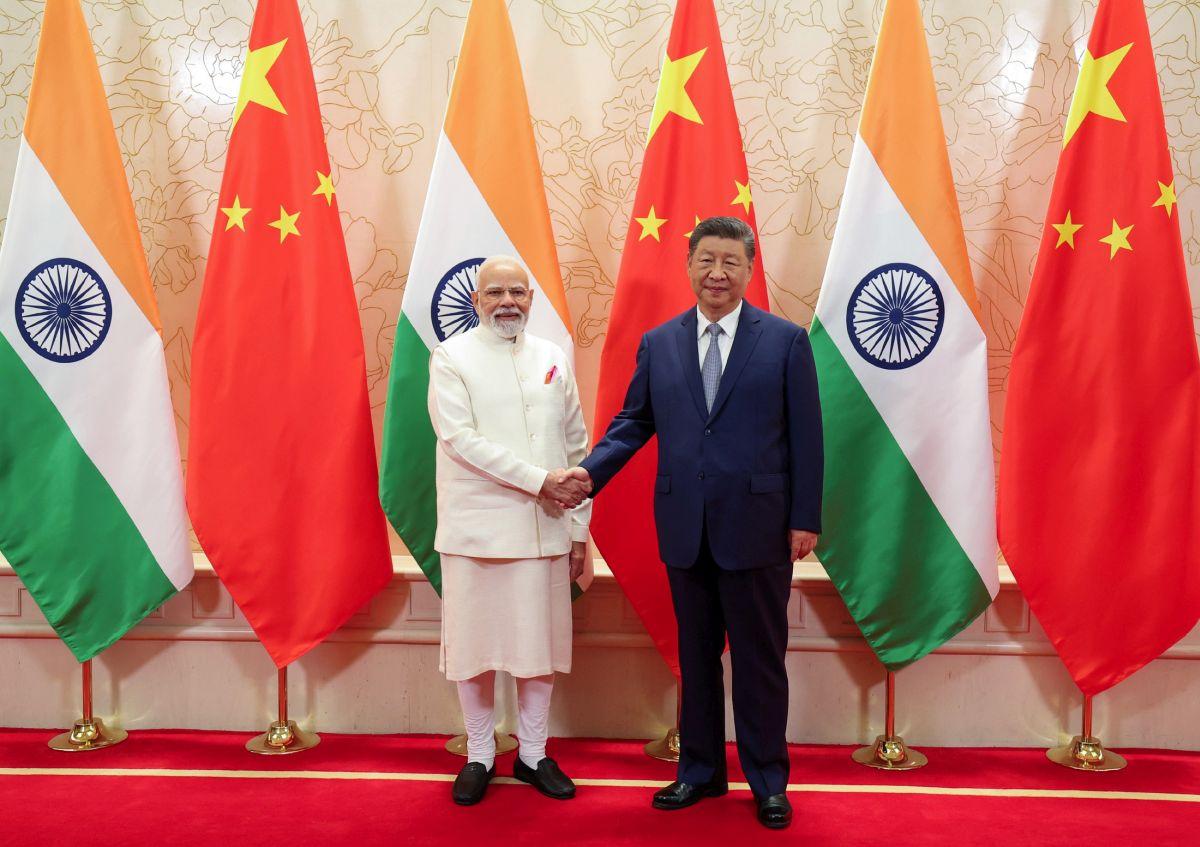
General M M Naravane's unpublished book has triggered a debate over the clash with China in Eastern Ladakh in 2020. As the Opposition accuses the government of inaction and the government insists the military was given a free hand, what balance does India's political leadership and armed force have to consistently make while dealing with the complex relations with China?
The balance here is between civilian control versus military autonomy. At the ground level along the LAC (Line of Actual Control, the boundary separating India and China), local commanders have a free hand to deal with PLA patrols/troops.
Local commanders do not contact New Delhi to ask what they should do if they see a Chinese patrol. They follow the protocols laid in the agreements signed in 1993, 1995 etc. There have been numerous instances of pushing and brawls along the LAC for a long time.
After the Galwan clash, the rules of engagement had changed with the army commanders allowed to use any means at their disposal as they deem fit for tactical operations. Only troops who were involved in direct confrontation with the Chinese soldiers were allowed to open fire if their lives were under threat.
So, it can be stated that the Indian Army had a free hand to deal with any situation. Of course, the army leadership kept the Indian governments in the loop and asked for instructions to deal with large scale Chinese troop movements in the end of August 2020 with both Indian and Chinese troops undertaking tactical manoeuvres to occupy heights along the banks of the Pangong Tso Lake.
Both the military and the political class need to be on the same page. Also, the political parties have to be on the same page. Beijing exploits the divisions between the political parties in India.
India's political leadership and military must balance strength with restraint, autonomy with control, and transparency with discretion -- using military power to deter China and protect territorial claims, while preventing a crisis from spiralling into a wider conflict.
That balance is difficult, imperfect, and often controversial, but it's unavoidable given the nature of the China challenge.

What are the long-term implications of the unresolved India-China border dispute? Has the Ladakh standoff cast a permanent shadow on India-China relations?
The positional (competition for status and influence in the region and globally) aspect of the India-China rivalry trumps the spatial (territorial) aspect in India-China rivalry. The Galwan Valley clash has aggravated India-China rivalry. Thus, the Galwan clash has cast dark clouds over the Sino-Indian bilateral relationship.
New Delhi was unable to gauge China's goals, intentions and ambitions, and the tools that Beijing will employ. China's incursions along the LAC in May 2020 and the Galwan Valley clash have exacerbated the rivalry, tensions and mistrust between the two countries. It will be difficult to overcome these issues even in the long term.
The thaw in the India-China bilateral relationship since October 2024 is tactical. The bilateral relations will continue to be characterised by rivalry, competition and cooperation.
Along the disputed border with more than 50,000 troops stationed on both sides, India and China are in a state of no war, no peace. This will continue. Beijing wants to exert pressure on New Delhi along the LAC.
Post Galwan, India has further aligned itself closer with the US, Japan and other countries. This has exacerbated China's security dilemma. Consequently, Beijing has strengthened its strategic partnership with Pakistan which has exacerbated India' security dilemma. This has led to a spiral down effect which has heightened tensions and mistrust between the two sides. This will continue.
The two countries will cooperate in regional and international organisations and forums on an issue-to-issue basis of mutual interest.
- Part II of the Interview: 'More India Aligns With US, More China Aligns With Pak'
Feature Presentation: Aslam Hunani/Rediff




 © 2026