

India would neither succumb to the Americans on issues of national security, such as its defence ties with Russia, nor cede ground on its domestic interests in the agriculture and dairy sectors.
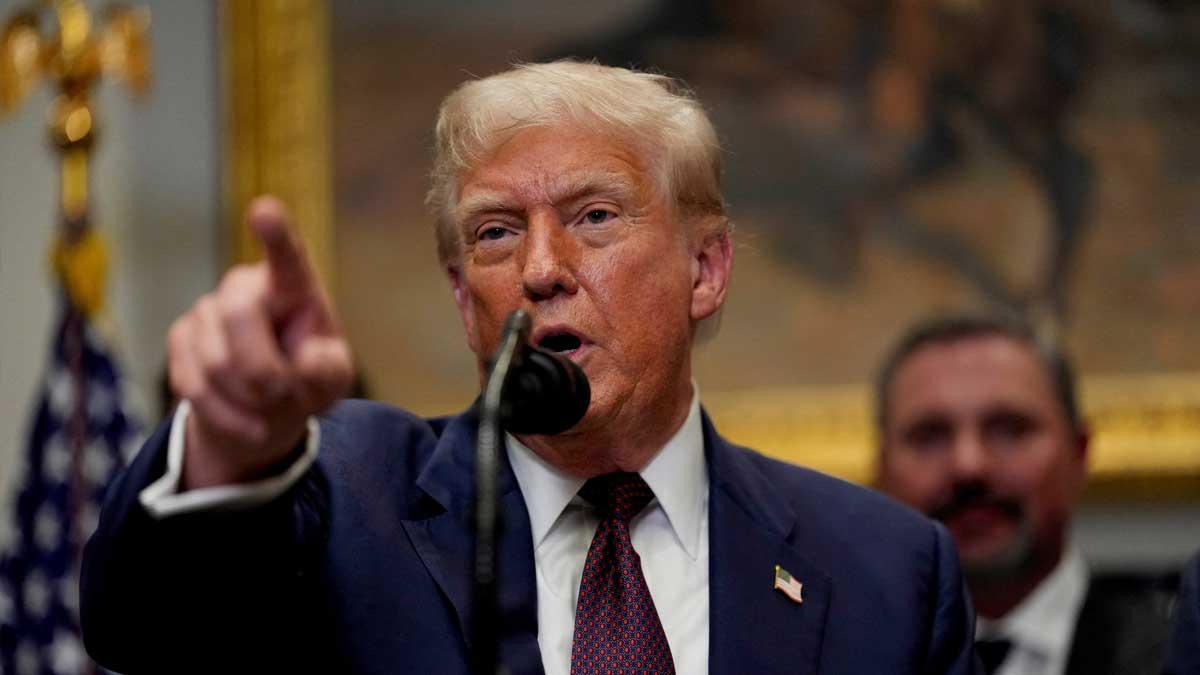
A day after US President Donald Trump announced a 25 per cent tariff, plus a penalty for oil and defence buys from Russia, on Indian exports from August 1, top government functionaries brainstormed on the way ahead.
The broad consensus was to weather the storm while persisting with New Delhi's multi-track engagement with the White House.
Top government sources conceded they were surprised at Trump's Wednesday announcement, especially since negotiations for a bilateral trade pact were still underway and a US team is scheduled to land in New Delhi on August 25 for the sixth round of talks.
However, they ruled out the prospect of any retaliatory action being initiated by New Delhi, and asserted that India would neither succumb to the Americans on issues of national security, such as its defence ties with Russia, nor cede ground on its domestic interests in the agriculture and dairy sectors.
The US insistence to secure greater market access in agriculture and dairy sectors has been a stress point in trade negotiations.
US Treasury Secretary Scott Bessent said in a CNBC interview on Thursday that the US trade team was frustrated with India, adding that the future of the trade deal between the two nations was now up to India.
In a statement in both Houses of Parliament on Thursday evening, Commerce and Industry Minister Piyush Goyal said the government will take all necessary steps to safeguard and promote national interest.
"Let us wait and watch how the situation evolves. The ball is in the US court," said a government source, adding that the government awaited clarity and the US executive order on the structure of the 25 per cent tariff and the quantum of penalty.
The government has also kept a close watch on how some leaders, such as Brazil President Luiz Inacio Lula da Silva, whom Prime Minister Narendra Modi had met during the BRICS Summit and bilateral visit to that country in the first week of July, have opted to defy Trump's threats.
Trump had threatened a 50 per cent tariff on Brazilian goods, which failed to cow down Lula with the result that the US has since issued a long list of exemptions to the levies on goods from Brazil.
Hours after announcing the 25% levy plus penalty on Indian shipments, Trump had partially blamed India's BRICS membership for the move.
Sources in the government also said that Trump's comment that India, along with Russia, were 'dead economies' shouldn't be given much heed as it was in response to some earlier comments of former Russian president Dmitry Medvedev, who is currently the deputy chairman of the Russian Security Council.
Trump and Medvedev have been sparring on social media for the last few weeks.
Minister Goyal said the government is examining the implications of the US tariffs and is engaged with all stakeholders including exporters and industry for taking feedback of their assessment of the situation.
'The government attaches the utmost importance to protecting and promoting the welfare of our farmers, workers, entrepreneurs, exporters, MSMEs and all sections of industry. We will take all necessary steps to secure and advance our national interest,' Goyal said.
Probably in response to Trump's description of India as a 'dead economy' along with that of Russia's, Goyal also said that in just over a decade, India has rapidly transformed from being one of the fragile five to the fastest growing major economy in the world and it is also widely expected that India will become the third largest economy in a few years.
Congress leader Jairam Ramesh termed this a 'non-statement'.
Along with other Opposition parties, Ramesh also took pot-shots at Prime Minister Narendra Modi, but a political skirmish did not take place on the issue, at least on Thursday.
'Prime Minister Modi had banked on his much-vaunted personal friendship with President Trump. This has proved to be completely hollow,' Ramesh said in a post on X.
However, during the course of the day, INDIA bloc parties were keen to protest in Parliament and disrupt proceedings over the Election Commission's Special Intensive Review in Bihar, and unwilling to pin down the government on Trump's tariff pronouncement.
Goyal said that in an increasingly protectionist world, India has done mutually beneficial trade agreements with the UAE, the UK, Australia and EFTA countries, adding that India is committed to similar trade agreements with other countries.
The government has broached these FTAs by drawing clear red lines to protect its farming sector.
Speaking to reporters on Wednesday, Trump had signalled the tariff and penalty that was set to take effect from August 1 may be delayed, adding that discussions with India are on over the matter.
'We are negotiating right now and it's also BRICS. BRICS, which is basically a group of countries that are anti the United States and India is a member of that... It is an attack on the dollar and we are not going to let anybody attack the dollar.
'So it's partially BRICS and it is partially trade...We had a tremendous deficit,' Trump said.
'They have one of the highest tariffs in the world. Now, they are willing to cut it very substantially. But we will see what happens. We are talking to India now. We will see what happens.
'It doesn't matter too much whether we have a deal or we charge them a certain tariff, you will know at the end of this week,' he said.
Indian officials, on the other hand, had maintained that they had made their final offer earlier this month and that said that the ball is on the court of Trump to accept the offers made by India.
Beyond the trade deal, what has peeved New Delhi is Trump's outreach to Pakistan.
While announcing Washington's trade deal with Islamabad, Trump also said that the US will work together on developing Pakistan's 'massive oil reserves'.
'We are in the process of choosing the oil company that will lead this partnership,' the president said while adding: 'Who knows, maybe they'll be selling oil to India some day.'
"We are a sovereign democracy with a global outlook, not a convenient scapegoat," former foreign secretary Nirupama Menon Rao said.
'If partnership is the goal, as it is, then respect can be the only foundation.'
With inputs from Shreya Nandi and Agencies
Feature Presentation: Ashish Narsale/Rediff



 © 2026