
In a region increasingly shaped by competition and coercion, such collaboration strengthens security without confrontation, builds capacity without dependency and promotes order without domination, points out Dr Kumar.

In the Indo-Pacific's new era -- where perception shapes reality faster than treaties -- the real entrapment is not of China or the United States. It is the test Japan has set for itself -- and whether partners like India, acting as balancers rather than accelerants, can help ensure that the story ends in stability, points out Varun Arya.

The goal of the CDS' visit was to emphasise the rising significance of defence collaboration between India and Japan while reiterating strategic cooperation

The compulsion behind India and Japan to deepen security cooperation is in response to China's growing political and economic clout and its assertive behaviour in disputed areas. This has been the key driver for bringing both India and Japan closer in the domain of security cooperation, explains Dr Rajaram Panda.

The trigger that led Japan and the Philippines to ink the deal was because of the deteriorating security situation in the South China Sea. China's coast guard increased the frequency and intensity of incursions into Philippine waters, provoking the Philippines to take countermeasures to deter China, explains Dr Rajaram Panda.

Shigeru Ishiba is expected to prioritise strengthening Japan's military capabilities and fostering deeper international partnerships, particularly with India, with whom Japan shares significant strategic interests, explains Dr Rajaram Panda.
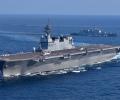
Here are some of the glimpses of the exercise held in the North Arabian Sea.

Veer Guardian is the first time the Indian and Japanese air forces are conducting a joint exercise.
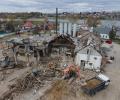
India on Thursday said it has approved the landing of Japanese commercial aircraft to collect humanitarian supplies from a UN depot in Mumbai for their distribution in Ukraine and its neighbouring countries.

Glimpses of the State funeral for Japan's former prime minister Shinzo Abe.

Modi will meet with Prime Minister Kishida Fumio during the visit.
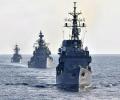
The Indian Navy is also ramping up its operational cooperation with various friendly naval forces like the United States Navy and Japan Maritime Self Defense Force in view of the fast evolving regional security landscape, they said.

The agreement provides for creation of an enabling framework for closer cooperation and interoperability, besides allowing militaries of the two countries to use each other's bases and facilities for repair and replenishment of supplies, the official said.
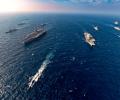
"Relevant countries should abandon the obsolete Cold War mentality and narrow-minded geopolitical rivalry concept and view correctly and respect people's aspiration in the region and do more things conducive to regional solidarity and cooperation," Chinese foreign ministry spokesman Zhao Lijian said.

Japanese soldiers managed to bring down eight more bodies by helicopter from the ash-blanketed peak of a still-erupting volcano on Monday, before toxic gases and ash forced them to suspend the recovery effort. At least 31 people are believed to have died after a volcano erupted on Mount Ontake on the Nagano-Gifu prefectural border in Japan.

The India-Japan joint naval exercises are a strategic signal for China, observes Dr Rajaram Panda.
National Security Advisor Ajit Doval on Thursday called for seamless coordination among various agencies involved in protecting India's maritime interests in the face of emerging security challenges and increasing rivalries and competitions in the Indian Ocean.

Malabar 2016 -- a trilateral maritime exercise involving the Indian Navy, the Japan Maritime Self-Defense Force and the US naval forces in the Indo-Asia-Pacific -- concluded on June 17.

The 19th edition of the Malabar naval exercise saw the Indian, US and Japanese maritime forces participated jointly in the routine.

The pullout will follow the reported withdrawal around May of British and Australian forces in charge of security in southern Iraq.

The navy has significantly expanded its deployment in the Indian Ocean Region deploying a plethora of warships and submarines to create pressure points on China as the maritime space around the Malacca Strait is very critical for its supply chain through sea routes.

Tokyo 2020 organisers received the Olympic flame in a scaled-down handover ceremony in the Greek capital on Thursday, amid the coronavirus spread that has cast doubt on the global, multi-billion dollar event. In a brief ceremony closed to spectators in Athens' Panathenaic stadium, site of the first modern Games in 1896, the torch was received by Tokyo Games representative Naoko Imoto.

The biggest storm -- Typhoon Hagibis -- to hit Japan in decades left deaths and destruction in its wake, as it battered the central and eastern parts of the country. The storm flooded rivers and caused secondary weather patterns like tornados that destroyed homes and public property in areas east of Tokyo. Hagibis hit the capital, where streets were largely deserted and people were bunkered down, moving past the city by midnight, but not before flooding some sections. Reports state that the storm killed as many as 33 people and injured 186 others.

Cruise ship Diamond Princess, carrying 3,711 people, arrived at the Japanese coast early last week and was quarantined after a passenger who de-boarded last month in Hong Kong was found to be the carrier of the novel virus on the ship. Around 60 people tested positive of the virus on Monday, taking the total number of those infected on the ship to 130.
China's behaviour in the post-pandemic geopolitical landscape which may determine the Quad's future trajectory, notes former foreign secretary Shyam Saran.
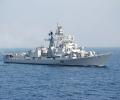
The Indian ships' participation in MALABAR-16, a maritime exercise with the US Navy and Japan Maritime Self-Defense Force, reflects the vital strategic importance of the region to India.

Curtains will fall on the Rim of the Pacific 2016, the world's largest international maritime exercise, on August 4.
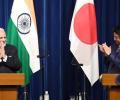
During the 13th annual summit, the two prime ministers reviewed developments in bilateral relations and explored new areas of cooperation, focusing on shared vision for peace and prosperity in the Indo-Pacific, where China is flexing its muscles.
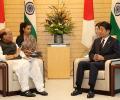
'Singh apprised the Japanese leaders about Islamabad's 'evil design' on Kashmir at a time when Pakistan has decided to internationalise the issue.'

95 aircraft, 16 ships and 2 submarines from 3 countries are taking part in Malabar exercise.

Unprecedented rainfall in Japan unleashed heavy floods on Friday that ripped through parts of the island nation on Thursday, forcing more than 1 lakh people from their homes.

New Delhi's growing defence partnership with Tokyo could take wing with the US-2 (Utility Seaplane Mark 2), a one-of-a-kind amphibious aircraft that has Indian naval planners goggle-eyed.

When a Chinese warship entered Japanese waters, the Indian commander called on China to maintain discipline at sea. Dr Rajaram Panda explains the significance of the Malabar exercises between India, Japan and the US.

Japan has the capital and needs to pull out of China, which has been its major destination. India, on the other hand, desperately needs capital especially for infrastructure, argues Rajeev Srinivasan.
 © 2026 Rediff.com - Investor Information - Advertise with us - Disclaimer - Privacy Policy - Sitemap - Feedback - About us - Terms of use - Grievances