'Given Chinese sensitivity to anything to do with Tibet -- and the fact that in the 1950s it was the Tibet issue which led to the deterioration of India-China relations and the border war in 1962 -- India should be particularly careful in not triggering a Chinese reaction which it may not be able to handle,' says former foreign secretary Shyam Saran.

'The world may be desirous of peace, but not Kim Jong-un.' 'Should we then accept the old adage that to maintain peace, we should be prepared for war?' asks Rajaram Panda.

For a rising country like China with its sights set on global and regional power, any coming together of the US and India is the worst case scenario. Hence, China is concerned with the emerging equations between New Delhi and Washington, says Srikanth Kondapalli.

Any settlement with Pakistan won't last unless it comes with big power guarantees, says Shekhar Gupta.

Rajaram Panda explains why the US president needs to restrain himself and build a relationship with China to put any credible pressure on North Korea.
Trump aides, who participated in the two-day talks held at the US President's Mar-a-Lago resort in Florida, described the meetings as productive and said the two leaders exhibited "positive" chemistry.

''The avoidance of the 'P' word had less to do with reality and more to do with the politics -- domestic and international -- of Mr Modi and his efforts to both appear statesman-like (vis-a-vis Pakistan) and rid himself of the taint of being some kind of Muslim-baiting hardliner.'

Glimpses of the final days of the 1965 War, as seen from the diary then defence minister Y B Chavan maintained during the war.

Russia and the US began second round of negotiations on securing Syria's chemical arsenal, hoping the high-stakes talks would lead to broader peace efforts, even as Damascus submitted application to UN for joining the chemical weapons convention.

Prime Minister Manmohan Singh has said that whatever action is required in Syria should be under the UN framework, amid growing pressure on US President Barack Obama from his Russian counterpart and other world leaders not to attack the Arab country.

Cancelling Uighur leader Dolkun Isa's visa could have been a mutual face-saving exercise for New Delhi and Beijing.

'Pyongyang's strategy seems to be a cry to be treated as equal with the US and Beijing and this aspiration is premised on equipping itself with weapons as devastating as theirs,' says Rajaram Panda.

The strategic pacts were inked after the summit between Prime Minister Narendra Modi and his Japanese counterpart Shinzo Abe during which they also discussed international and regional issues of mutual importance including UN security reforms.

Trump said that America's relationship with Russia 'may be at an all-time low', but he hoped that it would have been wonderful if the two countries could get along.

Sharif raises Kashmir issue at UNGA, renews plebiscite demand.
Will the unpredictable North Korean leader provoke conflict on the Korean peninsula?

'By the time he came out after nearly five hours, he had a one-to-one conversation with the President, a delegation-level meeting, a reception, a dinner, a tour of the White House and a joint statement of a kind none of his predecessors ever had,' says Ambassador T P Sreenivasan.
'There is a problem with the rise of a popular view that sees Kashmir through the prism of the larger, chronic Hindu-Muslim tensions.' 'By redefining the Kashmir problem simplistically in Hindu-Muslim terms could end up keeping Kashmir but losing most Kashmiris,' says Shekhar Gupta.

Russian President Vladimir Putin on Wednesday warned America and its allies against one-sided intervention in Syria, even as US said it not only risks losing friends but also credibility at the world stage if no military action is taken against the Bashar al-Assad regime.
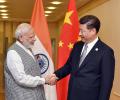
Chinese chief negotiator Ambassador Wang Qun told ANI on Friday, "NSG will not take up India's case as of now. There are differences on admitting non-Nuclear Non-Proliferation Treaty members. Signing the NPT first is one of five criteria (for membership). These have not been set by China, but by group as a whole."
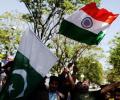
India suggested that Pakistan should refrain from using the Right of Reply and instead "use the right of introspection" to think about the direction in which the country is moving.
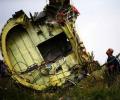
Balazs Jarabik, a visiting scholar at the Carnegie Endowment for International Peace, where his research focuses on Ukraine and Eastern Europe, says preliminary and not direct evidence points suggests that the Ukrainian rebels shot down the plane. In this interview with Rediff.com's Vicky Nanjappa, Jarabik says that it would not be right to call this an act of terror or a war crime as it appears to be a horrible mistake.

Is North Korea really dismantling its nuclear programme? Rajaram Panda explains the many challenges to denuclearise the Korean Peninsula.
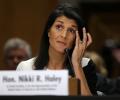
If confirmed by the US Senate, Haley, 44, would be the first Indian-American to serve in a Cabinet-level position in any presidential administration.
'New Delhi feels that given the internal dynamics in Pakistan and the overwhelming powers wielded by the army, one will have to wait for better times to see any meaningful progress in the India-Pakistan relationship,' says Ambassador G Parthasarthy.
'Indian diplomacy is once again being saddled with the heavy burden of a Pakistan-centric foreign policy. It is something grossly unfair at a crucial juncture in India's trajectory as an emerging power on the global stage,' argues Ambassador M K Bhadrakumar.
'The attack on the Pathankot base constituted an act of war. Yet Modi's only public comment up until now on that attack has been to blame it on "enemies of humanity".' 'Modi came to power talking tough about Pakistan. But in office, he has pursued a Pakistan policy that has lost both direction and purpose,' argues Brahma Chellaney.

Addressing world leaders at the 68th session of the UN General Assembly, Obama said if the international community cannot be united against forcing Syria to give up its chemical weapons, "then it will show that the United Nations is incapable of enforcing the most basic of international laws".

'Look East' policy was first coined by the Narasimha Rao government in the 1990s and has been followed by the successive governments.

The biological weapons convention is a non-starter in spite of the efforts of many states in the world for the last five decades mainly because the US is not ready to accept the 'verification protocol' which could allow the formation of some official mechanism for inspections, says Ajay Lele.

It asked all nations to work together to expedite the adoption of the Comprehensive Convention on International Terrorism in the UN General Assembly without any further delay.

Domestically, China's 'strike hard' policy is alienating Uighurs further in Xinjiang. China's quid pro quo with the Taliban is hardly any lasting solution to the Afghanistan crises or to regional security, says Srikanth Kondapalli.

The world is still figuring out the man as he continues his enigmatic journey towards the first 100 days of his presidency.

'What should worry India and which needs to be expressed is Russia's simultaneous proximity to both China and Pakistan from a strategic angle. That hasn't happened ever before,' says Lieutenant General Syed Ata Hasnain (retd).
While trying to persuade North Korea to give up its provocative actions, engaging China is the first hurdle that world leaders will have to deal with, says Rajaram Panda.
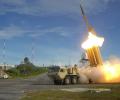
Deployment of THAAD in South Korea could unfold a new cataclysm in the Korean Peninsula with unwelcome prospects.

The joint statement issued after Prime Minister Narendra Modi and President Barack Obama's first-ever summit is high on intent and ambition. Notably missing from the statement is India's refusal to be America's partner in its war against ISIS.

'I am no longer surprised by how cynical university students generally are about American motives. America, no matter who the President, what the circumstances will act like a bully, is their collective belief,' says Ambassador B S Prakash after a recent interaction with students.

'If, as appears to be the case, India is on way to 'mending fences' with China, and China is equally desirous to 'reset' the relationship, this could be a self-reflexive moment in India's positioning vis-a-vis not just the Dalai Lama, but also the Tibetan issue and China as a whole,' points out China expert Alka Acharya.

President Obama had no intention of risking a global conflagration on account of the use of chemical weapons in Syria, especially at a time when he was struggling to wind up the wars his predecessor had started, says T P Sreenivasan
 © 2026 Rediff.com - Advertise with us - Disclaimer - Privacy Policy - Sitemap - Feedback - About us - Terms of use - Grievances