
Lawyer: 'Did YOU not ever feel scared?' Shyamvar Rai: 'I am a driver, I said okay. Madam said it is your job...'

'I kept photographs of everyone. Because I was working for them.' 'Madam, Saab...' Shyamvar Rai, the approver in the case, said in a tone that tried to suggest that that would be a routine practice for a driver.

In walked the scruffy band of pirates, without any swagger. Mostly tall or burly men, with weather beaten, resigned faces, the majority were dressed in track pants and tees; a few had skull caps. Some of their T-shirts had messages like 'I'm not in danger, I'm danger' or 'Long Beach California Surfer'.

The decision was announced at a press meet by Additional Chief Secretary (Home) K P Bakshi.

The close-onto four years (since November 2015) Peter has spent in Arthur Road jail, central Mumbai, in judicial custody, have taken their toll, lending him a bit of a melancholy stoop, a laborious gait and a tired face, turning him prematurely into a much older man than his nearly 64 years. Vaihayasi Pande Daniel/Rediff.com reports from the Sheena Bora murder trial.

On Thursday, Indrani will be obligated to change into the green uniform sari she receives visitors in, as per jail rules, and meet the gentlemen from the income tax department. She may also at some point on Thursday video conference with Delhi in the INX Media-Karti Chidambaram case where she might become an approver.

The ripping off the lid, that Mekhail did, on the chain of episodes that lead up to his sister's murder, while condemning Indrani for her actions, for the first time, paradoxically, allowed a more human -- if flawed and complicated -- picture to emerge of Indrani, allegedly The Woman Who Killed Her Own Daughter and shocked a nation.

Judge Jagdale, with a severe expression shadowing his face, looked sharply at Manoj Patil, Airtel's nodal officer, and told him plainly: "It is difficult to digest what you are saying (about) giving call data, but not giving call timings and durations."

'I am an old man. 64 years... Never used influence.' 'I am not a politician or a criminal. What influence?' 'Retired. I could not protect myself even (from fabricated charges)?' 'Have no money now either.' 'I don't want to die in custody in disrepute.'
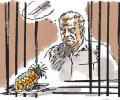
He was getting fruits, but no implement to cut them with. He told the judge, sadly: "I have tried and it is very difficult, your honour." His statement quickly brought up the imagery of Peter trying to cut a pineapple with his teeth or a papaya with a pen or a toothbrush.
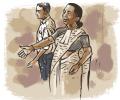
Ever since Mekhail had first entered the courtroom, he had, it would seem, never once looked at his mother, though they were a few metres away from each other. Curiosity, residual regard, memories, anger, none of it, could make him even look at the woman who gave birth to him. Was his hatred so overpowering?

The question being silently telegraphed around the court room was: When did this happen? Wasn't this trial about Indrani murdering her daughter to prevent her from marrying Rahul Mukerjea, her husband Peter Mukerjea's son from his first marriage?

Not Mekhail. Not Rahul. Not anyone. 'Wouldn't someone have asked?' Indrani asked.

'The talk in police circles is that Maria was about to crack the money transaction trail in the crime. The Mumbai police's Economic and Offences Wing had begun investigations into the money trail and Mumbai police officers had visited Singapore in this connection.'

Throughout, Mekhail spoke calmly, with hardly an inflection making even the barest attempt to hijack his tone. His tone was so empty it made his narrative all the more touching. And ugly and grey, as the monsoon sky beyond the window.

The sensational Sheena Bora murder case probe tonight acquired a new turn with police claiming that Sanjay Khanna, former husband of Indrani Mukerjea, confessed to his complicity in the crime during a joint interrogation of three accused on a day the victim's skeleton remains were recovered.

Pasbola had a number of queries about the nails of the corpse found at Gagode Khurd. Did it have nails? Nails, in a case of strangulation, are key because they often have particles and skin beneath them to show the victim had been grasping something as s/he was strangled.

"For years I had been the cynosure of all eyes in my residential complex -- 'the lady with the full-time maid!'"

Vaihayasi Pande Daniel reports from the Sheena Bora murder trial.

Shivade: "You didn't find any brain inside the brain cavity?" Dr Thakur nodded. The judge shocked: "Huh?!"

Though on the face of it appeared Pasbola was asking a series of odd questions that would be difficult for anyone to answer, there was, it gradually emerged, it seemed, a method to the questioning. Somehow, somewhere instinctively, Pasbola knew there was something not right with Riyaz's account.

And then came the chief moment of Friday. If the courtroom had a soundtrack, Beethoven's 9th would be playing, providing a triumphant, dramatic prologue to the production of this last clip. A woman reporter was asking Mekhail about Sanjeev Khanna. He says clearly, without mincing words, emphatically: 'Never seen him. First time I am hearing his name.'

'When the forensics have collapsed, approver is clearly proved to be a liar from the beginning to the end... Does the prosecution genuinely believe that we ought to remain in judicial custody despite showing that their own story is not being corroborated by evidence, for another 192 witnesses?'

The warmest reception came from his soon-to-be ex wife Indrani, who on spying him getting out of the lift, muttered an "Oh dear!" and walked over to him, trailed by her police guards, wreathed in high-wattage smiles.

Indrani is clearly in charge in her little corner. She is speaking rapidly to a not-very-tall, pot-bellied, balding man, whom she repeatedly, decisively, asks, "Have you understood?" The tone is that of a boss talking to an employee. The words "cheque" and "two lakhs" float by.

Here are the developments in the murder case which has taken explosive twists and turns since Indrani's arrest on Thursday night.

Her elfin face could be seen and once more after many days the victim of this murder had a face and a presence.

Dramatic minutes like the sentencing by a judge or a round of artful cross examination hog all the attention in a courtroom. But more noteworthy and infinitely more memorable are the human moments -- Like when a brother and sister hug before a judge. Or the steady support between a husband and a wife in court.

Indrani is easily the most striking woman arriving in the court complex from jail on trial days. For those who don't know who she is, there is absurd puzzlement written large on faces when they bump into her. When she reaches or leaves the premises, one notices heads swivelling in jaw-dropping curiosity, as did a pair of transsexual undertrials who crossed her path at the last hearing of 2018, who were, not surprisingly, a less unusual sight than Indrani.

If an FIR had been registered by the Pen police -- instead of a mere entry in the station diary -- an investigation could have taken place and the body might have been identified as Sheena's, leading to the case being cracked much earlier.
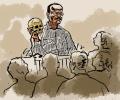
As Indrani, Sanjeev Khanna and Peter pass cupboard no 6 -- where the skull is stored -- what thoughts pass through their mind?

'Quite the raconteur, much to the dismay of Courtroom 51's CBI Special Judge Jayendra Chandrasen Jagdale, Christopher 'Doglis' Marquis, a Bandra dog-breeder who was Prosecution Witness No 57 and a panch or witness, seemed to move into the witness box with glee, embellishing every answer that he gave to the lawyers' questions with a variety of additional details.' Vaihayasi Pande Daniel reports from the Sheena Bora murder trial.

Shivade then asked if the skeleton finally came out of the ground in many parts. It was difficult not to gasp aloud at that revelation. Bhagat said that was true.

Many pictures showed The Skeleton Named Sheena. For the purpose of the photographs, the skeleton had been re-assembled and looked straight at the camera.
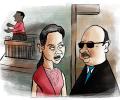
More noticeable than the hue of his shirt was his mast style in the witness box. He seemed to be reinventing the truth every few minutes. He yarned on and on, navigating his testimony further and further away from the facts, but he never lost his aplomb.

Sameer Buddha was just the kind of witness Indrani's lawyer Sudeep Pasbola dislikes. Someone, who had temporarily dumped his memory before entering the court. He answered most questions, one after another, one after another, one after another, with a monotonous, deadpan: 'I don't remember.' 'I don't remember.' 'I don't remember.'

Singh and Badami subsequently took Waghmare to a corner of the corridor outside, where others have no access, and gave him a lecture. The conversation was largely inaudible, except for a phrase here or there. The thrust was unmistakable. Waghmare had to learn not to give such detailed answers to the defence.

Devulkar had a certain abnormal vagueness about him that was unreal and defied belief. That came across in both his slightly too easy-going, extra-cooperative manner and the ragged nature of his testimony.

She continued to cry, harder, feebly dabbed her eyes with the handkerchief she had received, and declared painfully: "He is hurting my emotions!"

Then came the electrifying climax of Tuesday's hearing. Pasbola showed Sharma copies of cheques that had been deposited at the bank with Indrani's signature on them. He accused Sharma of forging Indrani's signature and collecting the money for herself. In the back Indrani stood up in the accused box and very pointedly nodded her head up and down and mouthed, "She did!".
 © 2026 Rediff.com - Investor Information - Advertise with us - Disclaimer - Privacy Policy - Sitemap - Feedback - About us - Terms of use - Grievances