
The space agency launched 104 satellites, breaking the previous record of 37 by Russia.
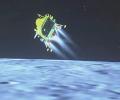
After Chandrayaan-3 touched down on the Moon, the Congress on Wednesday said it is a collective success of every Indian and ISRO's achievement reflects a saga of continuity and is truly fantastic.

In his address, the air chief marshal underlined that with a massive surge of new technologies and opening up of space to private players, there is a "disruption in the established scheme of things".

India's ambitious third Moon mission's spacecraft Chandrayaan-3 after the launch on July 14, had entered into lunar orbit or the Moon's orbit on August 5.
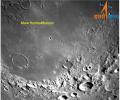
This camera that assists in locating a safe landing area -- without boulders or deep trenches -- during the descent is developed by Ahmedabad-based Space Applications Centre (SAC), a major research and development centre of ISRO.

Former National Aeronautics and Space Administration (NASA) Official Mike Gold has said Chandrayaan-3's success is a triumph of Indian innovation, human capital and the capabilities that will take India even further.

Only three countries (United States, Russia and China) have successfully landed spacecraft on the airless lunar surface.

The polar satellite launch vehicle-C42 launch vehicle carrying the two satellites blasted off from the first launchpad at the Satish Dhawan Space Centre at 10.08 pm.
Join us in honouring the scientists for their latest achievement. Post your messages in the message board below.
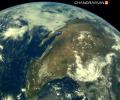
The pictures were captured by L 14 camera on board Chandrayaan II. The pictures show the earth in different hues.

Aditya-L1 is the first Indian space-based observatory that will study the Sun from a halo orbit around the first Sun-Earth Lagrangian point (L1), which is located roughly 1.5 million km from the Earth.

Here is a glimpse of the journey of India's third lunar exploration venture has taken so far.
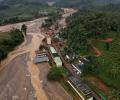
The deadly landslides in Kerala's ecologically fragile Wayanad district were triggered by a heavy burst of rainfall, made 10 per cent heavier by climate change, according to a new rapid attribution study by a global team of scientists.

The Supreme Court Thursday ordered that the report of a high-level committee on the role of erring police officials in the 1994 espionage case relating to Indian Space Research Organisation scientist Nambi Narayanan be given to the Central Bureau of Investigation and directed the agency to conduct further investigation on the issue.

The ISRO is looking at Mangalyaan-2, a follow-on mission to Mars, and launching two satellites that would look at Venus and explore asteroids.

The satellite would provide a thrust to mobile communication through multi-beam coverage facility, the ISRO said.

The Luna-25 spacecraft crashed into the Moon after it spun into an uncontrolled orbit, Russia's Roscosmos space agency said on August 20.

In view of cost, these vehicles will justify deployment only as public buses, taxis, three-wheelers

The mission objectives of Chandrayaan-3 are to demonstrate a safe and soft landing on the lunar surface, to demonstrate rover roving on the Moon, and to conduct in-situ scientific experiments.

Taken from the Indian Remote Sensing Satellite hovering over space, the image shared by ISRO on Sunday shows the grand new temple which will be inaugurated on January 22.
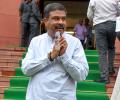
Pradhan further said the opposition had a chance to raise this issue during the motion of thanks to the President's address and asserted the government was ready for any type of discussion.
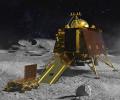
Asked if the lander was 'damaged' during the 'hard landing", Sivan said: "That we do not know".
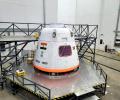
Modi gave these directions during a meeting to review the preparedness of the Gaganyaan mission and the first demonstration flight of the crew escape system test vehicle scheduled for October 21.

Other than the Cartosat-2 series satellite, the PSLV is carrying 29 nano satellites from 14 countries - Austria, Belgium, Chile, Czech Republic, Finland, France, Germany, Italy, Japan, Latvia, Lithuania, Slovakia, the United Kingdom and the United States of America besides a nano satellite from India.

Here is ISRO's SAC Director, Nilesh M Desai explains the crucial stage of soft landing.

The four astronauts are -- Prashanth Balakrishnan Nair, Angad Prathap, Ajit Krishnan, and Shubhanshu Shukla -- Modi said at the Vikram Sarabhai Space Centre (VSSC) at Thumba near the Kerala state capital.
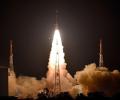
"I am really grateful to the entire ISRO family for having worked this hard and making IRNSS-1I a success," said the space centre's chief K Sivan.

The landing on the moon near the South Pole, an uncharted territory so far, would be on September 6 or 7, Sivan told reporters, as the Indian space agency is all set to embark on its most complex mission.

Weighing about 5,854 kg, GSAT-11 would play a vital role in providing broadband services across the country, and also provide a platform to demonstrate new generation applications.

ISRO Chairman K Sivan said the Indian Air Force and other agencies will play a major role during the selection of astronauts for the human space mission project.

'When a Project Director is appointed, the whole organization -- including the Chairman ISRO -- works for his success. It is a lesson that has been of abiding value all through the other projects I have worked on,' recalls the late President, one of the earliest pioneers at ISRO.

The Announcement of Opportunity (AO) is for space experiments by institutions in the country, and the last date for receiving the proposals is May 19, 2017, the Bengaluru-headquartered ISRO said.

According to the space agency, Chandra's Surface Thermophysical Experiment measured the temperature profile of the lunar topsoil around the south pole, to understand the thermal behaviour of the Moon's surface.

The soft landing of the spacecraft is planned for late August. The mission is expected to be supportive to future interplanetary missions.

A team of Indian Space Research Organisation scientists presented the first pictures of the Red Planet sent by Mars Orbiter Mission spacecraft to Prime Minister Narendra Modi on Thursday.

So, if ISRO is able to revive them as the Sun rises on the Moon again, information that is derived from experiments that could once again be conducted by the Chandrayaan-3 payloads would be a "bonus".
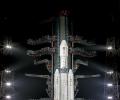
The Indian Space Research Organisation on Thursday launched its first experimental suborbital flight. Here are five things you need to know about the GSLV Mark III mission.

Her comments came amid the ongoing war of words between India and Pakistan ever since India withdrew Jammu and Kashmir's special status and bifurcated it into two union territories on August 5.

Aditya-L1 is meant to observe the corona, which are the outer layers of the Sun, extending to thousands of kilometres.

A key feature of the satellite is providing mobile communication to India through multi beam coverage facility.
 © 2026 Rediff.com - Advertise with us - Disclaimer - Privacy Policy - Sitemap - Feedback - About us - Terms of use - Grievances