
Sheena Bora may be the latest of India's 'gone girls' but the list is too long to enumerate, says Sunil Sethi

'When Vidhie was born, Indrani doted on her and was everything one could ask for in a mother and a wife. Then one fine morning, we heard that she had dumped Sanju and left for Mumbai.' 'It's possible for a scheming person like Indrani to squeeze out a 'favour' from her ex-husband using their daughter as bait.'

Dr Gupta handled Shivade's blows with quite some equanimity... So it was often only Shivade down in the mud pit, egging and enticing the doctor to join the fight, while Dr Gupta cautiously kept to the sidelines, barely stepping a toe into the mud.

At the prison, both Ranjan and Manglik's cell phones were pressed into service by the CBI. Why the CBI didn't bring its own equipment seems a mystery... Ranjan's cell handset was given to Indrani and Manglik dialed it. Indrani then spoke and her speech, that emanated from the phone, via speaker mode, was recorded.

The night before Sheena was allegedly killed, 'Indrani Madam instructed me to not send anyone up to her flat.' 'She told me to especially not allow Rahul Mukerjea.'

Lawyer: 'Did YOU not ever feel scared?' Shyamvar Rai: 'I am a driver, I said okay. Madam said it is your job...'

'I kept photographs of everyone. Because I was working for them.' 'Madam, Saab...' Shyamvar Rai, the approver in the case, said in a tone that tried to suggest that that would be a routine practice for a driver.

Indrani's words were quick, her hand gestures quicker. She kept pointing to certain paragraphs in their consent terms.

Shyamvar Pinturam Rai and Pradeep Waghmare. Both erstwhile employees of Peter and Indrani Mukerjea. In the witness stand on Monday, Waghmare came across as a cheerful, straightforward man who is attempting to clamber his way towards prosperity. In the witness stand on Friday, Rai shed his customary jauntiness and broke down weeping, begging forgiveness from CBI Special Judge Jayendra Chandrasen Jagdale.

Judge Jagdale, with a severe expression shadowing his face, looked sharply at Manoj Patil, Airtel's nodal officer, and told him plainly: "It is difficult to digest what you are saying (about) giving call data, but not giving call timings and durations."
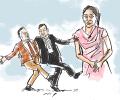
Dressed in pink, her hands flying about in eloquent gestures, excitement on her face, Indrani made quite a picture. There was pin-drop silence as she made strong points about why nothing in the hearings had uncovered anything against her. She spoke about there being "Not a shred of evidence... No scientific evidence because it didn't happen!"

Back to Sheena Bora's grave, via e-time travel

Not Mekhail. Not Rahul. Not anyone. 'Wouldn't someone have asked?' Indrani asked.

This week was the first time Peter and Indrani appeared in court no longer married, footloose and fancy free once again, even if in jail.

'Not only will Peter, Indrani, Sanjeev be making twice monthly trips to the sessions court for many years, so will their family, their lawyers and the journalists covering the case, becoming almost like bittersweet friends, as large portions of their lives play out there.'

The close-onto four years (since November 2015) Peter has spent in Arthur Road jail, central Mumbai, in judicial custody, have taken their toll, lending him a bit of a melancholy stoop, a laborious gait and a tired face, turning him prematurely into a much older man than his nearly 64 years. Vaihayasi Pande Daniel/Rediff.com reports from the Sheena Bora murder trial.

Though on the face of it appeared Pasbola was asking a series of odd questions that would be difficult for anyone to answer, there was, it gradually emerged, it seemed, a method to the questioning. Somehow, somewhere instinctively, Pasbola knew there was something not right with Riyaz's account.
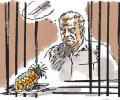
He was getting fruits, but no implement to cut them with. He told the judge, sadly: "I have tried and it is very difficult, your honour." His statement quickly brought up the imagery of Peter trying to cut a pineapple with his teeth or a papaya with a pen or a toothbrush.

Don't forget to make your pick for the newsmaker of 2015.

Indrani is clearly in charge in her little corner. She is speaking rapidly to a not-very-tall, pot-bellied, balding man, whom she repeatedly, decisively, asks, "Have you understood?" The tone is that of a boss talking to an employee. The words "cheque" and "two lakhs" float by.

Pasbola had a number of queries about the nails of the corpse found at Gagode Khurd. Did it have nails? Nails, in a case of strangulation, are key because they often have particles and skin beneath them to show the victim had been grasping something as s/he was strangled.

Shivade: "You didn't find any brain inside the brain cavity?" Dr Thakur nodded. The judge shocked: "Huh?!"

Ganesh Dhene said there had only been two or three mango trees in the grove, from where he found the skeleton, which he specified had no flesh on it.

Indrani kept Peter informed on phone about the selection of spot for disposing her body and recce conducted for the same.

Indrani exclaimed excitedly, her face lighting up like a little girl's: "I know him soo0o well." Sanjeev Khanna, Accused No 2, jokingly suggested to Badami: "Influencing the witness!" Badami retorted good humouredly: "She can't influence witnesses. She can only influence you and Peter."

Maruti Warke's basic understanding illustrated how far outside the system most less privileged Indians are -- simple, innocent people barely but admirably eking out an existence, with almost no knowledge of their surroundings or owning even the basic smarts to go about life. The same people who instinctively and often astutely vote governments into and out of office in New Delhi without knowing the entire reality of this country. The folks who are actually the essence of India.

Dramatic minutes like the sentencing by a judge or a round of artful cross examination hog all the attention in a courtroom. But more noteworthy and infinitely more memorable are the human moments -- Like when a brother and sister hug before a judge. Or the steady support between a husband and a wife in court.
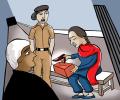
A mere pair of shoes sets off the kind of harsh condemnation Indrani draws in these corridors of justice. That she being a woman who killed her daughter -- never mind that she is an undertrial and the crime has not yet been proven -- apart from making her an object of curiosity, also makes her, by perception, more evil than the men that flood these corridors, facing trial for similar or worse crimes.
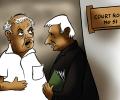
'If I have to write a letter I will give it to the media. They will put it out.'

He is, at the closing of 2018, a man quite different from the Peter Mukerjea who entered judicial custody three-and-a-half years ago. He is a man not yet convicted of a crime, but already suffering for it, like the hundreds that enter these courts every day and the thousands Peter shares jail space with in a central Mumbai prison.

'Quite the raconteur, much to the dismay of Courtroom 51's CBI Special Judge Jayendra Chandrasen Jagdale, Christopher 'Doglis' Marquis, a Bandra dog-breeder who was Prosecution Witness No 57 and a panch or witness, seemed to move into the witness box with glee, embellishing every answer that he gave to the lawyers' questions with a variety of additional details.' Vaihayasi Pande Daniel reports from the Sheena Bora murder trial.

Shivade then asked if the skeleton finally came out of the ground in many parts. It was difficult not to gasp aloud at that revelation. Bhagat said that was true.
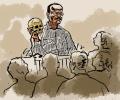
As Indrani, Sanjeev Khanna and Peter pass cupboard no 6 -- where the skull is stored -- what thoughts pass through their mind?

'It is perhaps kind of easy to see why Peter and the police clash.' 'The obvious air of entitlement that emanates from him, maybe unknowingly, probably gets the goat of the policemen.'

There it lay, a photograph on the desk under a stapler, and later a stamp pad, forgotten, done with, like its subject, a Mumbai Metro One employee who vanished overnight.
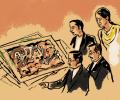
Many pictures showed The Skeleton Named Sheena. For the purpose of the photographs, the skeleton had been re-assembled and looked straight at the camera.

Peter told Judge Jagdale that there was only jewellery in the locker -- some of it that he had "gifted to my wife" and some that "she had received" at the time of their marriage, that the CBI had already inspected the locker in his presence and were aware of what was there.

Sameer Buddha was just the kind of witness Indrani's lawyer Sudeep Pasbola dislikes. Someone, who had temporarily dumped his memory before entering the court. He answered most questions, one after another, one after another, one after another, with a monotonous, deadpan: 'I don't remember.' 'I don't remember.' 'I don't remember.'

When it came to his cross examination by Sanjeev Khanna's lawyer Niranjan Mundargi, Imtiaz Shaikh appeared to be afflicted by that peculiar gap-in-one's-memory or Choosy Memory Syndrome with his recall of other dates in his life, except those directly related with the murder, shaky or non-existent.

She continued to cry, harder, feebly dabbed her eyes with the handkerchief she had received, and declared painfully: "He is hurting my emotions!"
 © 2026 Rediff.com - Investor Information - Advertise with us - Disclaimer - Privacy Policy - Sitemap - Feedback - About us - Terms of use - Grievances